37,156  PAGES BROWSED TODAY PAGES TODAY 90  ANTIQUES UPLOADED TODAY NEW ARRIVALS
ID #SA540791
FOR SALE
£4,500
Email
Save
Lemuel Francis Abbott, 1760-1802 Portrait of William Woodville, Md, Frs, Fls, 1752–1805, Physician and Botanist
Artware Fineart
for sale €5,265     $5,715
£4,500

Artware Fineart

Sellingantiques Verified Since Sep 2008
View Dealers Stock Page
Id #SA540791
PDF SHARE
SAVE

Lemuel Francis Abbott, 1760-1802 Portrait of William Woodville, Md, Frs, Fls, 1752–1805, Physician and Botanist

18th century
For Sale by Artware Fineart
Description

Lemuel Francis Abbott, 1760-1802

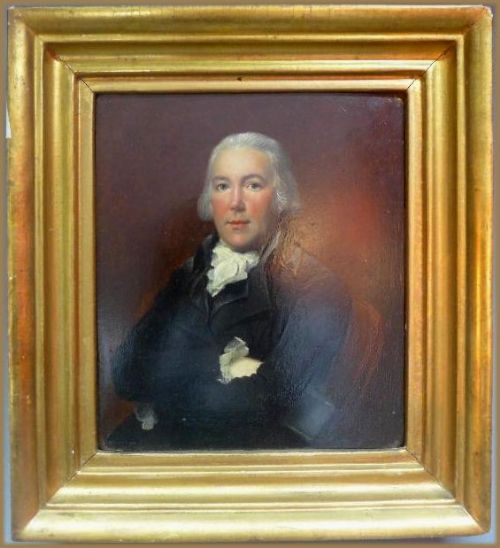
Portrait of William Woodville, MD, FRS, FLS, 1752–1805, Physician and Botanist

William Woodville, MD, FRS, FLS,

oil on panel, modello

20 x 17 cm . (8 x 7 in.)

inscribed in sepia ink exetsively on the reverse "William Woodville, MD, FRS, FLS, /Physician to the Middlesex Hospital and Small Pox Hospital/ Born at Lowswaid 1752 dield in London 1805/ This portrait was the property of Dr Woodville's friend Dr Piel, and was bequeathed by him together with his own portrait to Joseph Steel esq of Cockermouth who's son Edward Steel presented it to William …….of Birkby
Provenance

Dr Piel

Joseph Steel esq of Cockermouth

Edward Steel

William …….of Birkby

Notes

William Woodville, (1752–1805), physician and botanist, was born at Cockermouth in Cumberland, the fourth of the six children of William Woodville (1714–1758), and Jane Fearon (1723–1804). He came from a family of well-to-do Quakers, and was initially educated at a local grammar school. He began his medical training in 1767 with a short apprenticeship to William Birtwhistle, an apothecary. He later matriculated at Edinburgh University, graduating MD in 1775 with a thesis on irritable fibres. Woodville returned to Cumberland to practise in Papcastle, until a tragic incident in 1778 interrupted his career. One night he fired a gun through a window and killed a man who had been creating a disturbance in his garden. Although this was generally accepted as an accident, Woodville was disowned by his Quaker meeting and left the county to set up practice in Denbigh. By 1782 he had moved to London: there his career flourished. He was appointed physician to the Middlesex Dispensary, admitted as a licentiate of the Royal College of Physicians in August 1784, and became a member of the Physical Society at Guy's Hospital.

Woodville's medical career was distinguished by his contributions to the prevention of smallpox. In 1791 he was appointed physician to the London Smallpox and Inoculation Hospital at St Pancras, a charitable institution offering care to smallpox victims and free inoculation. Woodville became a staunch supporter of the procedure: in 1797 he published a pamphlet aimed at a popular audience, advocating inoculation. By this time he was also writing a major history of inoculation, probably intended as a triumphal history of the steady growth of the procedure, with an emphasis on the role of the hospital in encouraging inoculation and thus helping to control smallpox. The first of the projected two volumes of the History of the Inoculation of the Smallpox (1796) described inoculation techniques used in the Near East and the Far East, its introduction to Britain, and its gradual popularization up to 1770. However, history caught up with the project. In 1799 the second volume was announced as ready for the press but it never appeared, as the previous year Edward Jenner had announced his discovery of vaccination, which attracted considerable attention: although the older procedure was still widely used, the book would have lost much of its original purpose.

Woodville quickly switched his allegiance to vaccination and played an important role in establishing its merits. News of Jenner's discovery had aroused interest among medical men, but his source of vaccine had been lost and further experiments with the new procedure were therefore impossible. Woodville remedied this in January 1799, when he was told of an outbreak of cowpox in a London dairy. Having compared the lesions among the milkers with Jenner's illustration, Woodville took some fluid for use as vaccine at the Smallpox Hospital. The results of this action, the first large-scale trial of vaccination, were published as the Report of a Series of Inoculations for the Variolae vaccinae or Cow Pox (1799). Its case histories of two hundred vaccinations, most of which were

Physical Dimensions
Height
20cm (7.87")
Width
17cm (6.69")
Depth
2cm (0.79")
Declaration

Artware Fineart has dated this Georgian Oil Portrait Painting to the 18th Century.

Reference Numbers
Sellingantiques Reference
SA540791
Dealers Internal Reference
3989
Description
Lemuel Francis Abbott, 1760-1802

Portrait of William Woodville, MD, FRS, FLS, 1752–1805, Physician and Botanist

William Woodville, MD, FRS, FLS,

oil on panel, modello

20 x 17 cm . (8 x 7 in.)

inscribed in sepia ink exetsively on the reverse "William Woodville, MD, FRS, FLS, /Physician to the Middlesex Hospital and Small Pox Hospital/ Born at Lowswaid 1752 dield in London 1805/ This portrait was the property of Dr Woodville's friend Dr Piel, and was bequeathed by him together with his own portrait to Joseph Steel esq of Cockermouth who's son Edward Steel presented it to William …….of Birkby

fig 1. An 18th-century oil portrait depicting a gentleman with powdered hair, a white cravat, and a dark coat against a reddish-brown background.
fig 1. Lemuel Francis Abbott, 1760-1802 Portrait of William Woodville, Md, Frs, Fls, 1752–1805, Physician and Botanist

Provenance

Dr Piel

Joseph Steel esq of Cockermouth

Edward Steel

William …….of Birkby

Notes

William Woodville, (1752–1805), physician and botanist, was born at Cockermouth in Cumberland, the fourth of the six children of William Woodville (1714–1758), and Jane Fearon (1723–1804).
Artware Fineart

He came from a family of well-to-do Quakers, and was initially educated at a local grammar school. He began his medical training in 1767 with a short apprenticeship to William Birtwhistle, an apothecary. He later matriculated at Edinburgh University, graduating MD in 1775 with a thesis on irritable fibres. Woodville returned to Cumberland to practise in Papcastle, until a tragic incident in 1778 interrupted his career. One night he fired a gun through a window and killed a man who had been creating a disturbance in his garden. Although this was generally accepted as an accident, Woodville was disowned by his Quaker meeting and left the county to set up practice in Denbigh. By 1782 he had moved to London: there his career flourished. He was appointed physician to the Middlesex Dispensary, admitted as a licentiate of the Royal College of Physicians in August 1784, and became a member of the Physical Society at Guy's Hospital.

Woodville's medical career was distinguished by his contributions to the prevention of smallpox. In 1791 he was appointed physician to the London Smallpox and Inoculation Hospital at St Pancras, a charitable institution offering care to smallpox victims and free inoculation. Woodville became a staunch supporter of the procedure: in 1797 he published a pamphlet aimed at a popular audience, advocating inoculation. By this time he was also writing a major history of inoculation, probably intended as a triumphal history of the steady growth of the procedure, with an emphasis on the role of the hospital in encouraging inoculation and thus helping to control smallpox. The first of the projected two volumes of the History of the Inoculation of the Smallpox (1796) described inoculation techniques used in the Near East and the Far East, its introduction to Britain, and its gradual popularization up to 1770. However, history caught up with the project. In 1799 the second volume was announced as ready for the press but it never appeared, as the previous year Edward Jenner had announced his discovery of vaccination, which attracted considerable attention: although the older procedure was still widely used, the book would have lost much of its original purpose.

Woodville quickly switched his allegiance to vaccination and played an important role in establishing its merits. News of Jenner's discovery had aroused interest among medical men, but his source of vaccine had been lost and further experiments with the new procedure were therefore impossible. Woodville remedied this in January 1799, when he was told of an outbreak of cowpox in a London dairy. Having compared the lesions among the milkers with Jenner's illustration, Woodville took some fluid for use as vaccine at the Smallpox Hospital. The results of this action, the first large-scale trial of vaccination, were published as the Report of a Series of Inoculations for the Variolae vaccinae or Cow Pox (1799). Its case histories of two hundred vaccinations, most of which were

Height
20cm (7.87")
Width
17cm (6.69")
Depth
2cm (0.79")
Date of Manufacture

Artware Fineart has dated this Georgian Oil Portrait Painting to the 18th Century.

Reference Numbers
Sellingantiques Ref
SA540791
Dealers Internal Ref
3989
Artware Fineart
Sellingantiques verified Since Sep 2008
Dealer Profile

You can view the stock and full dealer information on the Artware Fineart Profile Page

PDF SHARE
SAVE
An 18th-century oil portrait depicting a gentleman with powdered hair, a white cravat, and a dark coat against a reddish-brown background.
1 / 2
Archive I An 18th-century oil portrait depicting a gentleman with powdered hair, a white cravat, and a dark coat against a reddish-brown background.

Lemuel Francis Abbott, 1760-1802 Portrait of William Woodville, Md, Frs, Fls, 1752–1805, Physician and Botanist

Archive II An 18th-century oil portrait depicting a gentleman with powdered hair, a white cravat, and a dark coat against a reddish-brown background. View II
FURTHER BROWSING

Visitors also looked at these ⇣

Enlarged Archival View
Telephone 07958 699 645
Location
18 La Gare
51 Surrey Row
London
SE1 0BZ
United Kingdom
Verified Since Sep 2008
Items For Sale 243
Items Sold 223
Artware Fineart
Verified Since Sep 2008
View Dealer Info
Location: 18 La Gare , 51 Surrey Row , London , SE1 0BZ , United Kingdom
Verified
Sep 2008
For Sale
243
Sold
223
An 18th-century oil portrait depicting a gentleman with powdered hair, a white cravat, and a dark coat against a reddish-brown background.
Lemuel Francis Abbott, 1760-1802 Portrait of William Woodville, MD, FRS, FLS, 1752–1805, Physician and Botanist
Ref: SA540791
An 18th-century oil portrait depicting a gentleman with powdered hair, a white cravat, and a dark coat against a reddish-brown background.
Detail View 1
Archival Detail
Every single antique dealer on our platform is individually approved by our internal team. We verify their professional trade history, ethical standards, and photographic quality to ensure a secure, high-standard buying environment. Upon joining, every dealer agrees to a strict 9-point code of conduct. While issues can occasionally arise, our dealers typically resolve them swiftly and directly with the buyer. In fact, since our founding in 2002, Sellingantiques has only had to step in to help resolve an issue on roughly five occasions—a true testament to the quality of our dealers and their dedication to your happiness.
Our dealers are highly experienced in packing and shipping fragile, high-value antiques. Because you are in direct contact with the dealer, you will be able to easily go through all available shipping and insurance options together to ensure your item arrives safely.
Antiques are the ultimate green purchase. By choosing historical pieces over newly manufactured goods, you completely eliminate the carbon footprint of modern mass production while preserving exceptional, timeless craftsmanship.

Georgian portraiture, spanning 1714 to 1830, emphasised realistic likeness combined with understated status symbols, such as formal attire or professional instruments. Artists of this period typically used oil on canvas to create subtle chiaroscuro lighting and formal compositions.

Paintings from this period were primarily executed using ground mineral and organic pigments bound in linseed oil, applied to hand-stretched linen canvas or oak panels. The finished works were typically coated with natural dammar or mastic varnishes for protection and depth.

Authentic 18th-century works show age-appropriate craquelure across the paint surface, historic stretcher bars or hand-carved wood panels, and period-correct costume details such as cravats, waistcoats, or powdered wigs. Examination under ultraviolet light often reveals historic varnish layers or old restoration.

A Georgian portrait functions as a focal point above a mantelpiece, sideboard, or framed within a gallery wall. It contrasts effectively against modern minimalist decor or creates depth when paired with rich wall colours in traditional study or library settings.

Display the artwork away from direct sunlight, radiators, and areas of high humidity to prevent cracking or warping. Dust gently with a dry, soft-bristle brush, and avoid household liquid cleaners; professional conservation is required for varnish removal or paint stabilization.
items
Add keywords to the filter
Price
£100
£250000
Era
Movements
Material
Origin
Stock Location
Freshness
Online Payments
Categories