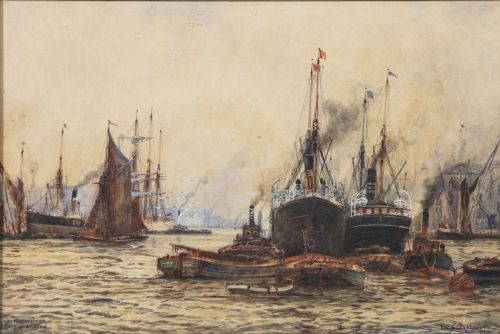
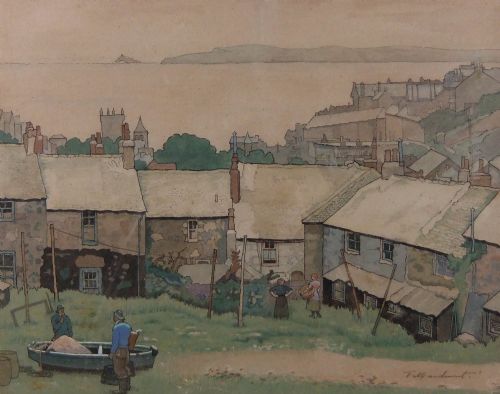
Artware Fineart has dated this Maritime Watercolour Painting to the Edwardian era.
A Tall Ship in Harbour, Falmouth
dated "1924"
pencil and watercolour
40 x 50 cm.
Tuke, Henry Scott [Harry] (1858–1929), landscape and figure painter, was born at Lawrence House, St Lawrence, York, on 12 June 1858, the second son of Daniel Hack Tuke (1827–1895), a physician, and his wife, Esther Maria Stickney (1826–1917), of Ridgmont, Holderness.
Daniel Tuke continued in the profession of caring for psychiatric patients and wrote about insanity. Owing to his father's ill health the family moved to Falmouth, Cornwall, and at the age of six Tuke was sent to a Quaker school at Weston-super-Mare. Unlike his brother William, who went into the medical profession, Harry Tuke had shown artistic promise from an early age. His sister Maria was also artistically gifted. In 1875 Tuke entered the Slade School of Fine Art, London, where he studied under Alphonse Legros. While at the Slade he made friends with Thomas Cooper Gotch. Tuke produced some fine etchings as a student, including one of his brother William. He had his first oil painting, The Good Samaritan, accepted for exhibition at the Royal Academy in 1879. A group portrait of his Slade friends, the Stantlet sisters and Caroline Yates (the future Mrs Gotch) (York City Art Gallery), was exhibited at the academy in 1880. For the rest of his professional career, from 1879 onwards, Tuke kept a register of paintings listing most of his major works as well as studies.
From November 1880 to July 1881 Tuke studied art in Florence, Italy. There he met the artist Arthur Lemon, who took him to stay with Charles Heath Wilson at Forte dei Marmi, where they spent a month painting the male nude outdoors. This was the style of painting and a way of life that suited Tuke, and it became his métier. In October 1881 Tuke travelled to Paris to study at the atelier of Jean Paul Laurens. He was in the company of many of his Slade friends, including (Albert) Chevallier Tayler, Fred Millard, and William Strang. They all went to admire the French painter Jules Bastein Lepage, but it was the American artist Alexander Harrison who had the biggest influence on Tuke, as he too painted the nude outdoors. While studying in Paris, Tuke made regular trips home to Bournemouth, where his parents and brother William were living. Towards the end of his studies in Paris, William died of tuberculosis, and his family decided to move to Hanwell in Middlesex. It was a watershed in Tuke's life. He decided to return to Cornwall and went first, in 1883, to Newlyn, where many of his friends from the Slade were based. Here in 1884 he painted Summertime, the subject of which was boys in boats, a theme that was to prove enduring in Tuke's work. On 5 June 1885 Tuke moved back to Falmouth, renting rooms in a cottage at Pennance Point outside the town where he could paint male nudes on the local beaches in privacy. He also painted several pictures featuring his housekeeper, Mrs Fouracre, such as The Message (1890; Falmouth Art Gallery). Later he built a studio at Pennance which was his base for the next forty years, and he purchased an old French brigantine, the Julie of Nantes, which became his floating studio. Tuke used local lads and fishermen in his paintings executed on board the Julie, including All Hands to the Pump (Tate collection), shown at the Royal Academy in 1889 and bought for the nation by the Chantrey Bequest.
Tuke's earlier nudes are somewhat over-worked; it is in his studies that his fresh, unique ability to paint skin tones reflected in water is visible. The evident homoerotic element in his paintings has given rise to speculation that Tuke was homosexual. The male nude was certainly his muse, but it was not an unusual subject
Artware Fineart has dated this Maritime Watercolour Painting to the Edwardian era.
You can view the stock and full dealer information on the Artware Fineart Profile Page

Attributed to Henry Scott Tuke 1858 – 1929 a Tall Ship in Harbour, Falmouth