8,714  PAGES BROWSED TODAY PAGES TODAY 36  ANTIQUES UPLOADED TODAY NEW ARRIVALS
ID #SA441086
FOR SALE
£1,200
Email
Save
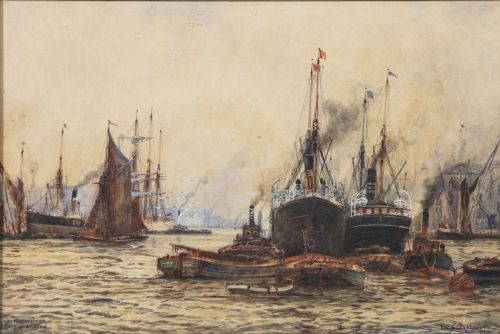
Attributed to Henry Scott Tuke 1858 – 1929 a Tall Ship in Harbour, Falmouth
Artware Fineart
for sale €1,404     $1,524
£1,200

Artware Fineart

Sellingantiques Verified Since Sep 2008
View Dealers Stock Page
Id #SA441086
PDF SHARE
SAVE

Attributed to Henry Scott Tuke 1858 – 1929 a Tall Ship in Harbour, Falmouth

1900 - 1920
For Sale by Artware Fineart
Description

Attributed to Henry Scott Tuke 1858 – 1929

A Tall Ship in Harbour, Falmouth

dated "1924"

pencil and watercolour

40 x 50 cm.

Tuke, Henry Scott [Harry] (1858–1929), landscape and figure painter, was born at Lawrence House, St Lawrence, York, on 12 June 1858, the second son of Daniel Hack Tuke (1827–1895), a physician, and his wife, Esther Maria Stickney (1826–1917), of Ridgmont, Holderness. His great-grandfather William Tuke (1732–1822) had founded the Friends' Retreat in York in 1792 for the care of the mentally ill. Daniel Tuke continued in the profession of caring for psychiatric patients and wrote about insanity. Owing to his father's ill health the family moved to Falmouth, Cornwall, and at the age of six Tuke was sent to a Quaker school at Weston-super-Mare. Unlike his brother William, who went into the medical profession, Harry Tuke had shown artistic promise from an early age. His sister Maria was also artistically gifted. In 1875 Tuke entered the Slade School of Fine Art, London, where he studied under Alphonse Legros. While at the Slade he made friends with Thomas Cooper Gotch. Tuke produced some fine etchings as a student, including one of his brother William. He had his first oil painting, The Good Samaritan, accepted for exhibition at the Royal Academy in 1879. A group portrait of his Slade friends, the Stantlet sisters and Caroline Yates (the future Mrs Gotch) (York City Art Gallery), was exhibited at the academy in 1880. For the rest of his professional career, from 1879 onwards, Tuke kept a register of paintings listing most of his major works as well as studies.

From November 1880 to July 1881 Tuke studied art in Florence, Italy. There he met the artist Arthur Lemon, who took him to stay with Charles Heath Wilson at Forte dei Marmi, where they spent a month painting the male nude outdoors. This was the style of painting and a way of life that suited Tuke, and it became his métier. In October 1881 Tuke travelled to Paris to study at the atelier of Jean Paul Laurens. He was in the company of many of his Slade friends, including (Albert) Chevallier Tayler, Fred Millard, and William Strang. They all went to admire the French painter Jules Bastein Lepage, but it was the American artist Alexander Harrison who had the biggest influence on Tuke, as he too painted the nude outdoors. While studying in Paris, Tuke made regular trips home to Bournemouth, where his parents and brother William were living. Towards the end of his studies in Paris, William died of tuberculosis, and his family decided to move to Hanwell in Middlesex. It was a watershed in Tuke's life. He decided to return to Cornwall and went first, in 1883, to Newlyn, where many of his friends from the Slade were based. Here in 1884 he painted Summertime, the subject of which was boys in boats, a theme that was to prove enduring in Tuke's work. On 5 June 1885 Tuke moved back to Falmouth, renting rooms in a cottage at Pennance Point outside the town where he could paint male nudes on the local beaches in privacy. He also painted several pictures featuring his housekeeper, Mrs Fouracre, such as The Message (1890; Falmouth Art Gallery). Later he built a studio at Pennance which was his base for the next forty years, and he purchased an old French brigantine, the Julie of Nantes, which became his floating studio. Tuke used local lads and fishermen in his paintings executed on board the Julie, including All Hands to the Pump (Tate collection), shown at the Royal Academy in 1889 and bought for the nation by the Chantrey Bequest.

Tuke's earlier nudes are somewhat over-worked; it is in his studies that his fresh, unique ability to paint skin tones reflected in water is visible. The evident homoerotic element in his paintings has given rise to speculation that Tuke was homosexual. The male nude was certainly his muse, but it was not an unusual subject

Physical Dimensions
Height
40cm (15.75")
Width
50cm (19.69")
Depth
2cm (0.79")
Declaration

Artware Fineart has dated this Maritime Watercolour Painting to the Edwardian era.

Reference Numbers
Sellingantiques Reference
SA441086
Dealers Internal Reference
3888
Description
Attributed to Henry Scott Tuke 1858 – 1929

A Tall Ship in Harbour, Falmouth

dated "1924"

pencil and watercolour

40 x 50 cm.

Tuke, Henry Scott [Harry] (1858–1929), landscape and figure painter, was born at Lawrence House, St Lawrence, York, on 12 June 1858, the second son of Daniel Hack Tuke (1827–1895), a physician, and his wife, Esther Maria Stickney (1826–1917), of Ridgmont, Holderness.

His great-grandfather William Tuke (1732–1822) had founded the Friends' Retreat in York in 1792 for the care of the mentally ill.
Artware Fineart

Daniel Tuke continued in the profession of caring for psychiatric patients and wrote about insanity. Owing to his father's ill health the family moved to Falmouth, Cornwall, and at the age of six Tuke was sent to a Quaker school at Weston-super-Mare. Unlike his brother William, who went into the medical profession, Harry Tuke had shown artistic promise from an early age. His sister Maria was also artistically gifted. In 1875 Tuke entered the Slade School of Fine Art, London, where he studied under Alphonse Legros. While at the Slade he made friends with Thomas Cooper Gotch. Tuke produced some fine etchings as a student, including one of his brother William. He had his first oil painting, The Good Samaritan, accepted for exhibition at the Royal Academy in 1879. A group portrait of his Slade friends, the Stantlet sisters and Caroline Yates (the future Mrs Gotch) (York City Art Gallery), was exhibited at the academy in 1880. For the rest of his professional career, from 1879 onwards, Tuke kept a register of paintings listing most of his major works as well as studies.

From November 1880 to July 1881 Tuke studied art in Florence, Italy. There he met the artist Arthur Lemon, who took him to stay with Charles Heath Wilson at Forte dei Marmi, where they spent a month painting the male nude outdoors. This was the style of painting and a way of life that suited Tuke, and it became his métier. In October 1881 Tuke travelled to Paris to study at the atelier of Jean Paul Laurens. He was in the company of many of his Slade friends, including (Albert) Chevallier Tayler, Fred Millard, and William Strang. They all went to admire the French painter Jules Bastein Lepage, but it was the American artist Alexander Harrison who had the biggest influence on Tuke, as he too painted the nude outdoors. While studying in Paris, Tuke made regular trips home to Bournemouth, where his parents and brother William were living. Towards the end of his studies in Paris, William died of tuberculosis, and his family decided to move to Hanwell in Middlesex. It was a watershed in Tuke's life. He decided to return to Cornwall and went first, in 1883, to Newlyn, where many of his friends from the Slade were based. Here in 1884 he painted Summertime, the subject of which was boys in boats, a theme that was to prove enduring in Tuke's work. On 5 June 1885 Tuke moved back to Falmouth, renting rooms in a cottage at Pennance Point outside the town where he could paint male nudes on the local beaches in privacy. He also painted several pictures featuring his housekeeper, Mrs Fouracre, such as The Message (1890; Falmouth Art Gallery). Later he built a studio at Pennance which was his base for the next forty years, and he purchased an old French brigantine, the Julie of Nantes, which became his floating studio. Tuke used local lads and fishermen in his paintings executed on board the Julie, including All Hands to the Pump (Tate collection), shown at the Royal Academy in 1889 and bought for the nation by the Chantrey Bequest.

Tuke's earlier nudes are somewhat over-worked; it is in his studies that his fresh, unique ability to paint skin tones reflected in water is visible. The evident homoerotic element in his paintings has given rise to speculation that Tuke was homosexual. The male nude was certainly his muse, but it was not an unusual subject

Height
40cm (15.75")
Width
50cm (19.69")
Depth
2cm (0.79")
Date of Manufacture

Artware Fineart has dated this Maritime Watercolour Painting to the Edwardian era.

Reference Numbers
Sellingantiques Ref
SA441086
Dealers Internal Ref
3888
Artware Fineart
Sellingantiques verified Since Sep 2008
Dealer Profile

You can view the stock and full dealer information on the Artware Fineart Profile Page

PDF SHARE
SAVE
A watercolour painting depicting a large white tall ship with rigging docked in a harbour beside smaller vessels.
1 / 1
Archive I A watercolour painting depicting a large white tall ship with rigging docked in a harbour beside smaller vessels.

Attributed to Henry Scott Tuke 1858 – 1929 a Tall Ship in Harbour, Falmouth

FURTHER BROWSING

Visitors also looked at these ⇣

Enlarged Archival View
Telephone 07958 699 645
Location
18 La Gare
51 Surrey Row
London
SE1 0BZ
United Kingdom
Verified Since Sep 2008
Items For Sale 243
Items Sold 223
Artware Fineart
Verified Since Sep 2008
View Dealer Info
Location: 18 La Gare , 51 Surrey Row , London , SE1 0BZ , United Kingdom
Verified
Sep 2008
For Sale
243
Sold
223
A watercolour painting depicting a large white tall ship with rigging docked in a harbour beside smaller vessels.
Attributed to Henry Scott Tuke 1858 – 1929 A Tall Ship in Harbour, Falmouth
Ref: SA441086
A watercolour painting depicting a large white tall ship with rigging docked in a harbour beside smaller vessels.
Archival Detail
Every single antique dealer on our platform is individually approved by our internal team. We verify their professional trade history, ethical standards, and photographic quality to ensure a secure, high-standard buying environment. Upon joining, every dealer agrees to a strict 9-point code of conduct. While issues can occasionally arise, our dealers typically resolve them swiftly and directly with the buyer. In fact, since our founding in 2002, Sellingantiques has only had to step in to help resolve an issue on roughly five occasions—a true testament to the quality of our dealers and their dedication to your happiness.
Our dealers are highly experienced in packing and shipping fragile, high-value antiques. Because you are in direct contact with the dealer, you will be able to easily go through all available shipping and insurance options together to ensure your item arrives safely.
Antiques are the ultimate green purchase. By choosing historical pieces over newly manufactured goods, you completely eliminate the carbon footprint of modern mass production while preserving exceptional, timeless craftsmanship.

British Impressionist maritime paintings capture coastal light and maritime activity using fluid brushwork and atmospheric washes, a style popularised by coastal artist colonies in Cornwall during the late nineteenth and early twentieth centuries.

Artists utilized water-soluble pigments applied to heavy cotton rag paper, often initiating the composition with light graphite underdrawing before layering washes to render light and water reflections.

Authentication relies on examining brushwork technique, handling of light, signature style, period paper watermarks, and documented provenance alongside comparative analysis with recorded catalogued works.

Mount the artwork in a simple wooden frame and place it above a sideboard or console table to complement traditional, coastal, or library interior schemes.

Display watercolours away from direct sunlight using UV-filtering glass, maintain stable ambient humidity to avoid foxing, and ensure acid-free archival mounting materials are used.
items
Add keywords to the filter
Price
£100
£250000
Era
Movements
Material
Origin
Stock Location
Freshness
Online Payments
Categories