24,653  PAGES BROWSED TODAY PAGES TODAY 93  ANTIQUES UPLOADED TODAY NEW ARRIVALS
ID #SA1162570
FOR SALE
£8,675
Email
Save
A Paul Philip Barraud Bracket Clock in the Manner of Thomas Hope.
Chalfont Clocks
for sale €10,150     $11,017
£8,675

Chalfont Clocks

Sellingantiques Verified Since Nov 2021
View Dealers Stock Page
  • About Us
    Specialists in antique clocks and their restoration.
Id #SA1162570
PDF SHARE
SAVE

A Paul Philip Barraud Bracket Clock in the Manner of Thomas Hope.

18th century
For Sale by Chalfont Clocks
Description

A very striking twin fusee bracket clock in an Egyptian revival style case by Paul Philip Barraud. The eight day movement with unusual round plates of thick brass engraved on the back and signed Barraud Cornhill LONDON. With an engraved pendulum of stirrup regulation and rack striking on a bell. The movement is housed behind a painted roman dial also signed Barraud LONDON.

The case is highly unusual with only one other example known. The Egyptian influenced inlay is reminiscent of designs by Thomas Hope in his influential Household Furniture and Interior Decoration published in 1807. The Mahogany case with gothic ebony column clusters supported on lions paw feet, and lancet top is surmounted by a pyramid with decorative and extremely fine marquetry inlay. The sound vents on each side of very idiosyncratic design in brass fretwork backed with dark blue velvet. The case design reflects the highly eclectic style of the late Georgian/Early Regency period and in particular the influence of Thomas Hope.

Paul Philip Barraud moved his company to the Cornhill premises in 1808, In 1809, the oldest child, Frederick Joseph, joined his father in partnership of the firm, at which point the name of the firm is changed to 'Barrauds'. This means we can confidently date this clock to 1808-1809, as the clock is marked with the Cornhill address but still signed in the singular BARRAUD. This date is important as it coincides closely with the publication of Hope’s decorative treatise and shows the influence of the Egyptian style in London at this time.

The Barraud family were an important family of clockmakers, originally French Huguenots, they arrived in London following persecution in France. Francis-Gabriel Barraud was born in 1727 and was a watchmaker by trade. With his elder son Paul Philip, born in 1752, and younger son John, he would establish the Barraud horology firm. By 1782 they were established in Fleet Street and were listed in trade directories simply as 'Barrauds'. Paul Philip seems to have focused on clocks, as several orders for movements by Thwaites are found in his name only. Shortly after this point, in 1795, Francis-Gabriel died, and Paul Philip took control of the firm signing his clocks BARRAUD. By the end of that same year, Paul Philip had entered into partnership with another horologist, George Jamison, and they began to manufacture chronometers. Barraud and BArraud and sons would late go on to win logitude prizes for their chronometers and supply the admiralty.

Paul Phillip Barraud was master of the Worshipful Company of Clockmakers twice in in 1810 and 1811, a mark of the esteem he was held in as it was highly unusual to be master for two consecutive years.

Interestingly this clock is stamped ROBSON 2150 on the front plate and also in the spring barrel caps, this suggests the movement was actually made by William Robson, who although a master horologist in his own right often manufactured clock movements for other clock makers just as Twaithes had done. William Robson was Master of the Clock Makers Company twice in 1809 & 1816 and died in 1823, so this clock has the hand of two of Georgian London’s top clockmakers present in it’s creation.

Examples of Barraud’s work can be found in the British Museum, the Science Museum, The Royal Observatory and the London Guildhall Collections.

This clock has been overhauled in our workshop and comes with our two year guarantee.

BARRAUD, the story of a family. By E.M. Barraud.

WATCHMAKERS AND CLOCKMAKERS OF THE WORLD By G.H. Baillie,

The Georgian Bracket Clock, 1714-1830 By Richard Barber

English Bracket and Mantel Clocks By Andrew Nicholls

Physical Dimensions
Height
59cm (23.23")
Width
31cm (12.20")
Depth
18cm (7.09")
Declaration

Chalfont Clocks has dated this Regency Mahogany Bracket Clock to the Georgian era.

Reference Numbers
Sellingantiques Reference
SA1162570
Dealers Internal Reference
357
Dealers Notes

All of our clocks come with a 2 year guarantee, all of our clocks are overhauled and sympathetically restored, all of our clocks are authentic and supplied in good original condition.

Description
A very striking twin fusee bracket clock in an Egyptian revival style case by Paul Philip Barraud.
The eight day movement with unusual round plates of thick brass engraved on the back and signed Barraud Cornhill LONDON.
Chalfont Clocks

With an engraved pendulum of stirrup regulation and rack striking on a bell. The movement is housed behind a painted roman dial also signed Barraud LONDON.

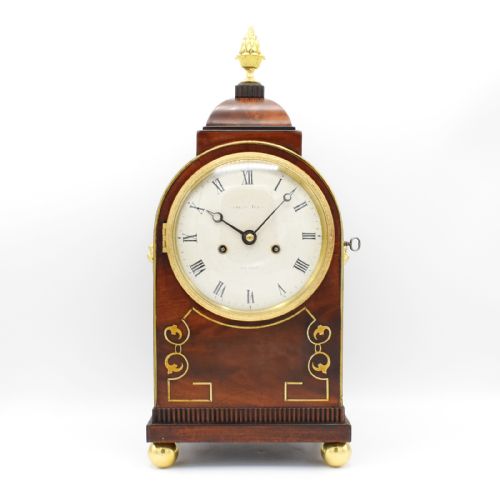
fig 1. A Regency mahogany bracket clock featuring an arched case with Egyptian revival marquetry, ebonised side columns, brass claw feet, and a circular white enamel dial signed Barraud London.
fig 1. A Paul Philip Barraud Bracket Clock in the Manner of Thomas Hope.

The case is highly unusual with only one other example known. The Egyptian influenced inlay is reminiscent of designs by Thomas Hope in his influential Household Furniture and Interior Decoration published in 1807. The Mahogany case with gothic ebony column clusters supported on lions paw feet, and lancet top is surmounted by a pyramid with decorative and extremely fine marquetry inlay. The sound vents on each side of very idiosyncratic design in brass fretwork backed with dark blue velvet. The case design reflects the highly eclectic style of the late Georgian/Early Regency period and in particular the influence of Thomas Hope.

fig 2. A Regency mahogany bracket clock featuring an arched case with Egyptian revival marquetry, ebonised side columns, brass claw feet, and a circular white enamel dial signed Barraud London.
fig 2. A Paul Philip Barraud Bracket Clock in the Manner of Thomas Hope.

Paul Philip Barraud moved his company to the Cornhill premises in 1808, In 1809, the oldest child, Frederick Joseph, joined his father in partnership of the firm, at which point the name of the firm is changed to 'Barrauds'. This means we can confidently date this clock to 1808-1809, as the clock is marked with the Cornhill address but still signed in the singular BARRAUD. This date is important as it coincides closely with the publication of Hope’s decorative treatise and shows the influence of the Egyptian style in London at this time.

fig 3. A Regency mahogany bracket clock featuring an arched case with Egyptian revival marquetry, ebonised side columns, brass claw feet, and a circular white enamel dial signed Barraud London.
fig 3. A Paul Philip Barraud Bracket Clock in the Manner of Thomas Hope.

The Barraud family were an important family of clockmakers, originally French Huguenots, they arrived in London following persecution in France. Francis-Gabriel Barraud was born in 1727 and was a watchmaker by trade. With his elder son Paul Philip, born in 1752, and younger son John, he would establish the Barraud horology firm. By 1782 they were established in Fleet Street and were listed in trade directories simply as 'Barrauds'. Paul Philip seems to have focused on clocks, as several orders for movements by Thwaites are found in his name only. Shortly after this point, in 1795, Francis-Gabriel died, and Paul Philip took control of the firm signing his clocks BARRAUD. By the end of that same year, Paul Philip had entered into partnership with another horologist, George Jamison, and they began to manufacture chronometers. Barraud and BArraud and sons would late go on to win logitude prizes for their chronometers and supply the admiralty.

fig 4. A Regency mahogany bracket clock featuring an arched case with Egyptian revival marquetry, ebonised side columns, brass claw feet, and a circular white enamel dial signed Barraud London.
fig 4. A Paul Philip Barraud Bracket Clock in the Manner of Thomas Hope.

Paul Phillip Barraud was master of the Worshipful Company of Clockmakers twice in in 1810 and 1811, a mark of the esteem he was held in as it was highly unusual to be master for two consecutive years.

fig 5. A Regency mahogany bracket clock featuring an arched case with Egyptian revival marquetry, ebonised side columns, brass claw feet, and a circular white enamel dial signed Barraud London.
fig 5. A Paul Philip Barraud Bracket Clock in the Manner of Thomas Hope.

Interestingly this clock is stamped ROBSON 2150 on the front plate and also in the spring barrel caps, this suggests the movement was actually made by William Robson, who although a master horologist in his own right often manufactured clock movements for other clock makers just as Twaithes had done. William Robson was Master of the Clock Makers Company twice in 1809 & 1816 and died in 1823, so this clock has the hand of two of Georgian London’s top clockmakers present in it’s creation.

fig 6. A Regency mahogany bracket clock featuring an arched case with Egyptian revival marquetry, ebonised side columns, brass claw feet, and a circular white enamel dial signed Barraud London.
fig 6. A Paul Philip Barraud Bracket Clock in the Manner of Thomas Hope.

Examples of Barraud’s work can be found in the British Museum, the Science Museum, The Royal Observatory and the London Guildhall Collections.

This clock has been overhauled in our workshop and comes with our two year guarantee.

fig 7. A Regency mahogany bracket clock featuring an arched case with Egyptian revival marquetry, ebonised side columns, brass claw feet, and a circular white enamel dial signed Barraud London.
fig 7. A Paul Philip Barraud Bracket Clock in the Manner of Thomas Hope.

BARRAUD, the story of a family. By E.M. Barraud.

WATCHMAKERS AND CLOCKMAKERS OF THE WORLD By G.H. Baillie,

The Georgian Bracket Clock, 1714-1830 By Richard Barber

English Bracket and Mantel Clocks By Andrew Nicholls

Height
59cm (23.23")
Width
31cm (12.20")
Depth
18cm (7.09")
Date of Manufacture

Chalfont Clocks has dated this Regency Mahogany Bracket Clock to the Georgian era.

Reference Numbers
Sellingantiques Ref
SA1162570
Dealers Internal Ref
357
Chalfont Clocks
Sellingantiques verified Since Nov 2021

Specialists in antique clocks and their restoration.

Dealer Profile

You can view the stock and full dealer information on the Chalfont Clocks Profile Page

PDF SHARE
SAVE
A Regency mahogany bracket clock featuring an arched case with Egyptian revival marquetry, ebonised side columns, brass claw feet, and a circular white enamel dial signed Barraud London.
1 / 17
Archive I A Regency mahogany bracket clock featuring an arched case with Egyptian revival marquetry, ebonised side columns, brass claw feet, and a circular white enamel dial signed Barraud London.

A Paul Philip Barraud Bracket Clock in the manner of Thomas Hope.

Archive II A Regency mahogany bracket clock featuring an arched case with Egyptian revival marquetry, ebonised side columns, brass claw feet, and a circular white enamel dial signed Barraud London. View II
Archive III A Regency mahogany bracket clock featuring an arched case with Egyptian revival marquetry, ebonised side columns, brass claw feet, and a circular white enamel dial signed Barraud London. View III
Archive IV A Regency mahogany bracket clock featuring an arched case with Egyptian revival marquetry, ebonised side columns, brass claw feet, and a circular white enamel dial signed Barraud London. View IV
Archive V A Regency mahogany bracket clock featuring an arched case with Egyptian revival marquetry, ebonised side columns, brass claw feet, and a circular white enamel dial signed Barraud London. View V
Archive VI A Regency mahogany bracket clock featuring an arched case with Egyptian revival marquetry, ebonised side columns, brass claw feet, and a circular white enamel dial signed Barraud London. View VI
Archive VII A Regency mahogany bracket clock featuring an arched case with Egyptian revival marquetry, ebonised side columns, brass claw feet, and a circular white enamel dial signed Barraud London. View VII
Archive VIII A Regency mahogany bracket clock featuring an arched case with Egyptian revival marquetry, ebonised side columns, brass claw feet, and a circular white enamel dial signed Barraud London. View VIII
Archive IX A Regency mahogany bracket clock featuring an arched case with Egyptian revival marquetry, ebonised side columns, brass claw feet, and a circular white enamel dial signed Barraud London. View IX
Archive X A Regency mahogany bracket clock featuring an arched case with Egyptian revival marquetry, ebonised side columns, brass claw feet, and a circular white enamel dial signed Barraud London. View X
Archive XI A Regency mahogany bracket clock featuring an arched case with Egyptian revival marquetry, ebonised side columns, brass claw feet, and a circular white enamel dial signed Barraud London. View XI
Archive XII A Regency mahogany bracket clock featuring an arched case with Egyptian revival marquetry, ebonised side columns, brass claw feet, and a circular white enamel dial signed Barraud London. View XII
Archive XIII A Regency mahogany bracket clock featuring an arched case with Egyptian revival marquetry, ebonised side columns, brass claw feet, and a circular white enamel dial signed Barraud London. View XIII
Archive XIV A Regency mahogany bracket clock featuring an arched case with Egyptian revival marquetry, ebonised side columns, brass claw feet, and a circular white enamel dial signed Barraud London. View XIV
Archive XV A Regency mahogany bracket clock featuring an arched case with Egyptian revival marquetry, ebonised side columns, brass claw feet, and a circular white enamel dial signed Barraud London. View XV
Archive XVI A Regency mahogany bracket clock featuring an arched case with Egyptian revival marquetry, ebonised side columns, brass claw feet, and a circular white enamel dial signed Barraud London. View XVI
Archive XVII A Regency mahogany bracket clock featuring an arched case with Egyptian revival marquetry, ebonised side columns, brass claw feet, and a circular white enamel dial signed Barraud London. View XVII
FURTHER BROWSING

Visitors also looked at these ⇣

Enlarged Archival View
Telephone 01494 763 793
Location
Chalfont Station Road
Little Chalfont
Buckinghamshire
HP7 9PN
United Kingdom
Verified Since Nov 2021
Items For Sale 61
Items Sold 79
Chalfont Clocks
Verified Since Nov 2021
View Dealer Info
Location: Chalfont Station Road, Little Chalfont, Buckinghamshire, HP7 9PN, United Kingdom
Verified
Nov 2021
For Sale
61
Sold
79
A Regency mahogany bracket clock featuring an arched case with Egyptian revival marquetry, ebonised side columns, brass claw feet, and a circular white enamel dial signed Barraud London.
A Paul Philip Barraud Bracket Clock in the manner of Thomas Hope.
Ref: SA1162570
A Regency mahogany bracket clock featuring an arched case with Egyptian revival marquetry, ebonised side columns, brass claw feet, and a circular white enamel dial signed Barraud London.
Detail View 1
Detail View 2
Detail View 3
Detail View 4
Detail View 5
Detail View 6
Detail View 7
Detail View 8
Detail View 9
Detail View 10
Detail View 11
Detail View 12
Detail View 13
Detail View 14
Detail View 15
Detail View 16
Archival Detail
Every single antique dealer on our platform is individually approved by our internal team. We verify their professional trade history, ethical standards, and photographic quality to ensure a secure, high-standard buying environment. Upon joining, every dealer agrees to a strict 9-point code of conduct. While issues can occasionally arise, our dealers typically resolve them swiftly and directly with the buyer. In fact, since our founding in 2002, Sellingantiques has only had to step in to help resolve an issue on roughly five occasions—a true testament to the quality of our dealers and their dedication to your happiness.
Our dealers are highly experienced in packing and shipping fragile, high-value antiques. Because you are in direct contact with the dealer, you will be able to easily go through all available shipping and insurance options together to ensure your item arrives safely.
Antiques are the ultimate green purchase. By choosing historical pieces over newly manufactured goods, you completely eliminate the carbon footprint of modern mass production while preserving exceptional, timeless craftsmanship.

Originating in the early nineteenth century following Napoleons Egyptian campaigns, Egyptian Revival horology incorporates neoclassical architectural forms and ancient Egyptian motifs popularized by designers like Thomas Hope. Bracket clocks of this era combine English mechanical movement engineering with decorative wood casing influenced by classical antiquity.

These timepieces typically feature flame mahogany cases, ebonised wood columns, brass fittings, and cast brass feet. The movement mechanisms feature brass plates, steel arbors, fusee drive mechanisms, and white enamel or silvered dials protected behind glass bezels.

Authentic examples exhibit signatures from recorded London clockmakers, hand-cut brass clockworks, fusee drive systems, and original cast brass feet. The timber exhibits natural age-related patina and shrinkage lines, while marquetry inlays reflect period craftsmanship techniques.

Positioning the timepiece centrally on a minimalist fireplace mantelpiece or a polished sideboard creates an architectural focal point. Pairing it with understated brass candlesticks or structural ceramic vessels complements the dark timber tones and classical proportions.

Wind the clock mechanism regularly using a properly fitted winding key and arrange professional horological servicing every five to seven years. Keep the case in a climate-controlled room away from direct sunlight, central heating sources, and excess moisture to prevent veneer lifting.
items
Add keywords to the filter
Price
£100
£250000
Era
Movements
Material
Origin
Stock Location
Freshness
Online Payments
Categories