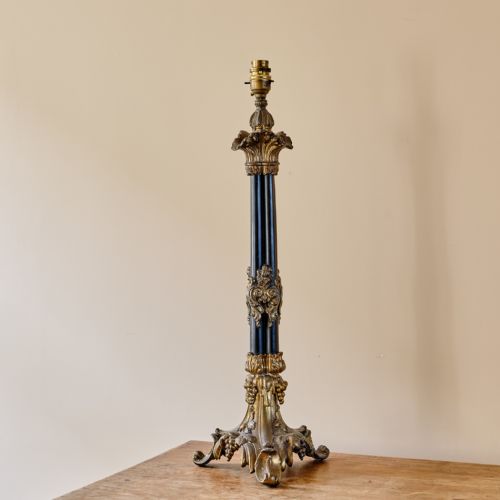
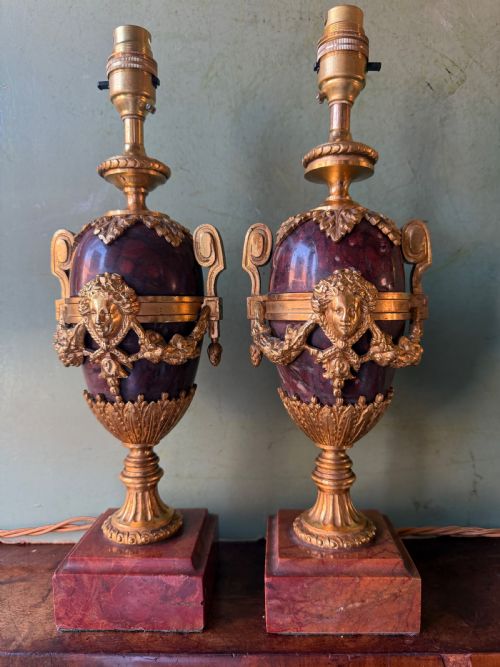
Baggott & Co. has dated this French Ormolu Table Lamp to the 19th Century.
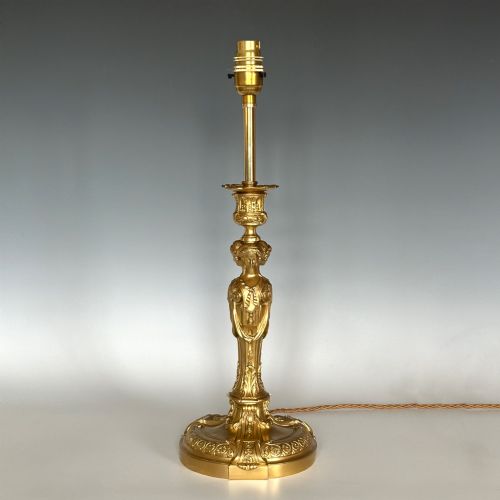
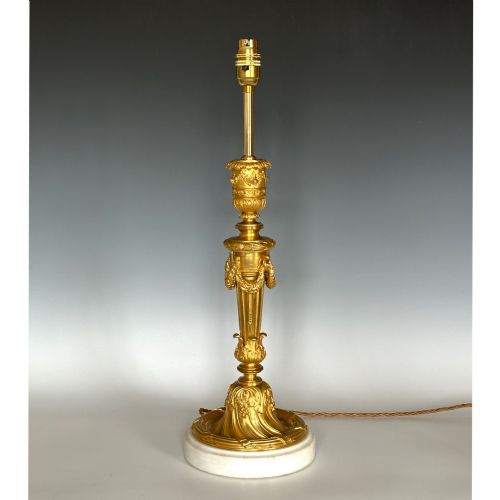
A gadrooned urned shaped candle holder with lion masks and paw feet on a stem with four caryatids standing on a circular plinth with a laurel border above a cast acanthus base and circular fluted plinth. Now converted to a lamp (the lamp holder can be removed with no damage to the original candlestick).

French, circa 1830
The candlestick 38cm H, 16cm W, 16cm D.
no. G F 21 no. 38.378], see the additional image. Candlesticks of the same design are held by the Wallace Collection [F174].

This candlestick has a variant design of the candle holder, or nozzle, it also has four co-joined caryatids to the central column, where others have only three, but the overall design is similar uniformly with the splayed acanthus base. The design is 18th century however this candlestick was made in the early 19th century, the quality of the casting and the figures is very good (later versions appear and it is noticeable that the quality of the figures and casting is not as precise). Variants appear in different sizes, this one is larger than most at 38cm H, a large scale imposing candlestick that could be converted to a lamp without altering or damaging the originality of the candlestick. Presented in excellent original condition retaining original gilding.

Caryatid, in classical Greek architecture, refers to a female figure used as a column support. The high stylobate of the south porch of the Erechtheion in Athens is supported by 6 maidens, or Caryatids, it is an ancient Greek Ionic temple on the north side of the Acropolis, which was primarily dedicated to the goddess Athena. Caryatides is the first use of the term in Latin and transliterates the Greek word meaning "maidens of Caryae."
Baggott & Co. has dated this French Ormolu Table Lamp to the 19th Century.
Dealers in antiques and decorative interiors based in the cotswolds and scotland
You can view the stock and full dealer information on the Baggott & Co. Profile Page

French Louis Xvi Style Ormolu Candlestick After a Model by Jean-démosthène Dugourc