22,572  PAGES BROWSED TODAY PAGES TODAY 71  ANTIQUES UPLOADED TODAY NEW ARRIVALS
ID #SA1074228
FOR SALE
£410
Email
Save
Victorian Scottish Silver & Agate Brooch C1855
Exhibit Antiques
for sale €480     $521
£410
Exhibit Antiques

Exhibit Antiques

Sellingantiques Verified Since Mar 2019
View Dealers Stock Page
  • About Us
    Specialists in 18th & 19th century antique glass
Id #SA1074228
PDF SHARE
SAVE

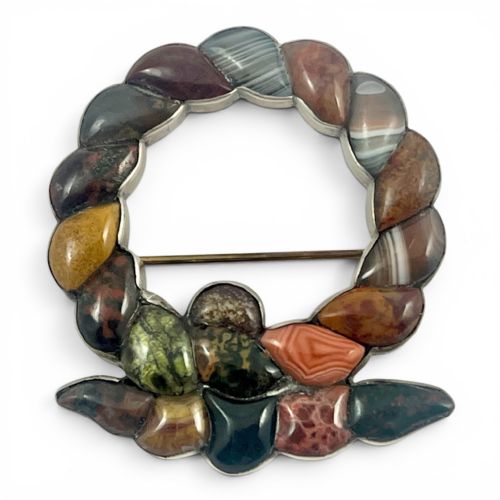
Victorian Scottish Silver & Agate Brooch C1855

19th century
For Sale by Exhibit Antiques
Description

Technical Description

A very fine 19th-century Victorian silver and agate brooch in the form of a twisted rope dating to c1855. A combination of five colourful Scottish agates have been expertly carved and set flush to the silver in a way that bevels the surface. The silver is mounted with a handmade scrolling c-clasp, extended pin and tube hinge. The small attachment loop is intact. Unmarked, as is the case with much of the Scottish silver jewellery produced during the mid-Victorian era.

The agates exhibited on this brooch are;

A particularly dark "classic" bloodstone to one end, the birthstone for March, Pisces. This is green jasper (chalcedony) with red hematite inclusions and showing some transparent quartz. This is likely a specimen from the west coast of Rum at Sgurr Mhor, otherwise known as Bloodstone Hill.

Next is a blue lace agate found mostly in the Montrose area, this is in the desirable waterline pattern which is when the deposits become completely parallel.

The central agate is a Campsie jasp-agate, very finely mottled yellow with reddish-brown inclusions and flashes of clear quartz spread throughout, native to central Scotland and found in the Campsie Hills north of Glasgow.

Next is a green moss agate with white and clear quartz bordering.

Lastly is a full jasper, again from the Campsie Hills showing its more characteristic ochre yellow mottled with rust red and black.

Date & Origin

Scotland. Period of Queen Victoria, c1855.

Condition

Excellent. The clasp is in full working order.

Dimensions

Diameter: 7.3cm x 2cm

Historical Context

Queen Victoria and Prince Albert visited Scotland in 1842 returning annually after being swept away by the charm and splendour of the Perthshire hills. The Royals' admiration towards the land and people promoted a similar reaction from their subjects.

The boom in trade between the nations saw that Scottish trinkets and motifs became very popular, especially the so-called ‘pebble jewellery’ that Queen Victoria had collected as souvenirs. The rarer Aberdeen granite may be classed as one such ‘pebble’, however, most are semi-precious chalcedony quartz gemstones that include agate and jasper, with some specimens being exclusively collected from particular regions of Scotland.

Physical Dimensions
Width
7.3cm (2.87")
Depth
2cm (0.79")
Declaration

Exhibit Antiques has dated this Victorian Scottish Agate Brooch to the Victorian era.

Reference Numbers
Sellingantiques Reference
SA1074228
Dealers Internal Reference
2024000000
Description
Technical Description
A very fine 19th-century Victorian silver and agate brooch in the form of a twisted rope dating to c1855.
Exhibit Antiques

A combination of five colourful Scottish agates have been expertly carved and set flush to the silver in a way that bevels the surface. The silver is mounted with a handmade scrolling c-clasp, extended pin and tube hinge. The small attachment loop is intact. Unmarked, as is the case with much of the Scottish silver jewellery produced during the mid-Victorian era.

fig 1. An elongated Victorian Scottish bar brooch featuring stylized inlaid panels of polished grey, yellow, and green agate set in silver.
fig 1. Victorian Scottish Silver & Agate Brooch C1855

The agates exhibited on this brooch are;

A particularly dark "classic" bloodstone to one end, the birthstone for March, Pisces. This is green jasper (chalcedony) with red hematite inclusions and showing some transparent quartz. This is likely a specimen from the west coast of Rum at Sgurr Mhor, otherwise known as Bloodstone Hill.

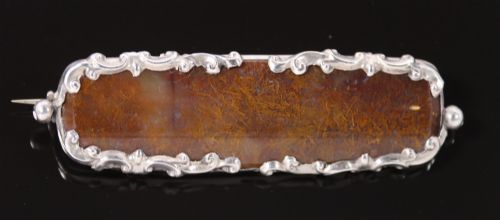
fig 2. An elongated Victorian Scottish bar brooch featuring stylized inlaid panels of polished grey, yellow, and green agate set in silver.
fig 2. Victorian Scottish Silver & Agate Brooch C1855

Next is a blue lace agate found mostly in the Montrose area, this is in the desirable waterline pattern which is when the deposits become completely parallel.

The central agate is a Campsie jasp-agate, very finely mottled yellow with reddish-brown inclusions and flashes of clear quartz spread throughout, native to central Scotland and found in the Campsie Hills north of Glasgow.

fig 3. An elongated Victorian Scottish bar brooch featuring stylized inlaid panels of polished grey, yellow, and green agate set in silver.
fig 3. Victorian Scottish Silver & Agate Brooch C1855

Next is a green moss agate with white and clear quartz bordering.

Lastly is a full jasper, again from the Campsie Hills showing its more characteristic ochre yellow mottled with rust red and black.

Date & Origin

fig 4. An elongated Victorian Scottish bar brooch featuring stylized inlaid panels of polished grey, yellow, and green agate set in silver.
fig 4. Victorian Scottish Silver & Agate Brooch C1855

Scotland. Period of Queen Victoria, c1855.

Condition

Excellent. The clasp is in full working order.

Dimensions

Diameter: 7.3cm x 2cm

Historical Context

Queen Victoria and Prince Albert visited Scotland in 1842 returning annually after being swept away by the charm and splendour of the Perthshire hills. The Royals' admiration towards the land and people promoted a similar reaction from their subjects.

The boom in trade between the nations saw that Scottish trinkets and motifs became very popular, especially the so-called ‘pebble jewellery’ that Queen Victoria had collected as souvenirs. The rarer Aberdeen granite may be classed as one such ‘pebble’, however, most are semi-precious chalcedony quartz gemstones that include agate and jasper, with some specimens being exclusively collected from particular regions of Scotland.

Width
7.3cm (2.87")
Depth
2cm (0.79")
Date of Manufacture

Exhibit Antiques has dated this Victorian Scottish Agate Brooch to the Victorian era.

Reference Numbers
Sellingantiques Ref
SA1074228
Dealers Internal Ref
2024000000
Exhibit Antiques
Exhibit Antiques
Sellingantiques verified Since Mar 2019

Specialists in 18th & 19th century antique glass

Dealer Profile

You can view the stock and full dealer information on the Exhibit Antiques Profile Page

PDF SHARE
SAVE
An elongated Victorian Scottish bar brooch featuring stylized inlaid panels of polished grey, yellow, and green agate set in silver.
1 / 5
Archive I An elongated Victorian Scottish bar brooch featuring stylized inlaid panels of polished grey, yellow, and green agate set in silver.

Victorian Scottish Silver & Agate Brooch c1855

Archive II An elongated Victorian Scottish bar brooch featuring stylized inlaid panels of polished grey, yellow, and green agate set in silver. View II
Archive III An elongated Victorian Scottish bar brooch featuring stylized inlaid panels of polished grey, yellow, and green agate set in silver. View III
Archive IV An elongated Victorian Scottish bar brooch featuring stylized inlaid panels of polished grey, yellow, and green agate set in silver. View IV
Archive V An elongated Victorian Scottish bar brooch featuring stylized inlaid panels of polished grey, yellow, and green agate set in silver. View V
FURTHER BROWSING

Visitors also looked at these ⇣

Enlarged Archival View
Telephone 01501 228 282
Location
Glasgow
Scotland
United Kingdom
Verified Since Mar 2019
Items For Sale 140
Items Sold 2,178
Exhibit Antiques
Exhibit Antiques
Verified Since Mar 2019
View Dealer Info
Location: Glasgow, Scotland, United Kingdom
Verified
Mar 2019
For Sale
140
Sold
2,178
An elongated Victorian Scottish bar brooch featuring stylized inlaid panels of polished grey, yellow, and green agate set in silver.
Victorian Scottish Silver & Agate Brooch c1855
Ref: SA1074228
An elongated Victorian Scottish bar brooch featuring stylized inlaid panels of polished grey, yellow, and green agate set in silver.
Detail View 1
Detail View 2
Detail View 3
Detail View 4
Archival Detail
Every single antique dealer on our platform is individually approved by our internal team. We verify their professional trade history, ethical standards, and photographic quality to ensure a secure, high-standard buying environment. Upon joining, every dealer agrees to a strict 9-point code of conduct. While issues can occasionally arise, our dealers typically resolve them swiftly and directly with the buyer. In fact, since our founding in 2002, Sellingantiques has only had to step in to help resolve an issue on roughly five occasions—a true testament to the quality of our dealers and their dedication to your happiness.
Our dealers are highly experienced in packing and shipping fragile, high-value antiques. Because you are in direct contact with the dealer, you will be able to easily go through all available shipping and insurance options together to ensure your item arrives safely.
Antiques are the ultimate green purchase. By choosing historical pieces over newly manufactured goods, you completely eliminate the carbon footprint of modern mass production while preserving exceptional, timeless craftsmanship.

Scottish agate jewellery, also known as pebble jewellery, gained widespread popularity during the mid-19th century. Queen Victorias enthusiasm for the Scottish Highlands and Balmoral Castle sparked a fashion trend for traditional Scottish designs incorporating native stones.

These items were crafted using locally sourced gemstones, including various forms of agate, jasper, bloodstone, and cairngorm quartz. The stones were hand-cut, polished, and fitted into sterling silver or gold mountings using precise lapidary inlay techniques.

Authentic 19th-century pieces typically exhibit hand-fitted stone seams, tube hinges, and extended steel pins that project past the rim of the brooch. Silver mountings from this period often feature engraved scrollwork or simple bevelled collet frames without modern laser welds or solder.

These brooches are frequently worn on wool jacket lapels, heavy coats, or silk scarves to add historical detail to modern attire. Collectors also display them mounted inside velvet-lined shadow boxes or framed jewellery display cases.

Clean the piece gently using a dry, soft microfiber cloth to remove oils and tarnish. Avoid soaking in water or using ultrasonic cleaners, as moisture can weaken organic cements holding the agate inlays inside the silver channels.
items
Add keywords to the filter
Price
£100
£250000
Era
Movements
Material
Origin
Stock Location
Freshness
Online Payments
Categories