


Yellow Gold Enamel Medal
A yellow gold enamel medal combines rich metalwork with delicate vitreous colour, offering wearable history that collectors prize for its devotional and symbolic art.
Yellow Gold Enamel Medal
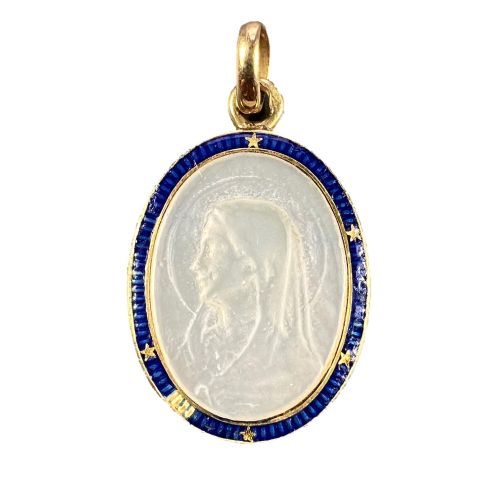
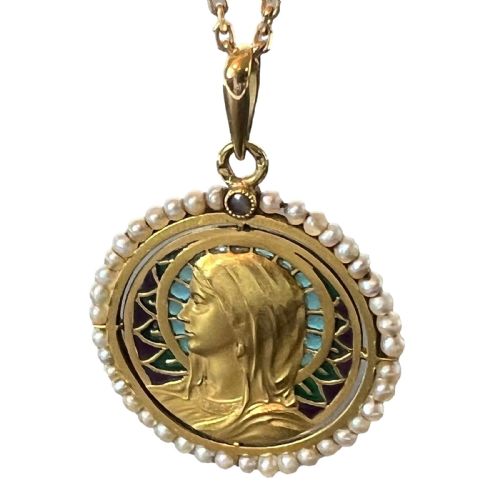
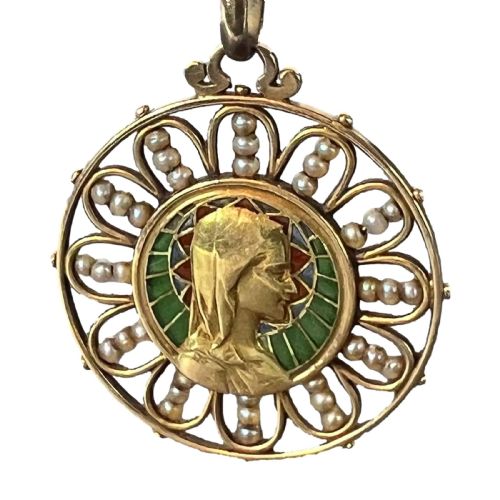
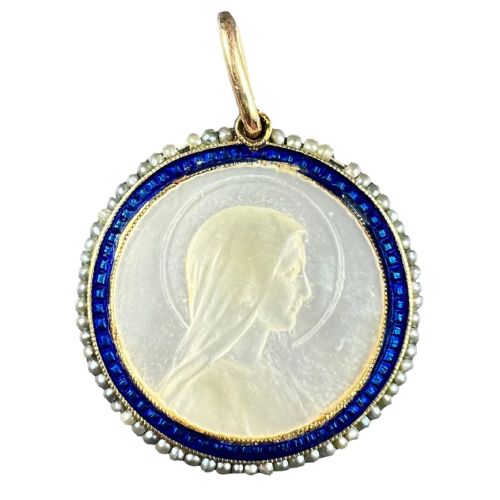
When you search for a yellow gold enamel medal, you find intricate French pendants and charms spanning from the Victorian era through the 1930s. These pieces frequently depict the Virgin Mary, Madonna and Child, or astrological signs like Pisces in miniature relief.
The version you are most likely to meet on this page is an 18K yellow gold French pendant featuring translucent enamel work. They combine devotional imagery with the fluid lines of Art Nouveau design, often accented with seed pearls or mother of pearl.
These items served primarily as personal talismans or devotional pendants rather than standard jewellery. Makers utilised precious metals to frame detailed miniature paintings and coloured glasswork meant to catch the light.
How they were made
Goldsmiths shaped 18K yellow gold into detailed frames and suspension loops to house delicate miniature paintings and metalwork. These structures provided a sturdy foundation for the glass pastes and pearl embellishments.
The distinct translucency in many examples relies on plique-a-jour enamel, a technique where vitreous enamel is fired within open wire cells without a backing. This lets light pass through the coloured glass like a tiny stained glass window.
Celestial interests join the heavenly host here, shifting smoothly from the Virgin Mary to Pisces.
What varies in quality
The distinction between standard examples and superior pieces rests on the complexity of the enamel work and the precision of the gold casting. Plique-a-jour pieces demand exceptional skill from the enameller to avoid cracking across the open wire frame during firing.
The Yellow Gold Enamel Medal Glossary
- Plique-a-jour
- An enamelling technique where the enamel is applied in open cells without a backing, allowing light to shine through the transparent glass. It resembles miniature stained glass and requires considerable skill to execute without flaws.
- Vitreous enamel
- Glass powder fused to a metal surface through high-temperature firing. This produces a durable, glossy coloured surface that resists fading over centuries.
- Seed pearl
- A very small natural or cultured pearl, often threaded or set in clusters around a central pendant. They provide a soft, luminous border common in antique French devotional jewellery.
- Mother of pearl
- The iridescent internal layer of certain mollusc shells, carved and polished for use as a backing or canvas. It shimmers with pearlescent pink and green hues beneath transparent glazes.
Yellow Gold Enamel Medal: Frequently Asked Questions
How were these medals worn?
These pieces were primarily worn suspended from delicate chains as pendant necklaces or hung from charm bracelets. Their dual function as charms and pendants allowed owners to keep devotional imagery close.
Most include a built-in jump ring or loop specifically designed for threading onto fine gold neckchains.
How do I date a medal?
Dating relies on stylistic markers such as the flowing organic curves typical of Art Nouveau or the material combinations recorded in the pieces. French hallmarks stamped onto the gold also provide clues to the exact period.
Pieces featuring plique-a-jour enamel and motifs of the Virgin Mary typically date from the late Victorian era through the 1930s.
What are plique-a-jour medals?
Plique-a-jour medals are special pendants where the enamel has no backing metal, creating a stained-glass effect. Light passes directly through the translucent coloured glass sections.
This technique is highly valued because each open cell of gold wire must hold the molten glass securely during the firing process.