



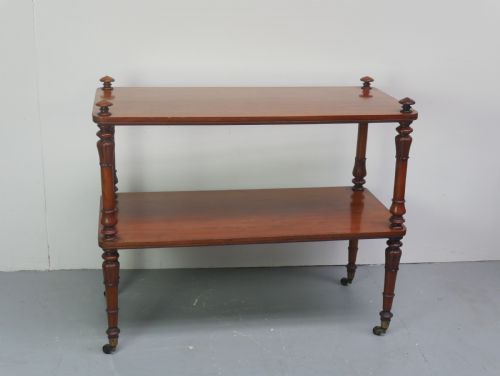


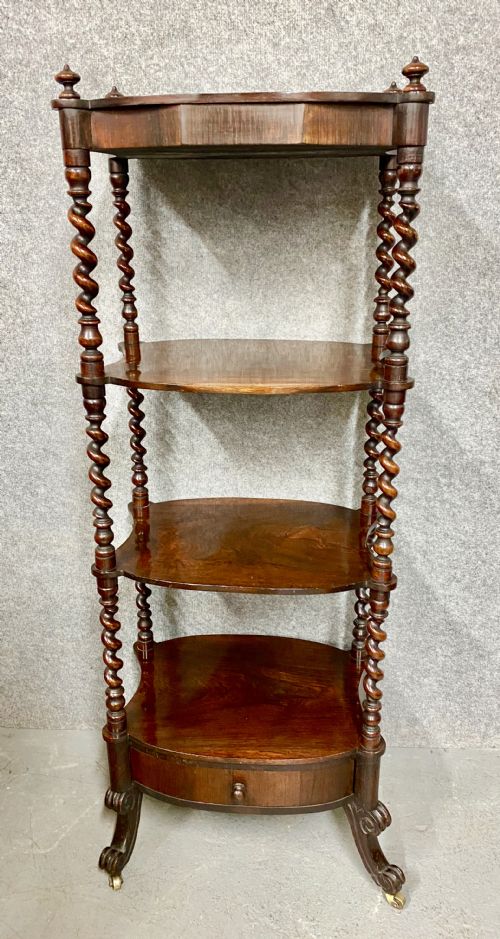

Wooden Victorian Whatnot
A wooden victorian whatnot is an open tiered shelving unit designed to display ornaments, and these pieces bring layered vertical display and figured timber to a room.
Wooden Victorian Whatnot
When you search for a wooden victorian whatnot, you encounter multi-tiered shelving units designed primarily for display and storage in nineteenth-century interiors. These pieces range from simple three-tier open corner stands to elaborate freestanding structures incorporating drawers, mirrors, and lower cupboards.
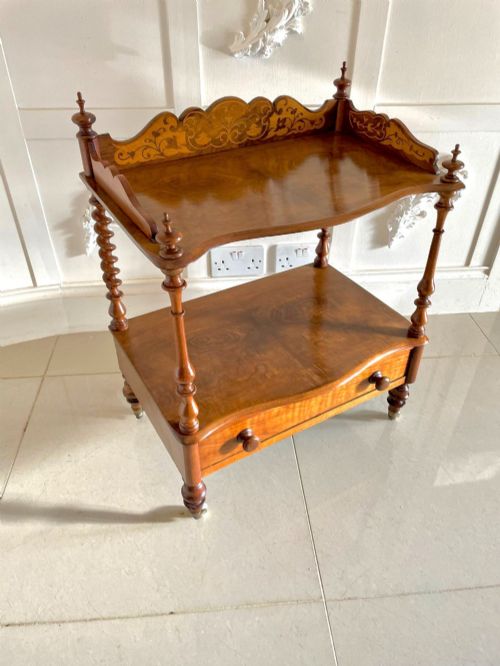
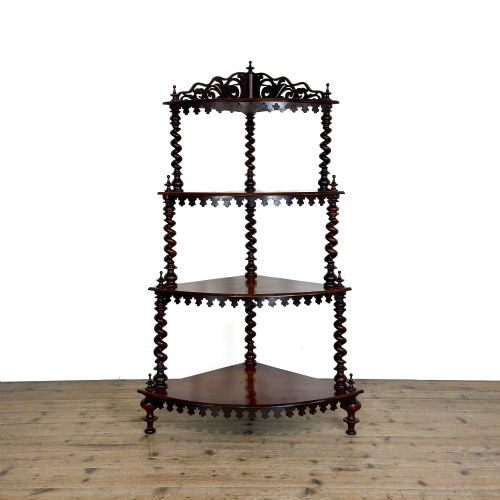
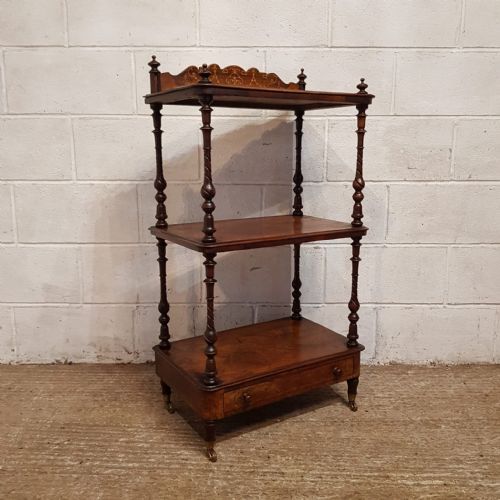
The version you are most likely to meet on this page is a mahogany or burr walnut multi-tiered shelf unit originating from the Victorian period. They appear frequently in corner formats or as rectangular freestanding etageres featuring turned supports and delicate spindle galleries.
Makers and cabinetmakers also produced hybrid forms that combined the open tiers of a whatnot with a Canterbury, a cellarette, or a chiffonier base. These variations offer additional utility while maintaining the characteristic stepped silhouette.
How they were made
Cabinetmakers utilised dense timbers such as mahogany, rosewood, and walnut, often applying highly figured burr walnut veneers to the visible shelf surfaces. These woods provided the structural strength needed for slender uprights and multiple stacked platforms.
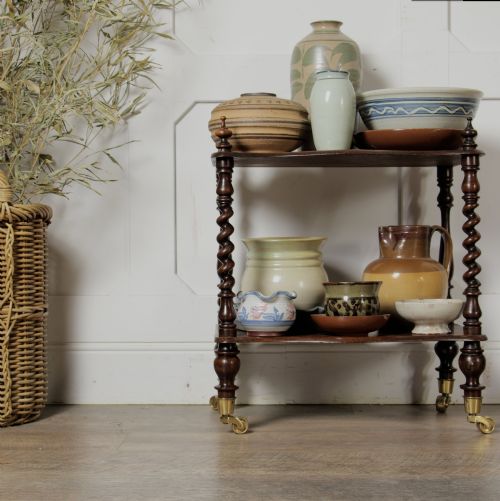
Joinery techniques included finely turned barley twist columns, shaped bracket supports, and delicate fretwork galleries fixed to individual tiers. Brass castors frequently fitted to the base allowed these display stands to move easily across carpets.
Wooden Victorian Whatnot Retail Price Guide 2026
Typical asking prices for wooden victorian whatnot among the pieces listed under this phrase on Sellingantiques today, from the lower quarter to the upper quarter. They describe what is for sale here now, not the wider market.
Several models incorporate hidden cellarettes or music partitions, proving that nineteenth-century Victorians liked their display stands to multitask.
What varies in quality
The distinction between standard domestic pieces and top-tier exhibition examples rests on the choice of timber and the ambition of the carving. Finely matched burr veneers, intricate marquetry inlay, and deeply carved supports elevate a piece well beyond basic utility.
Structural integrity also separates grades, as multiple stacked shelves place considerable weight on slender vertical turnings. Superior examples maintain rigid joints without wobble across every tier, while lesser items suffer from looseness in the upright supports.
The Wooden Victorian Whatnot Glossary
- Whatnot
- An open multi-tiered piece of furniture designed for displaying ornaments, books, or china. It gained popularity during the eighteenth century and remained a staple of Victorian drawing rooms.
- Etagere
- A French term for a piece of furniture consisting of a set of open shelves for displaying small objects. It is frequently used interchangeably with the term whatnot.
- Canterbury
- A low stand featuring partitioned sections for sheet music or books, often surmounted by display tiers in combined forms. They appear in both mahogany and burr walnut.
- Burr walnut
- A prized timber veneer taken from the knotted growth of a walnut tree, yielding swirling, highly decorative grain patterns. Cabinetmakers utilised it extensively on the top shelves and cabinet doors of high-status Victorian furniture.
- Barley twist
- A decorative turning technique resembling a spiralling rope column, common on the vertical supports of nineteenth-century stands. This detail adds movement and texture to the framework of a tiered shelf.
Wooden Victorian Whatnot: Frequently Asked Questions
What is a wooden victorian whatnot used for?
These tiered units served as display furniture for ceramics, small sculptures, and books in nineteenth-century drawing rooms. They lifted decorative objects off standard tables to utilise vertical wall space.
Today, they function well in contemporary spaces for displaying collections, plants, or bedside items while occupying minimal floor area.
How do I identify a Victorian whatnot?
Look for characteristic nineteenth-century timber choices such as mahogany, rosewood, and figured walnut combined with turned uprights. The presence of multiple open shelves arranged in a stepped or graduated fashion defines the form.
Detailing such as porcelain castors, fretwork galleries, and occasional inlaid marquetry further points towards nineteenth-century manufacturing methods.
Are all wooden victorian whatnots freestanding?
While many designs stand independently in the centre of a room or against a flat wall, a significant number are built specifically for corners. Corner versions feature triangular shelves designed to fit snugly into ninety-degree angles.
Freestanding models often feature finished backs and decorative turning visible from all sides, whereas corner units are strictly single-aspect.
How do I care for a wooden victorian whatnot?
Keep these tiered wooden pieces away from direct heat sources and strong sunlight to prevent the timber and delicate veneers from drying out or splitting. Dust the multiple shelves regularly with a soft, dry cloth rather than using silicone sprays.
Check the stability of the vertical column joints periodically, as heavy loads placed on upper tiers can strain the original fixings over time.