


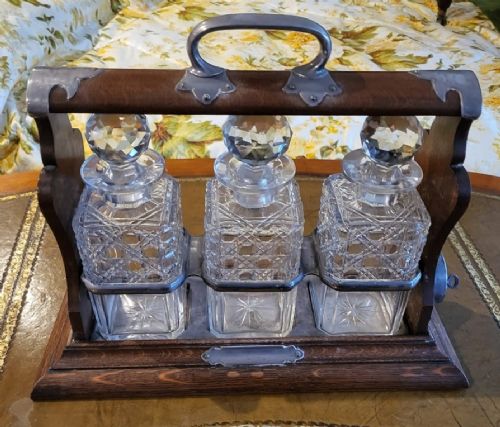


Wooden Silver Caddy
These wooden silver caddy items bring together timber and precious metal mountings, offering a functional centrepiece for the table.
Wooden Silver Caddy
When you search for a wooden silver caddy, you are looking at containers and fitted boxes built from timber and mounted with metal work. The evidence here spans tea caddies, biscuit barrels, and tantalus sets from the eighteenth century through to the Edwardian period.
The tea caddies appear in tortoiseshell, burr maple, and walnut, whilst the larger tantalus sets and biscuit boxes utilise oak fitted with silver plate and brass. These objects served to lock away precious dry goods or display bottles in period interiors.
You are most likely to meet Victorian and Edwardian examples in oak with silver plate, alongside earlier Georgian tea caddies in figured timbers. Each piece reflects the domestic storage habits of its era.
How they were made
Maker workshops built these boxes using dense hardwoods such as oak, walnut, and maple, often applying decorative veneers like burr walnut or tortoiseshell to the outer surfaces. Fine tea caddies rely on precise cabinet-making to shape curved bows and internal compartments.
Metal components include cast silver plate mounts, hinges, handles, and locking mechanisms in brass. Biscuit barrels and tantalus frames feature engineered metal bars and locking brackets to secure the glass containers within.
Wooden Silver Caddy Retail Price Guide 2026
Typical asking prices for wooden silver caddy among the pieces listed under this phrase on Sellingantiques today, from the lower quarter to the upper quarter. They describe what is for sale here now, not the wider market.
Listings feature oak, tortoiseshell, burr walnut, and silver plate across Victorian, Edwardian, and Georgian periods.
What varies in quality
Quality rests in the selection of the timber figure and the crispness of the metal mounts. Pieces utilising figured burr maple or finely worked tortoiseshell show greater cabinet-making ambition than standard plain oak frames.
The integration of the silver plate hardware and the integrity of the locking mechanisms separate standard production from superior examples. Well-cast mounts and original hinges preserve the intended function and appearance of the piece.
Walker & Hall·Mappin & Webb·Lenzkirch·John Grinsell & Sons
The Wooden Silver Caddy Glossary
- Tantalus
- A locking drink cabinet that holds decanters securely visible whilst preventing access without a key. The frame typically uses oak fitted with silver-plated metalwork.
- Tea caddy
- A small box designed to store tea leaves safely in the home. Early versions feature tortoiseshell or burr walnut construction.
- Silver plate
- A layer of silver fused to a base metal such as copper or brass. It provides the appearance of solid silver on hardware and mounts.
- Tortoiseshell
- The mottled horn shell of certain turtle species used as a decorative veneer on eighteenth-century boxes. It creates a rich amber and brown patterned surface.
- Burr walnut
- Timber taken from the wart-like growth on a walnut tree, showing twisted grain patterns. Cabinet-makers prized it for decorative veneering.
Wooden Silver Caddy: Frequently Asked Questions
How were tea caddies used?
Tea caddies held precious tea leaves under lock and key when tea was an expensive commodity. Servants or hosts kept the key to control access.
Inside, the boxes often featured compartments to separate different varieties of tea.
How do I date a wooden caddy?
Dating relies on timber choices, construction techniques, and the style of the metal mountings. Georgian pieces often utilise tortoiseshell or fine veneers, while Victorian and Edwardian examples lean towards oak with silver plate.
Maker marks on the metal hardware also help identify the period of production.
How do I care for antique wood and metal?
Keep wooden surfaces away from direct sunlight and sudden temperature changes to prevent the timber from splitting or warping. Clean silver-plated mounts gently with appropriate soft cloths without abrasive polishes.
Maintaining a stable room humidity preserves both the veneer and the metal hardware.