

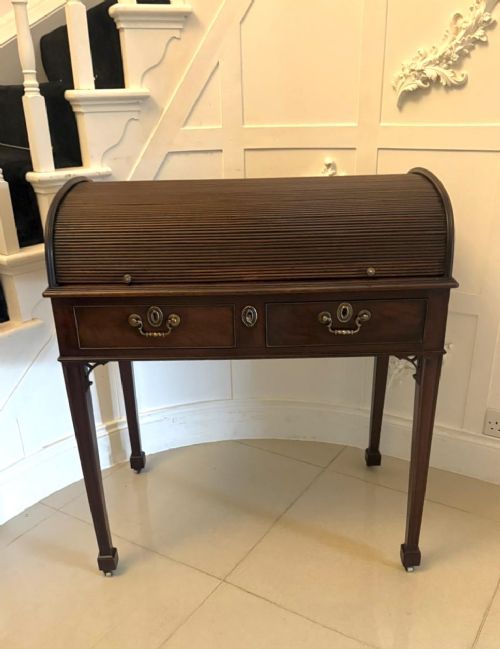
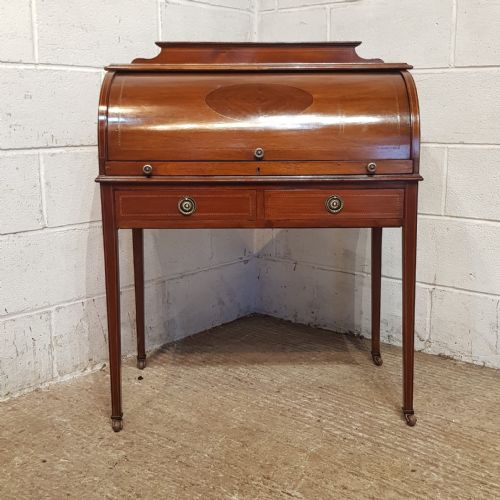


Wooden Roll Top Secretary
These wooden roll top secretary desks offer concealed writing surfaces and clever tambour enclosures, bringing period character and practical storage to a home study.
Wooden Roll Top Secretary
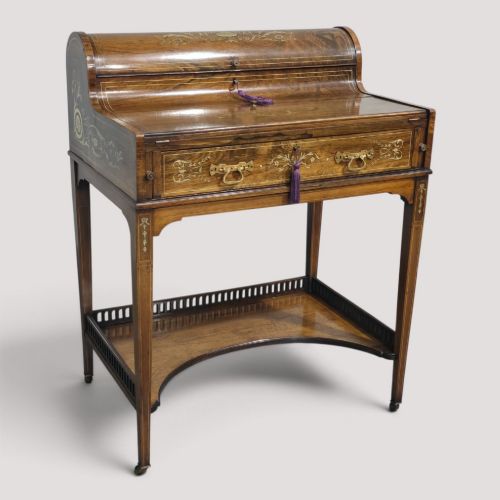
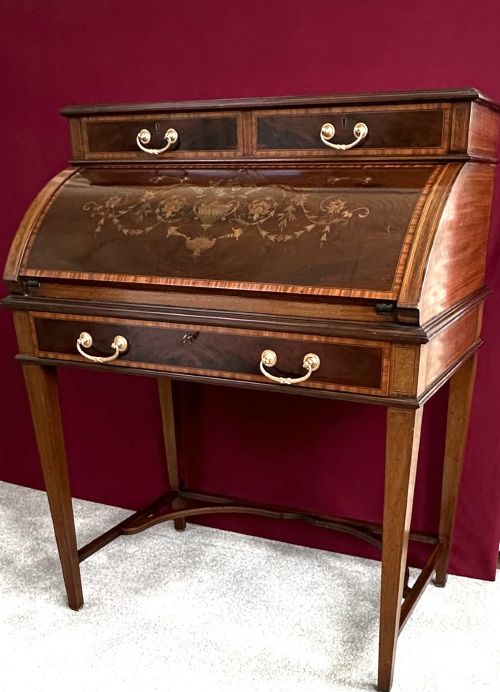
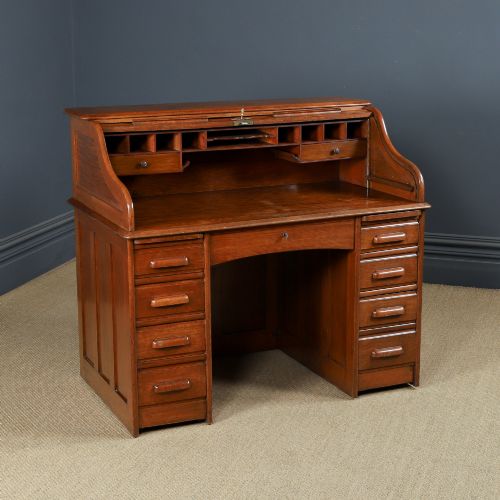
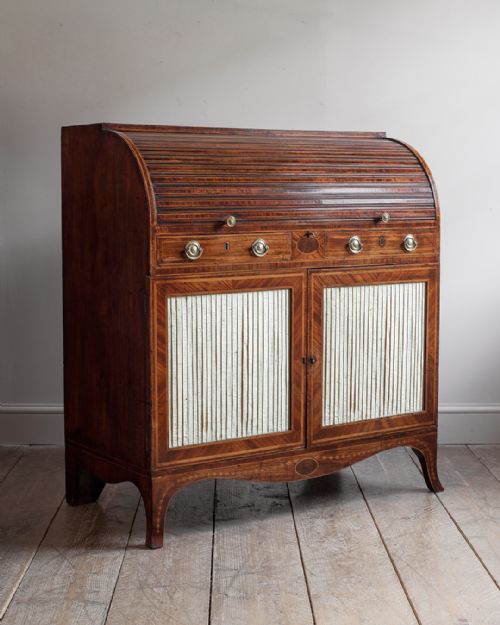
When you search for a wooden roll top secretary, you are looking at practical writing furniture that conceals paperwork behind a slatted cylinder or tambour shutter. The examples on this page span several periods, from Georgian and Regency eras through to Victorian, Edwardian, and early twentieth-century workshops.
The most common formats you will meet here include pedestal office desks in oak, alongside more refined cylinder bureau tables in mahogany and walnut. Certain pieces incorporate superstructure elements such as glazed bookcases above the main writing surface.
Origins vary across English, French, and American traditions, reflecting local cabinet-making preferences of the eighteenth and nineteenth centuries. You will encounter styles ranging from plain Edwardian office forms to Louis XVI Revival inlay and George III proportions.
Materials and construction methods
Cabinet-makers built these desks using substantial timbers including mahogany, walnut, and oak, frequently embellished with contrasting veneers of satinwood and maple. Brass hardware and ormolu mounts appear as functional handles and decorative accents.
The signature tambour or roll top action relies on numerous narrow strips of wood glued to a flexible canvas or leather backing, allowing the shutter to glide smoothly around a curved track. Internal fittings often feature textile-lined writing surfaces and small pigeonholes constructed with traditional joinery.
Wooden Roll Top Secretary Retail Price Guide 2026
Typical asking prices for wooden roll top secretary among the pieces listed under this phrase on Sellingantiques today, from the lower quarter to the upper quarter. They describe what is for sale here now, not the wider market.
Listings feature woods including oak, mahogany, walnut, maple, and satinwood, paired with brass and ormolu hardware.
Distinguishing grades of craftsmanship
Quality in these desks rests on the precision of the tambour mechanism and the stability of the sliding tracks. A superior piece operates with a fluid, silent motion where the slats align evenly when closed.
The selection of timber grain and the crispness of inlaid details distinguish finer workshops from standard commercial production. Heavier secondary woods and robust internal drawer construction indicate a higher standard of original manufacture.
Wiggers
The Wooden Roll Top Secretary Glossary
- Tambour
- A flexible shutter made from narrow strips of wood affixed to fabric, allowing it to slide around a curved track. This mechanism conceals the pigeonholes and writing surface.
- Cylinder desk
- A writing desk featuring a quarter-circle rotating wooden cylinder that covers the desk interior when closed. It differs from a standard roll top by using a solid curved panel rather than individual slats.
- Bureau
- A desk with a sloping or cylinder front that opens to reveal a writing surface and small compartments. Many traditional forms include drawer storage beneath.
- Pedestal desk
- A heavy freestanding desk supported by two separate piers of drawers or cupboards. The central writing section spans between them.
- Ormolu
- Gilded bronze mounts applied to furniture for decoration. This technique is frequently found on continental revival pieces.
Wooden Roll Top Secretary: Frequently Asked Questions
How do I maintain the roll top mechanism?
Keep the wooden tracks clean and free from dust to ensure the slats move smoothly along the curve without binding. Avoid excessive lubrication, which can attract grit and damage the hidden fabric backing.
Apply a suitable beeswax conditioner periodically to nourish the timber and maintain the finish of the individual slats.
Where were these desks typically used?
These pieces served primarily as functional writing and storage furniture in domestic studies, libraries, and commercial offices. The lockable cylinder or roll top allowed owners to secure private correspondence and ledgers.
Today, they function effectively as home office desks, combining period aesthetics with modern laptop or paperwork storage.
How do I date a wooden roll top desk?
Examine the secondary woods inside the drawers, the style of the brass hardware, and the overall construction methods. Georgian and Regency examples tend to feature fine mahogany veneers and hand-cut dovetails, while Edwardian and later office pieces often use heavier oak and mass-produced fixings.
Stylistic cues such as Louis XVI Revival inlay or heavy Victorian carved walnut provide further clues to the period of manufacture.
Are tambour desks and roll top desks different?
A tambour desk uses a shutter made of many small wooden slats joined together, which allows it to curve around corners. A true cylinder desk often uses a single curved solid panel that rotates into the body of the desk.
Both terms are frequently used interchangeably in modern descriptions to refer to desks with enclosed sliding writing areas.