

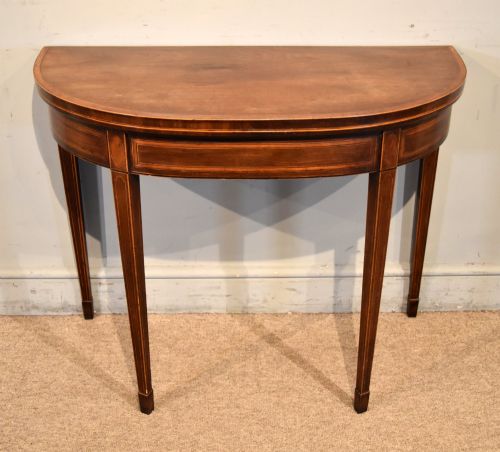
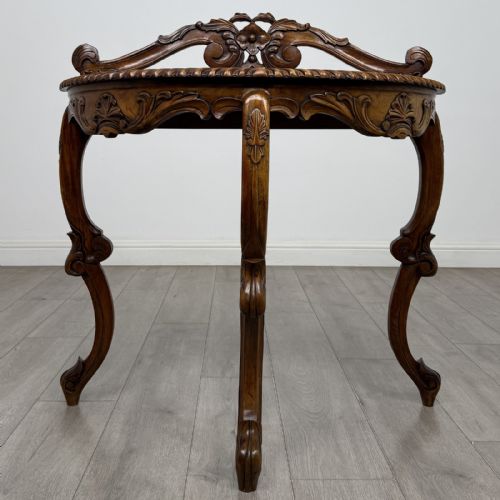
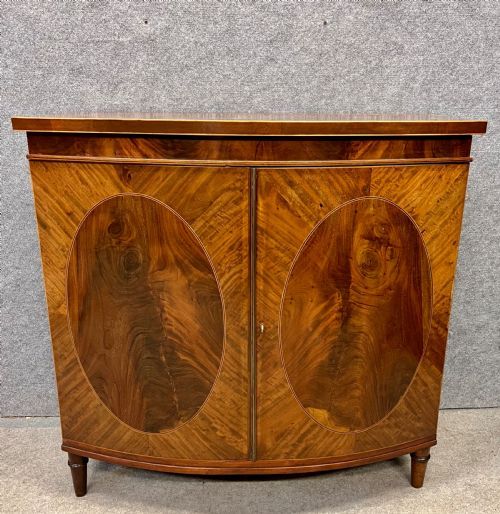
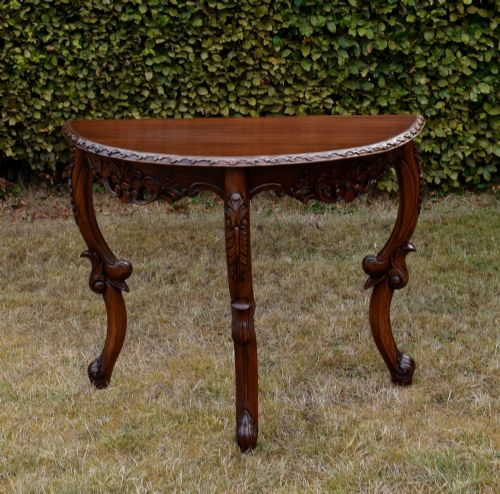


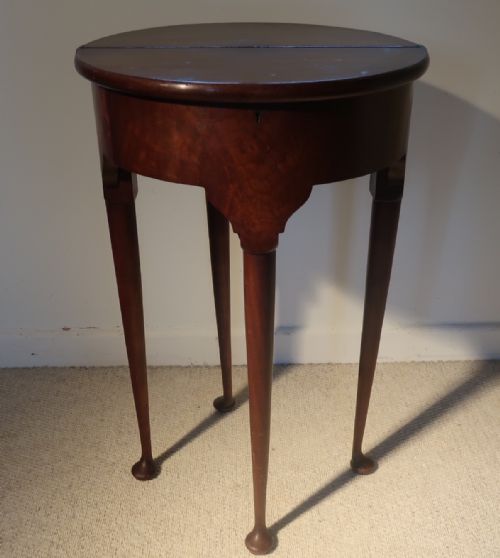



Wooden Demi Lune Table
A wooden demi lune table brings architectural grace to a tight hallway or corner, offering a flat wall edge and a sweeping semi-circular front.
Wooden Demi Lune Table
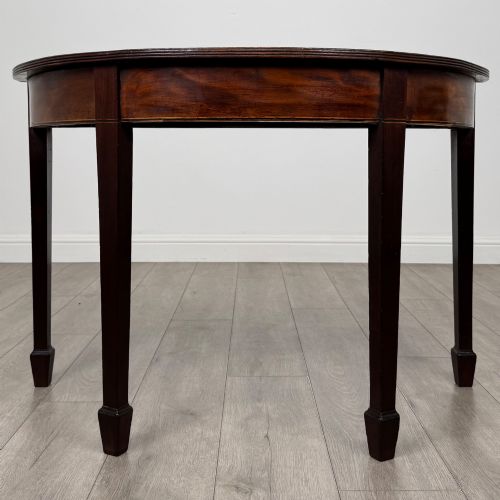
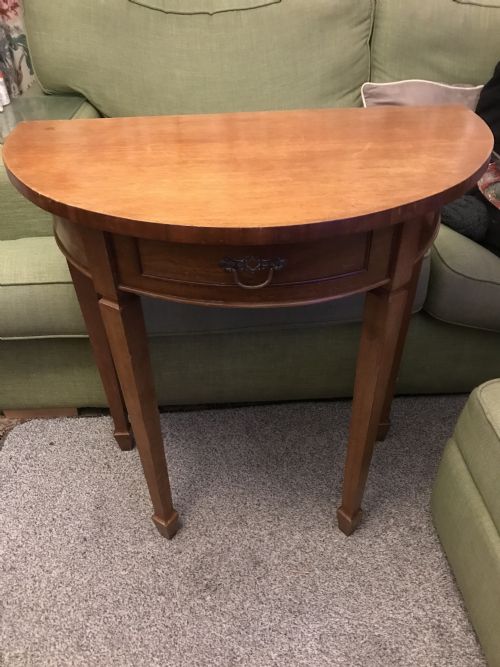
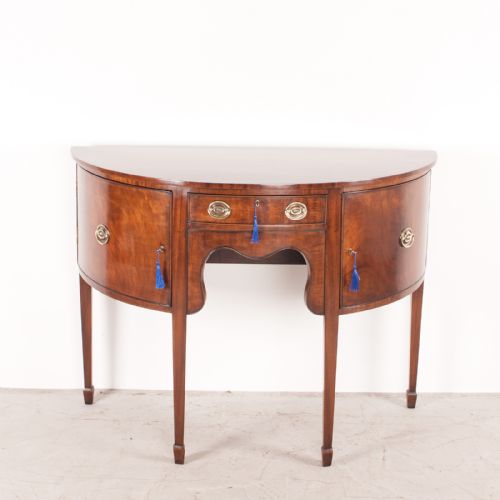
A wooden demi lune table takes the form of a half-circle, designed to stand flush against a wall while presenting a curved profile to the room. The selection ranges from compact tea tables and console tables to sideboards and cabinets.
The pieces span multiple eras, with examples originating from the Georgian, Victorian, and Edwardian periods, alongside earlier seventeenth-century forms and twentieth-century interpretations. Woods such as mahogany, oak, elm, and satinwood dominate the construction.
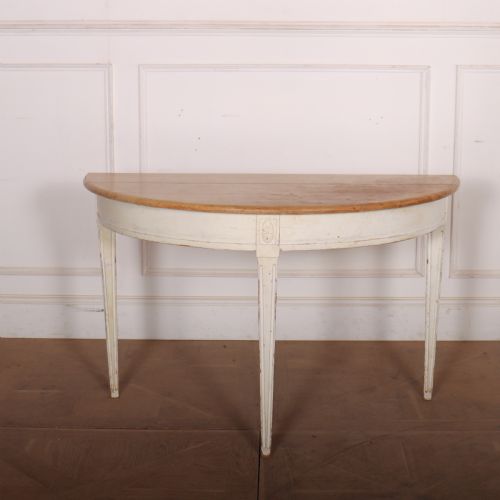
Buyers frequently encounter inlaid decoration, reeded friezes, or painted finishes, particularly on console and tea table formats. The function shifts according to the piece, serving variously as a serving surface, a display stand, or a fold-over tea table.
How they were made
Cabinetmakers utilised solid timbers such as mahogany, oak, and elm for structural integrity, often applying flame mahogany veneers to visible curved surfaces for visual depth. Satinwood inlay added contrasting linear detail to tabletops and friezes.
Curved aprons and tambour fronts demanded specialist woodworking techniques to shape timber along a radius without losing stability. Brass fittings, including castors and feet, provided both functional support and decorative accent.
Wooden Demi Lune Table Retail Price Guide 2026
Typical asking prices for wooden demi lune table among the pieces listed under this phrase on Sellingantiques today, from the lower quarter to the upper quarter. They describe what is for sale here now, not the wider market.
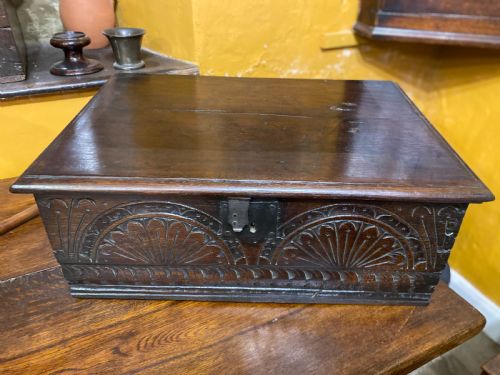
One seventeenth-century oak bible box hides its half-moon curves on the front panel rather than the table top.
What varies in quality
The refinement of the timber selection and the precision of the veneer matching dictate the visual standard of a piece. Fine execution shows in the crispness of inlaid motifs and the seamless alignment of curved tambour panels.
Structural integrity rests on the joinery of the semi-circular frame and the stability of the legs, whether spade feet, square tapered supports, or reeded columns.
Pietro Ferrario
The Wooden Demi Lune Table Glossary
- Demi-lune
- French for half-moon, describing the semi-circular shape of the table top and flat rear edge. This format allows the furniture to sit flat against a wall.
- Tambour
- A surface constructed from narrow strips of wood glued to a canvas backing, allowing the front of a cabinet to curve around a radius. It operates on a sliding track.
- Spade foot
- A narrow, tapering foot that widens slightly at the very base, frequently found on Edwardian and Georgian examples. It provides a lighter visual finish to straight legs.
- Console table
- A table designed to be fixed or to stand against a wall, supported by legs at the front. The demi-lune version uses the semi-circular top for balance.
Wooden Demi Lune Table: Frequently Asked Questions
Where does a wooden demi lune table fit best?
The flat back edge allows the piece to sit snugly against a hallway wall or in a narrow entrance space without blocking foot traffic.
Larger variations function effectively as sideboards or serving surfaces in dining rooms and living spaces.
How do I identify a Georgian demi lune table?
Georgian pieces typically rely on solid mahogany or detailed inlay work, often featuring folding leaves for tea table use.
Construction methods from this period show hand-cut joinery and traditional timber preparation without modern adhesives.
How should I care for polished mahogany surfaces?
Dust regularly with a soft, dry cloth to prevent abrasive particles from settling into the grain and finish.
Avoid placing the timber in direct sunlight or near heat sources to protect the polished surface and underlying veneer.