

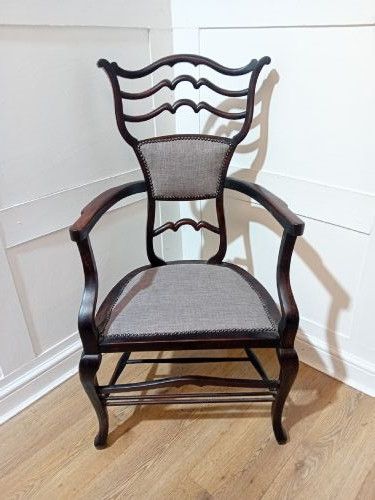
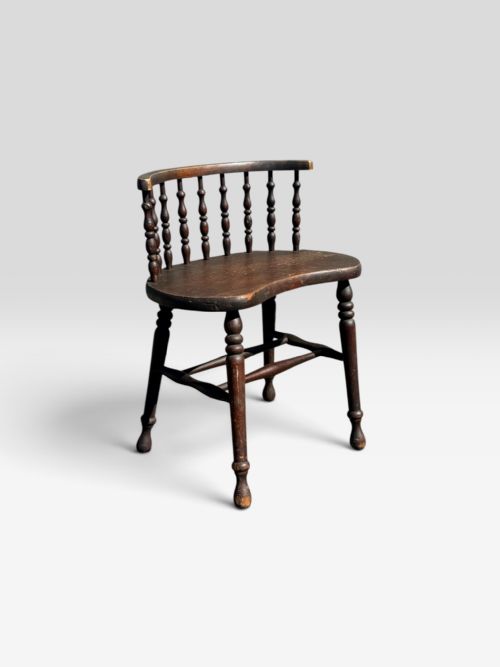
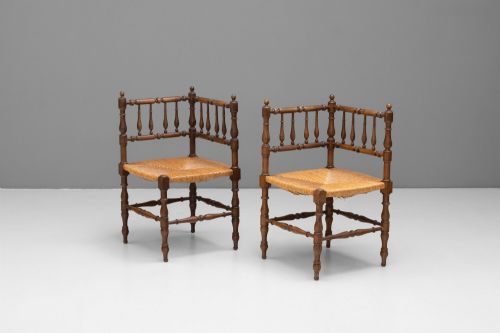


Wooden Corner Armchair
A wooden corner armchair is a clever space-saving seat designed to tuck neatly into room angles, offering a sturdy yet compact place to sit.
Wooden Corner Armchair
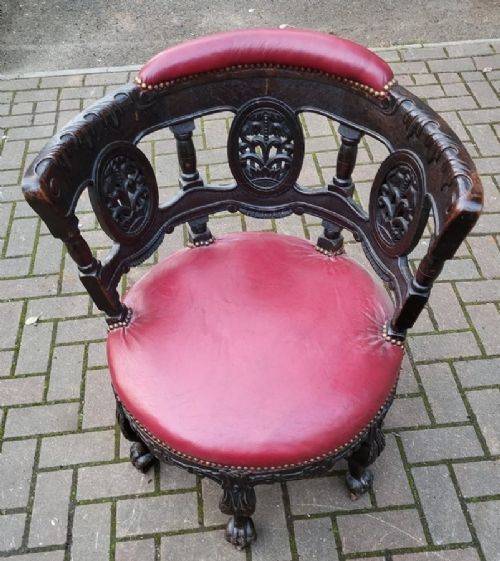
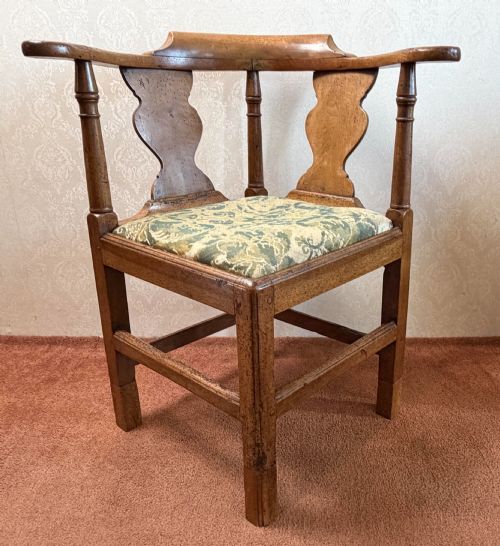
A wooden corner armchair is a distinctive form designed specifically to fit into the ninety-degree angle of a room, saving floor space while providing a functional seat. These pieces feature a semi-circular backrest supported by turned or shaped pillars above a square or diagonal seat.
The versions most commonly met on this page span from the eighteenth century through the Edwardian period, constructed in woods such as mahogany, oak, walnut and elm. Many examples incorporate decorative elements including inlay, carving, or turned spindles that reflect styles from Georgian simplicity to Victorian and Edwardian revival movements.
How they were made
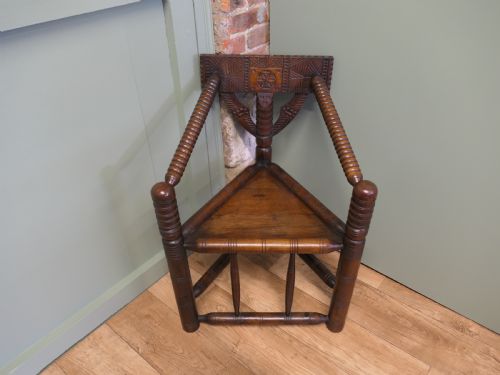
Makers constructed these chairs primarily using solid timbers such as mahogany, oak, walnut and elm, frequently employing mortise and tenon joints to ensure stability across the angular frame. Turned wooden spindles and curved armrests required skilled lathe work and steam bending to achieve the characteristic rounded back.
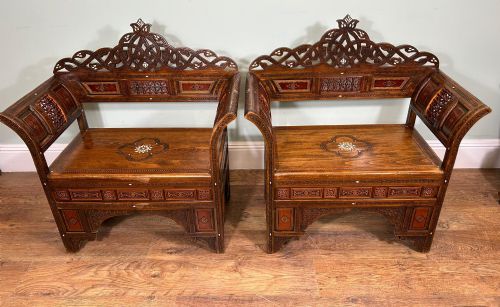
Surface ornamentation involved intricate wood carving, decorative inlay using contrasting veneers, and occasionally applied panels such as Mashrabiya woodwork. Seats were either left as exposed timber or fitted with drop-in pads upholstered in fabric, leather or tapestry.
Wooden Corner Armchair Retail Price Guide 2026
Typical asking prices for wooden corner armchair among the pieces listed under this phrase on Sellingantiques today, from the lower quarter to the upper quarter. They describe what is for sale here now, not the wider market.
The furniture styles represented across these listings include Georgian, Victorian, Edwardian, Gothic Revival, Moorish Revival and Arts and Crafts.
What varies in quality
Quality in these chairs rests upon the selection of timber and the integrity of the joinery where the diagonal legs and curved back meet. Finer examples display carefully matched grain patterns, crisp hand-carving and well-executed turnings rather than heavy machine-made repetition.
The refinement of the silhouette and the subtlety of decorative inlay distinguish high-end urban pieces from simpler country-made variants. Original surface patination and minimal structural alteration further elevate the standing of a piece.
Liberty and Co
The Wooden Corner Armchair Glossary
- Corner chair
- A chair designed to fit into a room angle, featuring a diagonal seat and a continuous curved backrest supported by corner posts. This form became popular during the eighteenth century.
- Turned
- Shaped on a wood-turning lathe to create cylindrical, spindle or baluster components. These shaped supports form the structural and decorative framework of the backrest.
- Inlay
- A decorative technique where contrasting pieces of wood or other materials are inserted into recesses within the primary surface. Edwardian examples frequently employ this method for subtle geometric or floral patterns.
- Bergère
- An enclosed upholstered armchair with exposed wooden framing and caned side panels. French examples often utilise carved oak for this lighter seating form.
- Mashrabiya
- An architectural element consisting of wooden turned lattices assembled in intricate geometric patterns. Certain nineteenth-century pieces incorporate these panels into their decorative backs.
Wooden Corner Armchair: Frequently Asked Questions
Where do you put a wooden corner armchair?
These chairs find their natural home in the corner of a bedroom, hallway or study where standard seating proves too cumbersome. Their diagonal footprint allows them to utilise awkward dead space without blocking pathways.
They also serve as functional desk chairs or accent pieces in living rooms, pairing well with small tables or floor lamps.
How do I tell an 18th-century corner chair apart from a later revival?
Eighteenth-century examples typically display heavy timber framing, such as oak or mahogany, with hand-cut joinery and simpler, functional turnings shaped by early hand tools. Their patination develops deep warmth through decades of use.
Later revival pieces from the Victorian and Edwardian periods often feature machine-precise turnings, lighter secondary timbers, and decorative elements like elaborate inlay or revival-style carving.
Are wooden corner armchairs comfortable to sit in?
The comfort of these chairs depends largely on whether the seat is solid timber or fitted with an upholstered pad. Many eighteenth-century country versions have plain wooden seats designed for upright posture rather than lounging.
Upholstered drop-in pads or added cushions provide a softer seat, while the wraparound backrest offers solid lumbar support.
What woods were commonly used for these chairs?
Mahogany remained a favoured choice for formal urban pieces from the Georgian era onward, prized for its rich tone and strength. Walnut and oak appear across multiple centuries, offering durability and distinct grain patterns.
Country workshops frequently utilised local hardwoods such as elm and fruitwood, resulting in sturdy chairs with unique regional character.