

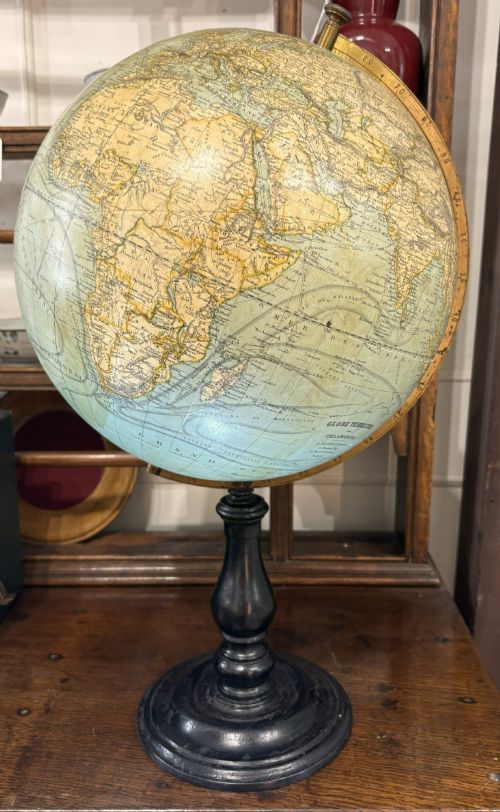

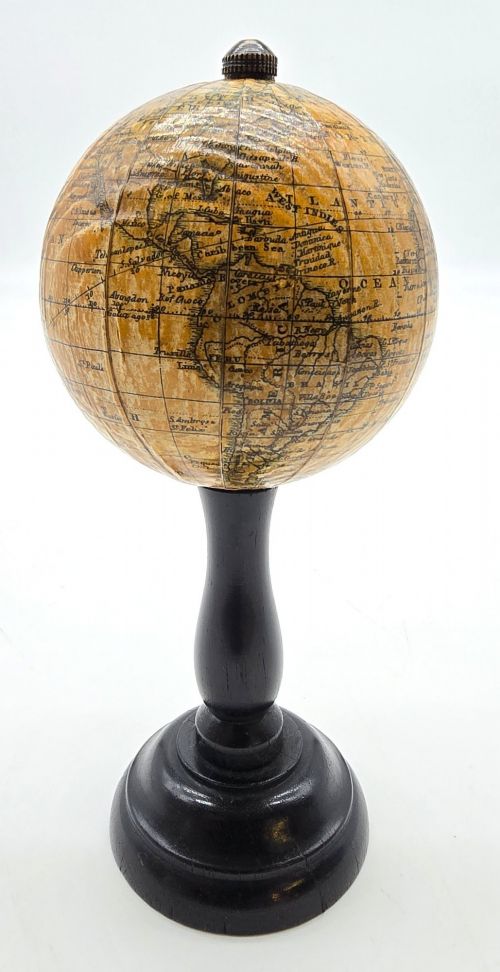


Wood Globe Stand
These wood globe stand pieces carry centuries of cartography, offering a grounded way to display terrestrial and celestial spheres in your home.
Wood Globe Stand
A wood globe stand supports geographical globes ranging from small miniature table versions to large floor standing models. These stands anchor paper, plaster and metal spheres across periods spanning the eighteenth century through to the mid-twentieth century.
You will most commonly encounter wooden desk globes and floor-standing pieces originating from English, French and German makers. The selection includes library globes and pairs of terrestrial and celestial globes resting upon turned or ebonised wood supports.
The styles shift from Georgian and Regency forms through Victorian designs to interwar and mid-century modern pieces. Each wood globe stand pairs cartographic history with supportive cabinetry suited to studies and libraries.
How they were made
The primary structures combine turned woods, mahogany and ebonised wood to create stable frames for the spheres above. Metal and brass components frequently secure the axes and meridians within the wooden cradles.
Globes mounted upon these stands utilise printed paper gores applied over plaster or papier-mâché cores. Joinery techniques reflect the period of production, utilising solid timbers for heavier floor models and delicate turning for miniature desk variations.
Wood Globe Stand Retail Price Guide 2026
Typical asking prices for wood globe stand among the pieces listed under this phrase on Sellingantiques today, from the lower quarter to the upper quarter. They describe what is for sale here now, not the wider market.
Some tiny German and English globes measure just four inches across, offering a miniature world perched upon a turned wooden base.
What varies in quality
Quality rests upon the crispness of the cartographic detail printed on the paper gores and the fidelity of the wood turning. Superior stands exhibit balanced proportions, well-seasoned timbers and accurate geographical or celestial mapping.
The relationship between the sphere and its wooden support dictates the overall success of the piece. Finer examples maintain original surfaces on both the stand and the globe, preserving the integrity of the maker's work.
Carey·M.Vivien·Raths·Malby·Geographia
The Wood Globe Stand Glossary
- Terrestrial globe
- A spherical map representing the earth. These objects show political and physical boundaries recorded at the time of manufacture.
- Celestial globe
- A sphere mapping the stars and constellations relative to the earth. They frequently appear paired with terrestrial globes on floor stands.
- Gores
- Printed paper strips cut in curved segments and applied to the sphere. They require precise alignment to ensure accurate cartography.
- Meridian
- A brass or metal ring surrounding the globe that allows it to spin on an axis. This ring fits directly into the supporting wood stand.
- Papier-mâché
- A composite material made from paper pulp mixed with glue or resin. This substance forms the lightweight core beneath the printed paper gores.
Wood Globe Stand: Frequently Asked Questions
How do I date a wood globe stand?
Dating relies on the geographical boundaries printed on the globe paper rather than the wood alone. Political borders, country names and cartographic styles shift across the eighteenth, nineteenth and twentieth centuries.
The woodwork itself offers secondary clues through turning styles, such as Georgian proportions or mid-century modern lines. Examining both the sphere and the stand provides a reliable timeframe.
What is the difference between desk and floor globes?
Desk globes feature compact stands designed for tabletops, bureau surfaces or libraries. They measure smaller in diameter and suit close inspection.
Floor standing globes incorporate taller wooden legs or pedestals to stand directly on the floor. They often include horizon rings and heavier structural frames.
How should I care for an antique globe stand?
Keep wooden stands away from direct sunlight and fluctuating radiator heat to prevent timber splitting. Dust the turned wood gently with a dry cloth.
Avoid applying liquid cleaners to the paper globe surface or the wooden frame. Stable indoor humidity protects both the paper gores and the underlying core.
Why do some listings feature pairs of globes?
Pairs combine a terrestrial globe showing the earth with a celestial globe mapping the night sky. Makers during the nineteenth century frequently produced these as matching sets for libraries.
Displaying them together on compatible wood stands reflects traditional scientific collections. Each sphere serves a distinct observational purpose.