

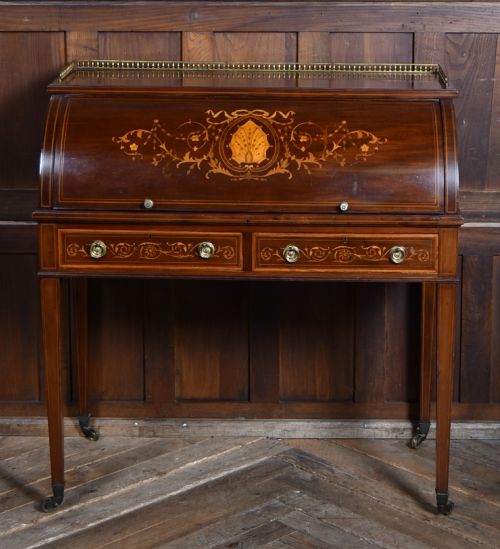
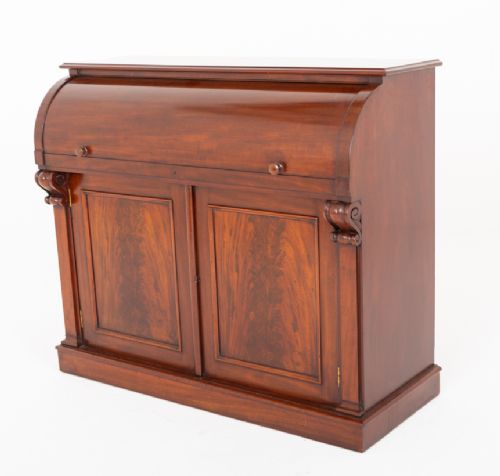
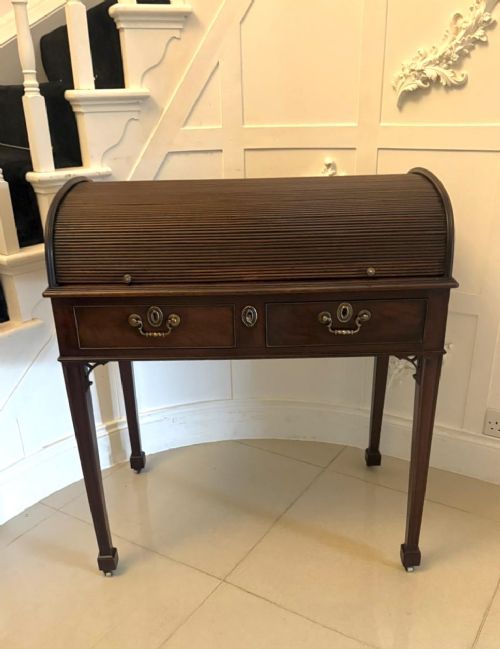
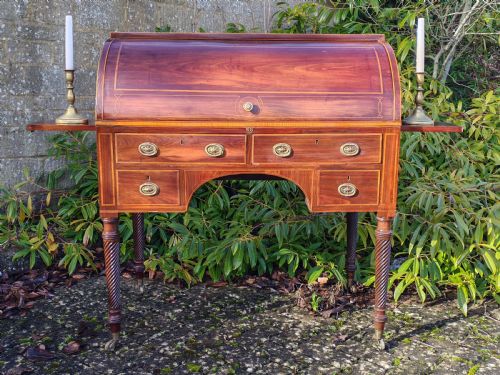


Wood Cylinder Desk
A wood cylinder desk gives you a private writing surface enclosed by a rolling shutter, keeping papers neatly concealed.
Wood Cylinder Desk
When you search for a wood cylinder desk, you are looking at practical writing furniture designed to secure correspondence and documents out of sight. The form conceals pigeonholes and small drawers beneath a curved wooden shell that rolls up or back when in use.
The version you are most likely to meet on this page is a nineteenth century or Georgian piece executed in mahogany, often incorporating a pull-out writing slide and secondary storage compartments. Examples span periods from the eighteenth century through to the Edwardian era, including pedestal forms and larger bureau bookcases.
Makers adapted the cylinder mechanism into various formats, ranging from full-sized estate desks to small examples and occasional miniature furniture. Alongside traditional British styles like Sheraton Revival, the selection includes pieces with Dutch marquetry and Oriental elements.
How they were made
Cabinet makers built the curved cylinder top from multiple narrow vertical wooden slats glued to a flexible canvas backing, allowing the shutter to slide smoothly within internal tracks. This method required precise joinery to ensure the roll mechanism operated without binding.
Primary surfaces relied on solid timbers and veneers such as mahogany, walnut, satinwood and partridgewood, frequently enhanced with contrasting stringing or marquetry inlay. Interiors often featured leather-lined writing surfaces and small brass pulls on internal drawer fronts.
Wood Cylinder Desk Retail Price Guide 2026
Typical asking prices for wood cylinder desk among the pieces listed under this phrase on Sellingantiques today, from the lower quarter to the upper quarter. They describe what is for sale here now, not the wider market.
Listings feature wood cylinder desks from the Georgian period up to the Edwardian era, constructed in mahogany, walnut, satinwood and partridgewood.
What varies in quality
The distinction between ordinary and superior pieces rests upon the crispness of the cabinet work and the selection of timber figures. Flame mahogany veneer or finely figured satinwood demonstrates a higher grade of workshop production than plain secondary woods.
Smooth operation of the internal mechanism separates better examples from lesser ones. A well-adjusted cylinder glides effortlessly within its grooves, and fitted internal drawers align squarely without sagging or sticking.
Boston Chair Company of Massachusetts
The Wood Cylinder Desk Glossary
- Cylinder top
- A curved wooden shutter that rolls back to reveal a writing surface and internal pigeonholes. It provides a secure enclosure for correspondence compared to a traditional flat table.
- Tambour
- A flexible sliding shutter formed from narrow strips of wood glued to fabric. This mechanism serves a similar enclosing function to a solid cylinder.
- Bureau bookcase
- A writing desk with a shelved cabinet superstructure above. It combines storage for books with a closed writing compartment.
- Writing slide
- A pull-out board that extends the usable surface area of a desk. It slides beneath the main writing top when not required.
- Parquetry
- Geometric patterns formed by fitting small pieces of wood veneer together. Cabinet makers used this technique to decorate drawer fronts and writing surfaces.
Wood Cylinder Desk: Frequently Asked Questions
What is a wood cylinder desk?
A wood cylinder desk is a piece of antique writing furniture featuring a curved, rolling wooden shutter that encloses the desk interior. When closed, it hides papers and stationary from view.
The design provides a secure and tidy workspace, bridging the gap between a traditional bureau and a flat writing table.
How do you use a cylinder desk?
You pull the curved wooden shutter upward or backward to reveal the internal pigeonholes, small drawers, and writing surface. Many versions include a sliding leather-lined board that pulls forward to give extra knee room.
When writing is finished, you push the shutter down to lock away documents and keep the room tidy.
Where should I place a cylinder desk?
Because these desks often feature finished backs and polished timber surfaces, they sit comfortably away from walls in the centre of a study or home office. Measure the depth of the room carefully to allow space for pulling out the writing slide.
Keep them away from direct sunlight and heat sources to protect the polished wood veneer and leather inserts.
How do I date a cylinder desk?
Dating relies on observing the timber species, construction methods, and stylistic details such as Sheraton Revival inlay or Georgian proportions. Earlier pieces from the eighteenth century typically show hand-cut dovetails and solid timber framing.
Later Victorian and Edwardian examples often incorporate mechanical complexity and factory-produced hardware alongside machine-sawn internal components.