
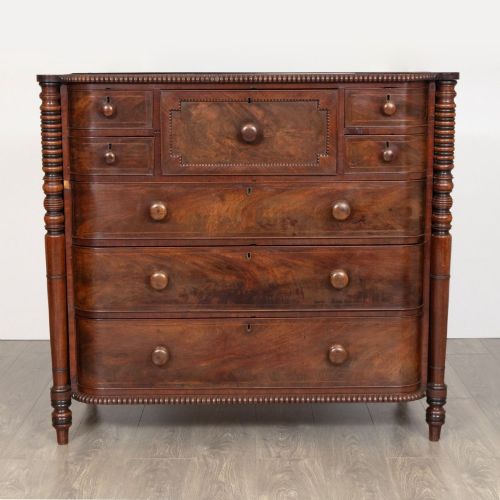

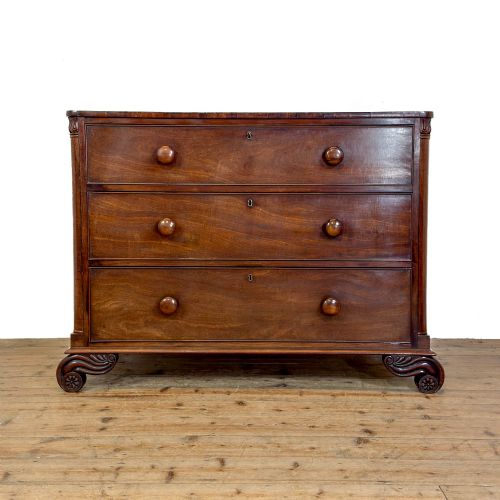


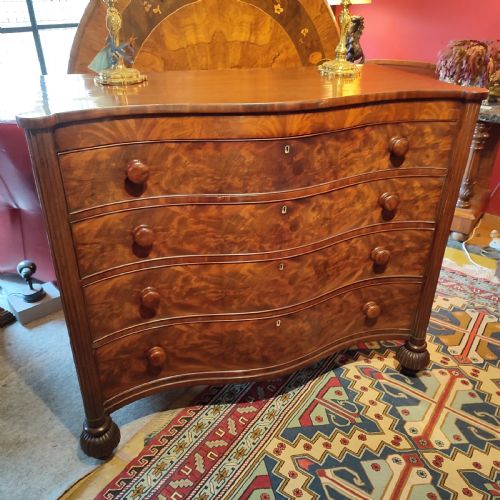


William IV Dresser
A william iv dresser offers heavy mahogany construction and classic 19th century presence, bringing practical storage and bold proportions to any room.
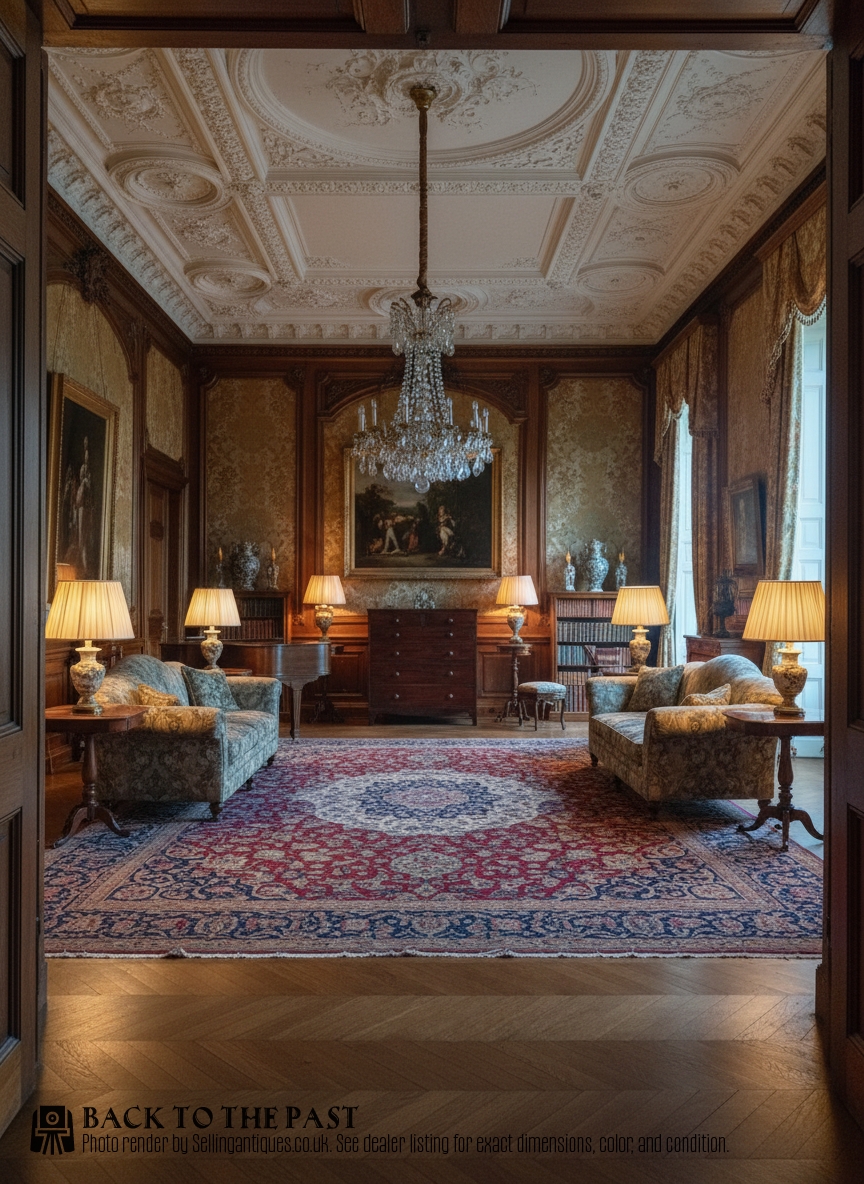
William IV Dresser
Buyers seeking a william iv dresser will encounter substantial case furniture originating from the 19th century, often overlapping with late Regency and early Victorian periods.
Makers utilised rich materials such as flame mahogany veneer, burr walnut, burr oak, and brass hardware to define the aesthetic of these robust storage pieces.
Materials and Construction
Cabinet makers relied heavily on solid mahogany and flame mahogany veneer, selecting timber for deep grain patterns and warm colour.
Details such as brass mounts, burr oak accents, and occasional marble tops completed the surface work on these sturdy items.
Joinery techniques produced bow front shapes, serpentine contours, and compact multi-drawer configurations designed for daily utility.
Listings span the nineteenth century, featuring styles from Georgian and Regency eras through to the eighteen-fifties.
Assessing Quality
Superior examples distinguish themselves through the choice of timber, displaying lively flame mahogany or figured burr walnut across the primary surfaces rather than plain boards.
The crispness of carved details and the integration of specialised forms, such as serpentine fronts or fiddle back grain, elevate certain pieces above standard production.
C Hindley
The William IV Dresser Glossary
- Flame mahogany
- A veneer cut from timber fork where the grain twists to create a distinctive flickering flame pattern. It appears on finer drawer fronts.
- Serpentine front
- A furniture front curving outward in the centre and inward at the sides in an undulating line. This shape demands precise woodworking skill.
- Bow front
- A convex curved cabinet or chest front that swells outward. It is a common configuration found on nineteenth-century case pieces.
- Chiffonier
- A low sideboard or cabinet featuring shelves or a raised back, developed during the nineteenth century for dining rooms and parlours.
William IV Dresser: Frequently Asked Questions
What is a william iv dresser?
A william iv dresser or related storage piece is a nineteenth-century item typically constructed from mahogany or exotic veneers, featuring the heavy classical proportions characteristic of the period between the Regency and Victorian eras.
These items provide deep drawers and cabinet space while serving as a strong focal point in a traditional interior.
How do I identify the period?
Look for dense mahogany timbers, flame veneer selections, and brass hardware combined with architectural mouldings typical of the eighteen-thirties. Cabinet work from this era often balances Regency elegance with early Victorian mass.
Secondary woods and construction methods inside the drawers further help confirm the nineteenth-century timeline.
Are these pieces suitable for modern homes?
Their sturdy construction and generous drawer capacities make them practical for everyday clothing and linen storage in bedrooms or hallways. The rich timber tones blend well with both traditional and contemporary room schemes.
Placing them away from direct heat sources helps protect the polished mahogany surfaces and veneered details over time.
What woods were commonly used?
Mahogany is the dominant timber across these listings, frequently enhanced by flame mahogany veneer for decorative effect. Other variations incorporate burr walnut, burr oak, and brass fittings.
Pine also appears in archived painted pieces, showing the variety of materials utilised by period craftsmen.