





White Platinum Gemstone Ring
A white platinum gemstone ring brings together bright precious metal and coloured stones, offering enduring elegance for daily wear.
White Platinum Gemstone Ring
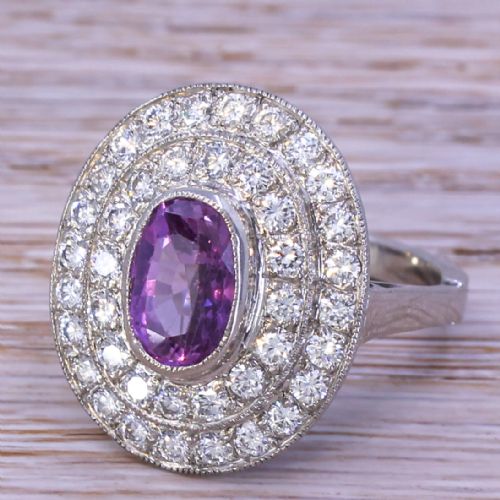
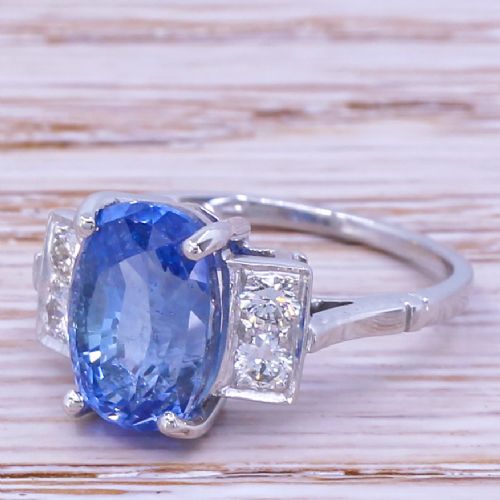
A white platinum gemstone ring combines durable platinum settings with striking centre stones such as sapphire, ruby, diamond, emerald, aquamarine, moonstone, tanzanite and zircon. These pieces span several decades, including the 1920s, 1930s, 1950s and 1960s, alongside later twentieth-century examples.
Buyers most frequently encounter distinct aesthetic movements such as Art Deco, Art Deco Revival, Mid-Century Modern and 1960s designs. Common configurations range from solitary gemstones and cluster arrangements to multi-stone five-stone rings and twist formats.
How they were made
The construction relies heavily on platinum and white gold, often pairing a platinum setting with an eighteen-carat white gold band to secure prominent gemstones safely. This dense, robust metal allows for fine, intricate claw and bezel work without adding unnecessary bulk to the piece.
Gemstones such as old-cut diamonds, unheated sapphires, natural Burmese rubies, Ceylon pink sapphires, and oval emeralds are shaped with var-cut and baguette facets. These stones are meticulously set to maximise light return and colour saturation within the metal framework.
Some mid-century stones have travelled further than the wearer, having formed deep in the earth over millions of years before reaching a London workshop.
What varies in quality
The distinction between tiers rests upon the natural origin, carat weight, and optical purity of the central gemstone, alongside the integrity of the surrounding metalwork. Natural unheated sapphires and certified Burmese rubies sit firmly at the upper end of the scale.
Execution of period styles, such as geometric Art Deco symmetry or fluid Mid-Century lines, dictates the overall refinement. Superior examples maintain crisp piercing and secure stone alignment that withstands generations of handling.
The White Platinum Gemstone Ring Glossary
- Platinum
- A dense, naturally white precious metal prized for its strength and secure holding of gemstones. It develops a soft patina over decades of wear.
- Art Deco
- A design style from the nineteen-twenties and nineteen-thirties characterised by geometric symmetry, stylised motifs, and sharp lines. It frequently pairs diamonds with deep blue sapphires or red rubies.
- Old-cut diamond
- A vintage diamond cutting style featuring smaller tables, higher crowns, and larger facets designed to catch candlelight. These stones display a softer, deeper scintillation than modern brilliant cuts.
- Cluster ring
- A setting style where a central gemstone is surrounded by a border of smaller stones, typically diamonds. This arrangement maximises visual impact and perceived scale on the hand.
- Solitaire
- A ring featuring a single, prominent gemstone mounted on its own. This minimalist approach draws complete focus to the qualities of the main stone.
White Platinum Gemstone Ring: Frequently Asked Questions
How do I care for a platinum ring?
Platinum is exceptionally durable and requires minimal maintenance beyond gentle cleaning in warm soapy water with a soft brush.
The metal develops a natural surface finish known as patina over time, which many collectors prefer for its authentic vintage character.
Can I wear my gemstone ring daily?
Diamonds, sapphires, and rubies possess the hardness required for everyday wear when set securely in robust platinum mountings.
More delicate stones like moonstone or aquamarine benefit from slightly more careful handling to avoid heavy impact.
What defines an Art Deco ring?
Art Deco rings showcase geometric patterns, straight lines, and precise symmetry that reflect the aesthetic of the nineteen-twenties and nineteen-thirties.
They frequently feature high-contrast combinations such as white platinum paired with deep blue sapphires and sparkling diamonds.
How do I identify Mid-Century ring designs?
Mid-century pieces from the nineteen-fifties and sixties often feature organic forms, cluster arrangements, and bold single-stone settings.
These designs move away from strict geometric rigidity towards softer, rounded profiles and varied gemstone cuts.