

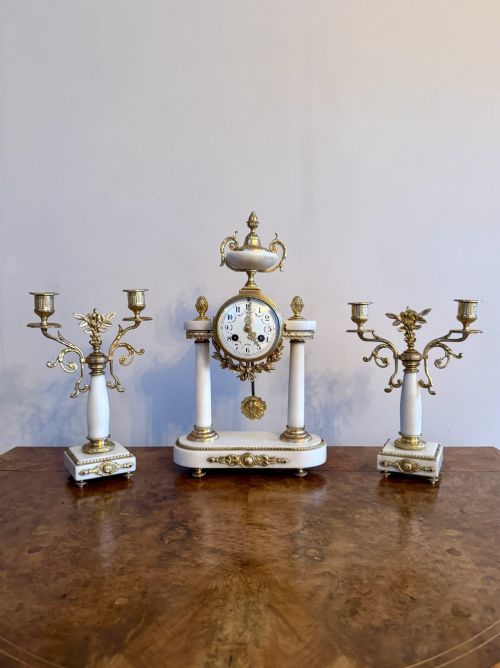
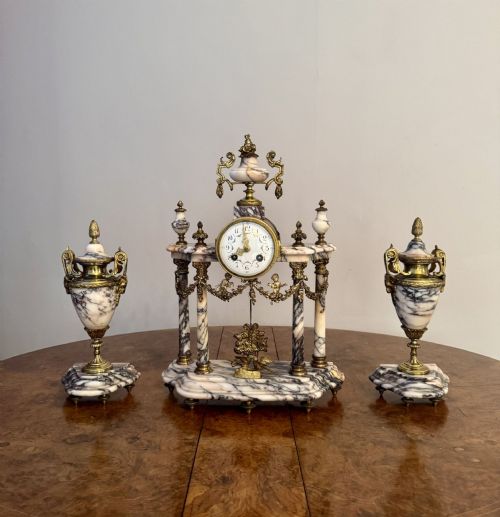


White Marble Portico Clock
These white marble portico clock examples unite neoclassical architectural form with the brilliance of gilded bronze, bringing symmetry and measured grandeur to any mantel.
White Marble Portico Clock
A white marble portico clock rests on columnar supports beneath a classical pediment, creating an architectural elevation that houses a central movement. These pieces emerge from the eighteenth and nineteenth centuries, spanning periods from Directoire and Restoration to Victorian revivals.
Buyers meet mantel clocks and larger garniture sets complete with matching candelabras or side ornaments. The prevalent materials unite white marble or alabaster with ormolu mounts, enamel dials, and glass bezels.
French workshops dominate the surviving examples, often channelling Louis XVI style through columns, urns, and gilt bronze appliqués. Simpler single-fusee models appear alongside elaborate clock sets featuring cherubs and classical detailing.
Materials and construction
Masons shaped white marble and alabaster into slender columns, plinths, and pediments, achieving smooth surfaces that contrast with polished brass and gilt bronze. Founders cast the ormolu mounts separately, chasing the metal details by hand before applying mercury gilding.
Enamelled dials received delicate black numerals and fine metal hands behind protective glass, while brass movements drove the mechanical timekeeping. Makers integrated these heavy stone and metal components with threaded rods and pins to stabilise the elevated portico structure.
White Marble Portico Clock Retail Price Guide 2026
Typical asking prices for white marble portico clock among the pieces listed under this phrase on Sellingantiques today, from the lower quarter to the upper quarter. They describe what is for sale here now, not the wider market.
Listings feature white marble combined with ormolu, brass, alabaster, and gilt bronze across nineteenth-century Victorian and earlier French styles.
Distinctions in quality
Quality rests in the crispness of the gilt bronze chasing and the density of the white marble. Superior examples display deeply chiselled mounts with sharp articulation in the leaf scrolls and figural bronzes, whereas lesser pieces rely on softer, shallower casting.
The integrity of the stone structure and the original matching of the garniture elements set fine items apart from assembled sets. Original enamel dials free of hairline cracks and signed movements by known makers elevate the piece.
Baltazart·Japy Freres·AD Mougin Paris
The White Marble Portico Clock Glossary
- Portico clock
- A clock designed with a raised architectural case supported by columns resembling a classical porch. This symmetrical layout frames the swinging pendulum visible through the centre.
- Ormolu
- Gilded bronze mounts applied to furniture and clock cases for decorative contrast. The technique uses a mercury amalgam fired onto the bronze base to yield a rich, lasting sheen.
- Garniture
- A set of matching decorative objects displayed together on a mantelpiece, usually comprising a central clock flanked by two matching candelabras or vases.
- Fusee
- A conical pulley used in spring-driven clocks to maintain even power as the mainspring unwinds. This mechanism improves timekeeping accuracy across the duration of the wind.
- Directoire
- A transitional French design period bridging the eighteenth and nineteenth centuries. It favours restrained neoclassical lines, austere geometry, and classical motifs.
White Marble Portico Clock: Frequently Asked Questions
How do I wind a portico clock?
Use the designated winding key in the dial holes to turn the springs gently until resistance is felt. Care must be taken not to overwind the movement.
Ensure the pendulum is hung securely on its suspension spring before setting the clock in motion on a level surface.
What is a clock garniture?
A clock garniture is a matched set consisting of a central timepiece accompanied by side ornaments such as candelabras or urns. These sets create a balanced decorative display on a mantelpiece.
Originating in fine European salons, the pieces share identical materials, styles, and gilt bronze mounts.
How do I identify Louis XVI style?
Louis XVI style draws on classical Roman and Greek architecture, featuring straight lines, symmetry, and architectural columns. Decoration includes acanthus leaves, urns, and floral garlands rather than excessive curves.
White marble and ormolu combinations reflect the restrained elegance and structural clarity of this period.
Are these clocks suitable for daily use?
These antique movements function reliably when serviced by a professional clockmaker. Regular maintenance keeps the gear train and escapement operating correctly.
Position the clock away from direct sunlight, drafts, and temperature fluctuations to protect the delicate enamel dial and marble case.