




Waterfall Landscape Painting
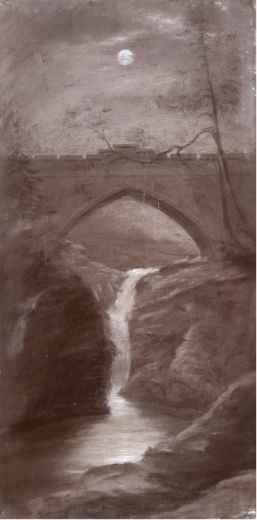
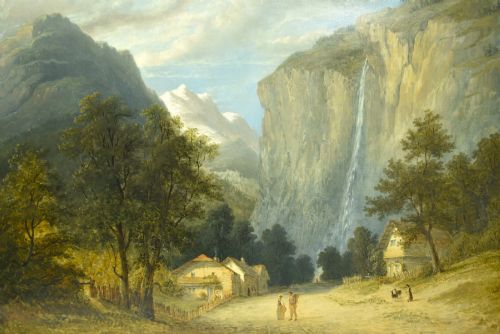
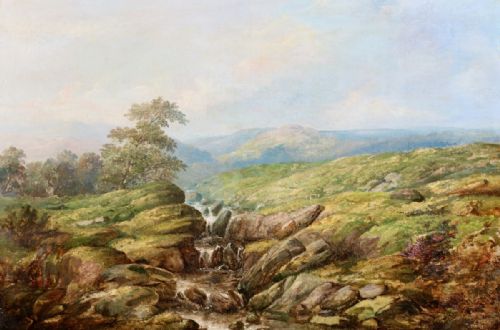
A waterfall landscape painting captures the motion of rushing water within nineteenth-century scenery, offering a romantic view of nature.
Waterfall Landscape Painting
A waterfall landscape painting depicts rivers, streams, and cascades set within mountainous, woodland, or alpine terrain. When exploring a waterfall landscape painting, buyers encounter works executed during the nineteenth century, including Victorian pieces and examples from the eighteen-seventies through nineteen-hundred.
Most examples on this page are oil paintings on canvas or board, alongside historical watercolours. These works span British, Continental, and American subjects, recording locations from North Wales and Scotland to Switzerland and New York State.
Materials and methods
Artists painted primarily in oil on canvas, though watercolour on paper and charcoal on canvas also appear in the record. Canvases are stretched over wooden frames and often housed in original gilded wood or giltwood frames.
Techniques range from detailed realism to atmospheric romanticism, utilising pigments layered to render the churning foam of water against dark boulders and surrounding foliage.
Anglers frequently appear standing patiently beside rushing mountain streams, seemingly undisturbed by the roaring torrents.
Assessing quality
Quality rests upon the artist's ability to render the movement and weight of falling water while establishing atmospheric depth in the surrounding landscape. Skilled brushwork distinguishes dynamic water and convincing rock formations from stiff or formulaic compositions.
The survival of the original gilt frame and the clarity of the artist's signature or attribution further elevate the standing of a canvas.
Alexandre Le Bihan·Clarence Henry Roe·William Mellor·John Syer junior·Frederick Richard Lee·James Poole·Peter de Wint·John Sowden·Axel Nordgren·Thomas Creswick·William James Smith Crampton·John Arthur Dees·Tom Seymour·David Motley
The Waterfall Landscape Painting Glossary
- Oil on Canvas
- Pigments bound in a drying oil applied to a woven fabric support. This was the primary medium for substantial nineteenth-century landscapes.
- Continental School
- A term used for artworks produced by artists trained in mainland Europe rather than Britain. It groups together diverse national traditions from the period.
- Victorian Naturalism
- An artistic approach focusing on the detailed observation of the natural world. Painters working in this style sought accurate depiction of light and terrain.
Waterfall Landscape Painting: Frequently Asked Questions
How do I identify a Victorian waterfall painting?
Victorian waterfall paintings typically date from the nineteenth century and often exhibit romanticism or realism in their treatment of mountains and rivers. Look for period framing and traditional brushwork characteristic of the era.
Subject matter often includes specific British or Alpine locations, sometimes accompanied by figures fishing or crossing bridges in the foreground.
Were these painted outdoors?
Many nineteenth-century landscape artists sketched outdoors to capture accurate geological formations and the motion of water. They then completed the final oil paintings within the studio.
Watercolours were frequently executed on site as direct studies of the cascading streams and surrounding foliage.
What frames are original to these paintings?
Original frames are typically constructed from wood with gilt or gilded finishes reflecting nineteenth-century decorative preferences. These frames were designed specifically for the dimensions of the canvas.
The presence of an original giltwood frame enhances the historical context of the artwork.
How should I care for an antique oil painting?
Keep antique oil paintings away from direct sunlight and fluctuating humidity to protect both the canvas and the wooden stretcher. Dust the surface gently with a soft, dry brush without applying pressure.
Avoid using liquid cleaners on the paint surface or the gilded frame.