

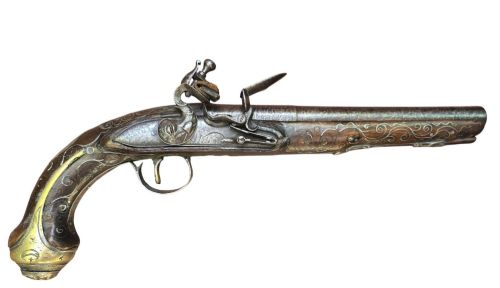


Walnut Stock Flintlock Pistol
These walnut stock flintlock pistol examples combine historical weight with practical mechanics, offering a direct connection to the tactical encounters of the eighteenth and early nineteenth centuries.
Walnut Stock Flintlock Pistol
A walnut stock flintlock pistol represents the standard sidearm of military officers, travellers, and naval personnel during the eighteenth century and the Georgian period. Collectors searching for a walnut stock flintlock pistol will encounter diverse iterations spanning British, French, Italian, German, and Ottoman origins. The variants range from heavy military service pieces to delicate travelling and muff pistols.
The pieces appearing on this page predominantly belong to the eighteenth century, encompassing styles such as Queen Anne, Napoleonic, Georgian Military, and French Rococo. Buyers frequently meet heavy holster pistols featuring brass furniture alongside slender pocket variants inlaid with silver wire. Each walnut stock flintlock pistol serves as a tangible document of contemporary metallurgy and woodwork.
Materials and construction
Makers shaped the stocks of a walnut stock flintlock pistol from dense domestic and continental timber, prized for its resistance to splitting under the stress of discharge. Craftsmen often enhanced these walnut stocks with intricate silver wire inlay, carved relief, or cast brass furniture including butt caps and side plates.
The metal components combine forged steel for barrels, locks, and triggers with brass or iron for mountings. Flint mechanisms required precise hardening of the frizzen and tempering of the mainspring to generate the necessary spark against a piece of flint held in the jaws of the cock.
Walnut Stock Flintlock Pistol Retail Price Guide 2026
Typical asking prices for walnut stock flintlock pistol among the pieces listed under this phrase on Sellingantiques today, from the lower quarter to the upper quarter. They describe what is for sale here now, not the wider market.
The listings on this page feature walnut stock flintlock pistol examples incorporating steel, brass, silver, and flint materials across eighteenth-century styles.
Distinctions in quality
Quality in a walnut stock flintlock pistol rests upon the crispness of the lock engraving, the fidelity of the maker's signature, and the degree of integration between wood and metal. High-tier pieces display finely chiselled lockplates, well-figured timber with minimal shrinkage, and balanced proportions.
Secondary examples show heavier utility manufacturing intended for rugged service rather than gentlemanly display. The presence of original signed locks by established makers elevates a piece above standard military issue.
La Motte·Timothy Hughes·R. Willoughby·John Rimes·Collumbell Of London·Hofmann
The Walnut Stock Flintlock Pistol Glossary
- Flintlock
- A firearm ignition mechanism that uses a piece of flint struck against a steel frizzen to create sparks that ignite priming powder. This system dominated European military and civilian arms for centuries.
- Holster pistol
- A large sidearm designed to be carried in a saddle holster rather than on a belt or inside a pocket. These typically feature substantial bores and robust construction.
- Turn-off pistol
- A firearm featuring a barrel that unscrews from the breech to facilitate loading. This design allows the ball to be loaded directly into the chamber.
- Bore
- The interior diameter of the barrel. In antique arms, bore size often corresponds to the number of lead balls of that diameter which equal one pound.
- Escutcheon
- A small metal plate inlet into the stock, frequently engraved with a crest or initials. These plates also serve to reinforce the pin fastenings holding the barrel.
- Frizzen
- The vertical steel plate struck by the flint to create sparks and uncover the priming pan. Proper hardening of this component determines ignition reliability.
Walnut Stock Flintlock Pistol: Frequently Asked Questions
What is a walnut stock flintlock pistol?
A walnut stock flintlock pistol is a muzzle-loading personal firearm utilising a flint ignition system and a wooden stock made from walnut timber. These pieces date primarily from the eighteenth century and the Georgian era.
They served military, naval, and civilian self-defence roles across Europe and the Ottoman Empire. Surviving examples reflect the regional manufacturing standards of various domestic and international workshops.
How do I identify periods for these pistols?
Period identification relies on lock shape, barrel form, furniture style, and maker signatures. Stylistic markers such as Queen Anne bulbous butts or French Rococo cast brass distinguish eras.
Proof marks and crowned inspector stamps stamped onto the metal components provide further chronological anchor points. Comparing the lock architecture against dated examples helps narrow the production window.
Were these pistols used in combat?
Many examples saw active service in military and naval conflicts during the Georgian and Napoleonic periods. Service pistols issued to dragoon regiments or naval vessels experienced rigorous field conditions.
Conversely, delicate muff pistols and travelling arms served civilian protection needs during stagecoach journeys. Their deployment varied entirely according to the original owner's profession and social standing.
How should I care for a walnut stock flintlock pistol?
Maintenance requires keeping the walnut stock and metal surfaces in stable environmental conditions away from excessive moisture and direct heat. Light applications of museum-grade wax protect the timber and inhibit metal oxidation.
Handling should be minimised, and the lock mechanism should remain uncocked to preserve the tension of the mainspring over time.