




Walnut Marquetry Corner Cabinet
A walnut marquetry corner cabinet brings intricate floral or figural inlay and warm timber tones to an empty room angle.
Walnut Marquetry Corner Cabinet
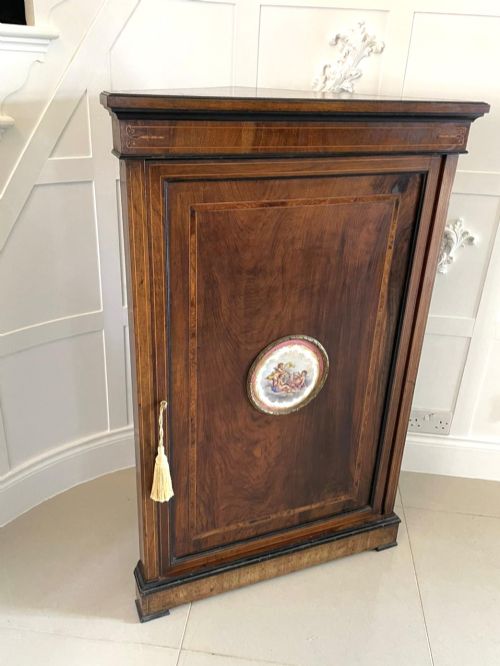
A walnut marquetry corner cabinet is designed to fit snugly into room intersections while displaying elaborate timber veneers and decorative floral or geometric patterns across the exterior surfaces. These pieces serve as functional storage units with shelving concealed behind panelled or glazed doors, making efficient use of difficult angles in traditional interiors.
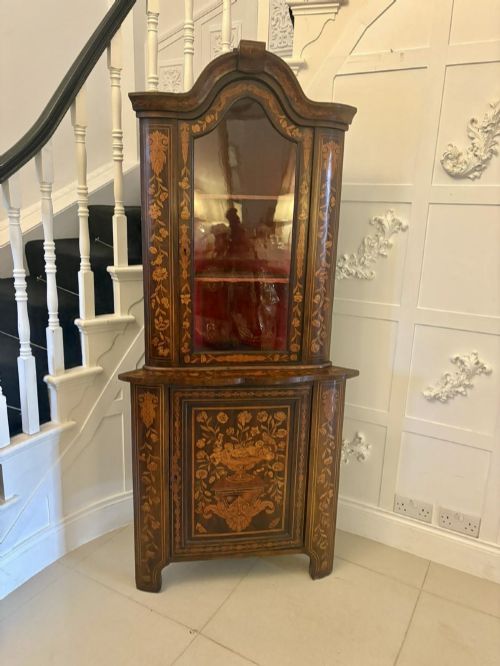
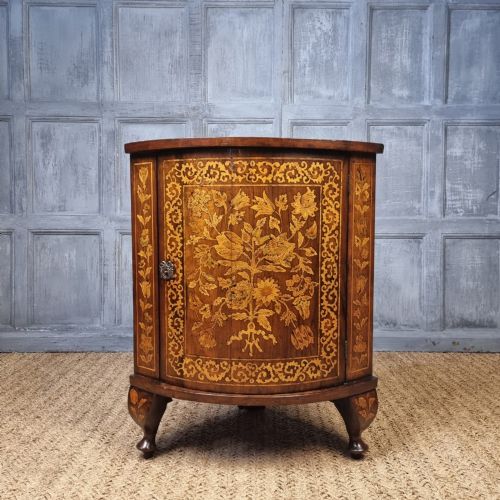
The versions most frequently encountered on this page originate from the eighteenth and nineteenth centuries, spanning Georgian, Victorian, and continental European traditions. Dutch and French stylistic influences predominate among the examples recorded here, often featuring distinctive curved or serpentine fronts and contrasting secondary timbers.
Makers utilised the natural grain and colour variations of walnut to construct these corner cabinets, frequently pairing the primary wood with fruitwood, boxwood, and other light veneers to create detailed pictorial panels. Both wall-hanging cupboards and floor-standing models appear across the inventory, offering diverse proportions to suit various ceiling heights and room dimensions.
Materials and construction techniques
Cabinet makers constructed the foundational carcase from solid structural timbers before applying thin decorative veneers of walnut to the external faces. The distinct patterned sections known as marquetry were meticulously hand-cut from contrasting sheets of fruitwood and boxwood, then assembled like a puzzle before being pressed onto the surface.
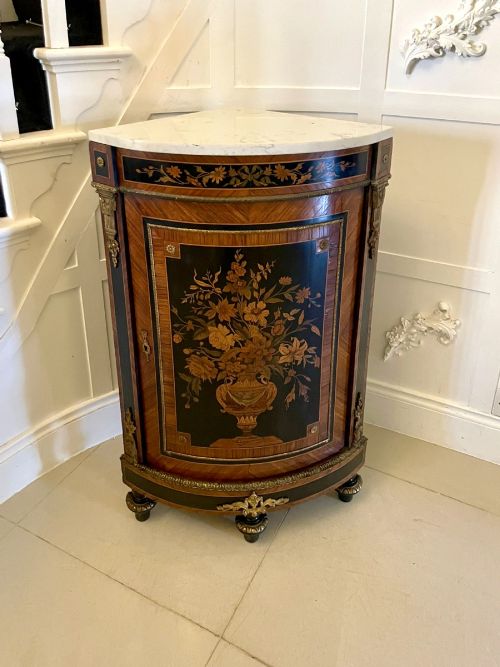
Metal mounts in brass, bronze, or ormolu frequently reinforced key stress points and decorated the edges, escutcheons, and hinges of these cabinets. On specific continental and later nineteenth-century pieces, marble tops provided a durable and polished display surface above the wooden framework.
Walnut Marquetry Corner Cabinet Retail Price Guide 2026
Typical asking prices for walnut marquetry corner cabinet among the pieces listed under this phrase on Sellingantiques today, from the lower quarter to the upper quarter. They describe what is for sale here now, not the wider market.
Listings feature walnut, fruitwood, and boxwood veneers applied across Georgian and Victorian corner cabinets.
Assessing craftsmanship and condition
Quality in a walnut marquetry corner cabinet depends largely on the precision of the veneer work and the complexity of the inlaid motifs. Superior examples display tight, seamless joints within the marquetry panels, where contrasting woods fit together without visible filler or gaps.
The choice of underlying walnut and the depth of its natural figure contribute significantly to the visual appeal of each piece. Finer specimens maintain crisp carving details on mounts and mouldings, alongside well-preserved door alignments and original operational hardware.
The Walnut Marquetry Corner Cabinet Glossary
- Marquetry
- The decorative craft of applying small pieces of veneer to a structural carcase to form pictorial or geometric designs. This technique relies on contrasting timber colours and grains to create visual depth.
- Serpentine
- A furniture front shaped with a central convex curve flanked by two concave curves. This contour requires skilled woodworking to ensure the doors close flush against the frame.
- Ormolu
- Gilded bronze mounts applied to furniture edges and corners for decorative effect. The metal is cast and then treated with a gold amalgam or finish.
- Boxwood
- A dense, pale yellow wood frequently utilised in marquetry for highlights and delicate stems. Its fine grain permits intricate cutting without splintering.
Walnut Marquetry Corner Cabinet: Frequently Asked Questions
How do I clean walnut marquetry?
Dust the surfaces regularly with a soft, dry cloth to prevent dirt accumulation in the fine veneer joints. Apply a traditional beeswax sparingly to nourish the timber and maintain a gentle sheen.
Avoid using liquid polishes containing silicone or heavy solvents, which can penetrate old veneer seams and loosen the historic glue beneath.
Can these cabinets hold heavy items?
Internal shelving is generally constructed to support standard decorative objects, books, or tableware suited to display cabinets. Distribute weight evenly across the shelves to protect the historical timber supports.
Floor-standing models offer greater structural stability for heavier loads than wall-mounted or hanging variants, which rely entirely on secure wall fixings.
Where should I place a corner cabinet?
Position the unit in an unused room angle where its angled back fits flush against intersecting walls. Ensure the room environment avoids direct sunlight and extreme humidity fluctuations to protect the delicate veneers.
Allow sufficient clearance for the doors to swing open fully without striking adjacent furniture or wall mouldings.
How can I tell Dutch from English styles?
Dutch examples often feature more exuberant floral marquetry covering the entire exterior, frequently paired with serpentine or bombé forms. English pieces tend towards restrained inlaid borders and simpler geometric or architectural door panels.
Examine the secondary woods inside the carcase, as regional workshops typically employed local timber varieties that differ between Britain and continental Europe.