

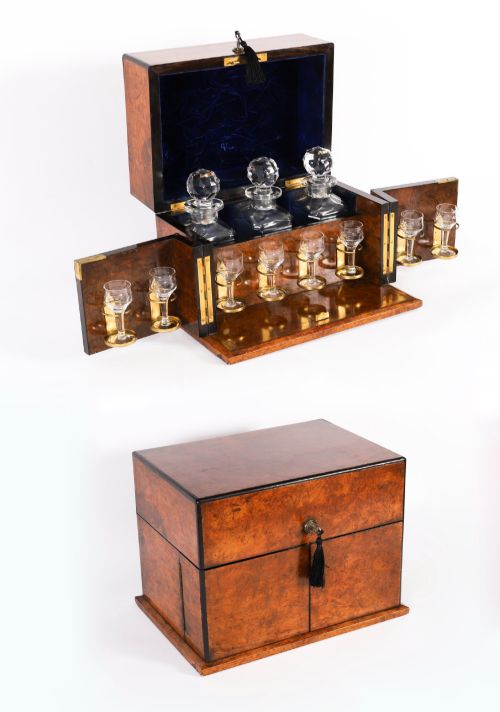


Walnut Locking Box
A walnut locking box offers secure storage for valuables, letters and private collections, crafted from rich timber with working locks and keys.
Walnut Locking Box
A walnut locking box is a fitted container designed to safeguard documents, jewellery, tobacco or spirits behind a secured lid or door. When you search for a walnut locking box, you encounter diverse forms ranging from Georgian tea caddies and Victorian writing slopes to cigar cabinets, tantalus sets and desk safes.
The most common examples on this page date from the Victorian and 18th century periods, executed in plain walnut, burr walnut or figured timber. These pieces often incorporate brass mounts, velvet linings and internal secret drawers or compartments designed to keep personal effects private.
Materials and construction
Makers utilised solid walnut and burr walnut veneers applied to secondary timbers, selecting the grain for its rich figuring and depth. Boxes frequently feature brass binding, escutcheons and specialised locking mechanisms such as Bramah or Chubb systems operated by fitted keys.
Internal fittings incorporate materials like boxwood inlay, velvet, cut crystal decanters and steel components for mechanical security. Construction methods rely on precision joinery suited to housing stationery, writing slopes, razors, firearms or glass decanters.
Walnut Locking Box Retail Price Guide 2026
Typical asking prices for walnut locking box among the pieces listed under this phrase on Sellingantiques today, from the lower quarter to the upper quarter. They describe what is for sale here now, not the wider market.
Listings feature walnut locking boxes spanning the 18th century, the Victorian era, 1880, 1890, and the 1920s Art Deco period.
Evaluating quality and execution
Quality rests in the selection of the walnut timber, particularly the liveliness of burr figures and the precision of any boxwood inlay. Superior examples display careful timber matching across the surfaces and robust internal organisation.
The sophistication of the hardware distinguishes finer pieces, notably the inclusion of fully functioning branded locks with matching keys and secret drawers. The integrity of internal fittings, whether crystal decanters, velvet pads or fitted compartments, elevates the standard of the piece.
Waring and Sons·JH Browne·J Robinson
The Walnut Locking Box Glossary
- Burr walnut
- Timber taken from a tree growth that produces intricate, swirling grain patterns. It is sliced into veneers to adorn the exterior surfaces of luxury boxes.
- Bramah lock
- A high-security patented lock invented by Joseph Bramah in the late eighteenth century. It uses a cylindrical key and sliding tabs to secure valuable contents.
- Writing slope
- A box with a slanted lid that folds open to form a slanted writing surface. Inside, it provides storage for paper, inkwells and pens.
- Tantalus
- A locking wooden frame holding decanters visible to the eye but prevented from removal without a key. It typically houses cut crystal bottles for spirits.
- Escutcheon
- A decorative brass plate surrounding a keyhole. It protects the surrounding wood from wear and enhances the visual appearance of the lock.
Walnut Locking Box: Frequently Asked Questions
What fits inside a walnut locking box?
These boxes accommodate a wide range of personal items depending on their internal configuration. Many contain fitted compartments for writing instruments, documents, correspondence or jewellery.
Other variants are specifically designed to hold cigars, shaving gear, flintlock pistols or crystal decanters for spirits.
How can I tell the period of a walnut box?
Dating relies on observing construction methods, timber preparation and hardware styles. Eighteenth-century examples often feature simpler, heavier walnut carcases with basic brass plates.
Victorian and later pieces frequently display burr veneers, complex internal mechanisms, secret drawers and refined brass binding or Bramah locks.
How should I care for antique walnut wood?
Walnut timber benefits from stable indoor humidity away from direct heat sources and strong sunlight, which can fade the rich grain and dry out the wood. Regular dusting with a soft, dry cloth preserves the finish.
Applying occasional appropriate wax polish helps maintain the lustre of the walnut and protects the antique surface.