

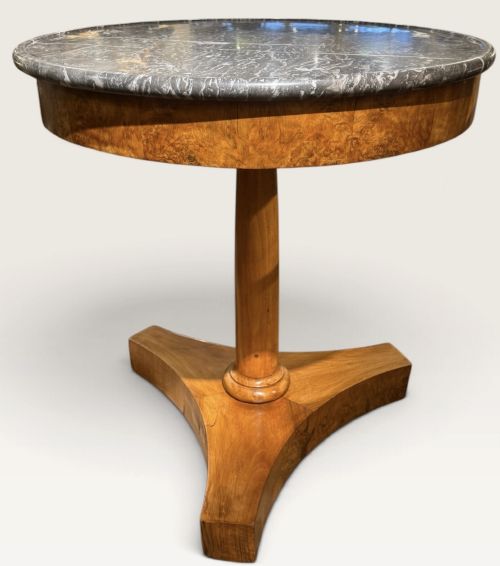


Walnut Circular Gueridon
A walnut circular gueridon brings French elegance to any room, offering a small, versatile table surface rooted in classical design.
Walnut Circular Gueridon
When you search for a walnut circular gueridon, you are looking at small French tables designed to stand freely in a room rather than against a wall. These pieces function as centre tables, side tables, and occasional tables, serving both decorative and practical purposes.
The versions you are most likely to meet on this page date from the nineteenth century into the early twentieth century. They draw upon various historical French aesthetics, including Louis XVI Revival, Empire, and Art Deco Modernist styles.
Makers and workshops utilised rich timber grains and contrasting inserts to create visually striking surfaces. Many examples incorporate inset marble tops and small drawers, balancing utility with refined French craftsmanship.
How they were made
Cabinet makers utilised walnut, burr walnut, and fruitwood as the primary timbers for these frames. Figured veneers and intricate inlay work provide the characteristic rich patterns across the circular tops and pedestals.
Many of these tables incorporate heavy marble slabs fitted into the wooden rims. Brass, ormolu, and glass details frequently appear as mounts and decorative trims around the edges and legs.
Walnut Circular Gueridon Retail Price Guide 2026
Typical asking prices for walnut circular gueridon among the pieces listed under this phrase on Sellingantiques today, from the lower quarter to the upper quarter. They describe what is for sale here now, not the wider market.
Some tables include small hidden drawers just beneath the rim, perfect for storing secret love letters.
What varies in quality
The choice and cut of the walnut veneer dictates much of the visual depth. Highly figured timber and burr walnut display richer grain patterns than plain sawn surfaces.
The integration of materials like marble and cast metal mounts separates standard production from finer pieces. Precise fitting of marble slabs and crisp detailing in brass or ormolu reflect the maker's skill.
Michel Dufet
The Walnut Circular Gueridon Glossary
- Gueridon
- A small French table, typically round and supported by a central pillar or a set of legs. These pieces originated in the seventeenth century and evolved through various revival styles.
- Ormolu
- Gilt bronze mounted onto furniture as decorative hardware and trim. This technique was widely utilised in French cabinet making during the nineteenth century.
- Burr walnut
- A specialised cut of walnut timber featuring swirling knot formations. Cabinet makers prized this wood for its decorative grain patterns on table tops.
- Marble top
- A polished stone slab inset into the wooden frame of a table. This surface provided a durable and cool area for serving drinks or displaying objects.
Walnut Circular Gueridon: Frequently Asked Questions
What is a walnut circular gueridon used for?
These pieces serve as occasional tables, wine tables, or centre tables in living spaces. Their compact circular shape allows them to sit easily beside seating or in the middle of a room.
Historically, they held small lamps, decorative objects, or refreshments. Today, collectors utilise them in similar ways to add French character to traditional or modern interiors.
How do I date a walnut circular gueridon?
Dating relies on observing stylistic details, construction methods, and materials. Nineteenth-century examples often display revival motifs like Louis XVI or Empire influences.
Later pieces from the 1920s and 1930s shift towards cleaner lines and modernist forms. Comparing the wood finishing and mount quality helps narrow down the period of production.
Are these tables always made of solid walnut?
Most examples utilise a combination of solid timbers and applied veneers over a secondary wood core. Figured and burr walnut veneers were standard practice to achieve decorative surfaces without structural warping.
Secondary woods like fruitwood or mahogany often support the internal framing and drawer construction. The visible surfaces showcase the primary walnut grain.
Did all gueridon tables come with marble tops?
Marble tops appear frequently on nineteenth-century examples, though many other variations feature plain or inlaid wood surfaces. The choice of top depended on the intended function and the specific revival style.
Tables intended for serving or general use often received stone inserts for durability. Other versions highlight the natural beauty of figured timber across the entire top.