
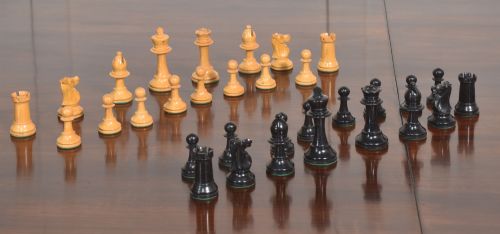


Vintage Wooden Chessmen
These vintage wooden chessmen are tactile relics of past matches, offering collectors heavy weighted forms and rich traditional boxwood and ebony grains.
Vintage Wooden Chessmen
When you search for vintage wooden chessmen, you are looking at complete chess sets and folding boards spanning the nineteenth century through the Edwardian era. The most common examples you will meet on this page are Staunton pattern sets, along with Calvert pattern and miniature variants.
The listings draw from Victorian, late Victorian, and Edwardian periods, featuring makers such as F. H. Ayres, the British Chess Company, and Whitty. These sets frequently arrive housed in games boxes or accompanied by folding chess boards.
How they were made
Craftsmen shaped these chessmen primarily from boxwood paired with contrasting ebony, ebonised wood, rosewood, or mahogany. Many of these pieces incorporate lead weighting to improve stability during play, often lined with felt on the bases.
Makers utilised precise turning and carving techniques on the wood, yielding uniform yet hand-finished Staunton and Calvert patterns. Bone also appears in select compositions alongside the predominant wooden media.
The listings on this site span the nineteenth century, Victorian, and Edwardian periods, utilising boxwood, ebony, mahogany, bone, and brass.
What varies in quality
Quality separates ordinary sets from exceptional ones through the precision of the turnery on the knights' carved heads and the uniformity of the weighting. Finer examples display crisp detail in the crowns, mitres, and rooks, bearing attribution to recognised makers like F. H. Ayres or the British Chess Company.
The choice of materials dictates the upper tier of the range, where true ebony and finely grained boxwood supersede ebonised alternatives. Preservation of the original felt pads and matching games boxes also elevates a set's standing.
F. H. Ayres·British Chess Company·Whitty
The Vintage Wooden Chessmen Glossary
- Staunton
- The standard design for chess pieces created in the mid-nineteenth century, featuring realistic architectural forms for the major pieces. It remains the definitive pattern for tournament play.
- Boxwood
- A dense, pale wood traditionally used for the lighter pieces in a chess set. Its fine grain takes intricate carving exceptionally well.
- Ebonised wood
- Fruitwood or another pale timber stained black to imitate ebony. It offered a cost-effective alternative for the darker pieces in nineteenth-century sets.
- Calvert pattern
- An early nineteenth-century English chess set style characterised by distinctive turned and incised details, particularly on the rooks and pawns.
Vintage Wooden Chessmen: Frequently Asked Questions
How can I date my chessmen?
Dating vintage wooden chessmen involves examining the turning style of the rooks, the carving of the knights, and the materials used. The introduction of the Staunton pattern in the mid-nineteenth century provides a firm starting point for many sets.
Makers' marks, lead weighting methods, and accompanying boxes or folding boards further help narrow down whether a set originates from the Victorian or Edwardian era.
Why are some pieces weighted?
Weighting was added to the base of nineteenth-century chessmen to improve stability and tactile feel during fast-paced or competitive play. Makers embedded lead into the turned wooden bases to prevent the pieces from tipping easily.
Weighted sets, particularly those bearing maker attributions, were intended for serious library and club use rather than casual travel.
How do I care for wooden chess pieces?
Wooden chessmen require a stable indoor environment away from direct sunlight and extreme humidity fluctuations to prevent the timber from splitting. Occasional gentle cleaning with a soft, dry cloth preserves the original polish of the boxwood and ebony.
Storing the pieces in a dedicated games box or lined compartment protects the delicate carved details of the knights and rooks from accidental damage.