

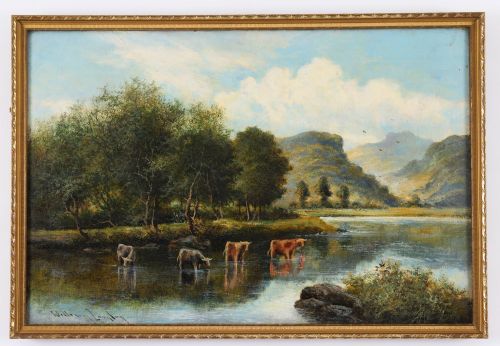
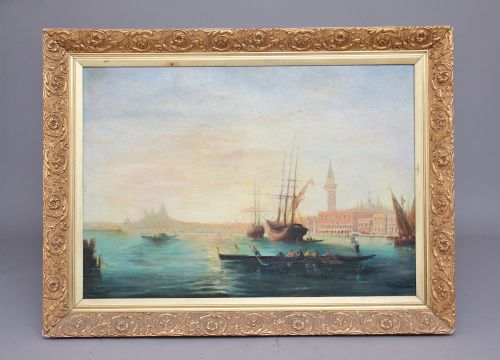


Vintage Water Landscape Art
Vintage water landscape art brings rivers, canals, lakes, and coasts into view through oil and watercolour paintings.
Vintage Water Landscape Art
When you search for vintage water landscape art, you meet oil paintings and watercolour paintings depicting rivers, canals, seascapes, and lakes. The selections span the nineteenth century through the mid-twentieth century, encompassing Edwardian works, French Impressionism, and Victorian marine art.
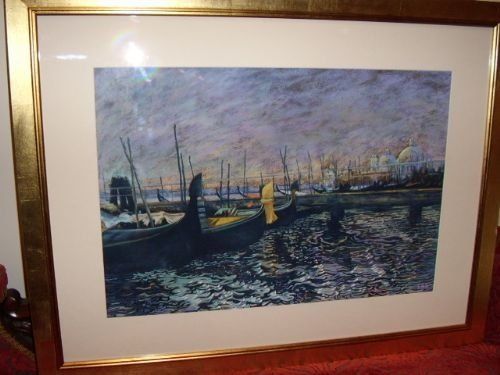
The versions most common on this page are framed works on paper, canvas, and wood panels. Painters recorded scenes ranging from Venetian lagoons and the River Humber to French countryside rivers and mountain lakes.
Makers and artists documented in the records include Antonio DeVity, William Frederick Settle, Mario Pinetti, Percy Robertson, Alfred Grey, Fred Stead, Armand Guillaumin, Edith E Caswall, William Knox, William Boyce, Tom Dudley, Yves Brayer, Adolphe Gumery, Rene His, Charles Edmund Rene His, Charles Clement Calderon, Albert Pile, Fred Lawson, John Arthur Dees, Orlando Greenwood, Butler, Cecil Arthur Hunt, A E Martin, and W H Dyer.
How They Were Made
Artists applied oil paint and watercolour onto paper, canvas, wood panels, and glass, secured in framed formats with gilt elements. Painters utilised techniques associated with impressionism and post-impressionism to capture light upon water surfaces, rivers, and coastal scenes.
Substrates varied between absorbent paper for fluid watercolours and textured canvas or wood for heavier oil applications. Works frequently display brushwork characteristic of French and Italian impressionist styles alongside British landscape traditions.
Vintage Water Landscape Art Retail Price Guide 2026
Typical asking prices for vintage water landscape art among the pieces listed under this phrase on Sellingantiques today, from the lower quarter to the upper quarter. They describe what is for sale here now, not the wider market.
Listings feature works created across the 19th Century, Edwardian period, 1910, 1920, 1930, 1950, and 1960 using oil, watercolour, canvas, paper, and wood.
What Varies In Quality
Quality rests in the handling of light, atmospheric depth, and the natural movement of water across the composition. Stronger examples demonstrate confident brushwork and tonal balance that define the reflection of sky and light upon rivers, canals, and seas.
Material preservation dictates the integrity of the piece, distinguishing works with stable pigments and preserved paper or canvas from those showing environmental degradation. The directness of the artist's touch on the medium separates standard decorative items from accomplished paintings.
Antonio DeVity·William Frederick Settle·Mario Pinetti·Percy Robertson·Alfred Grey·Fred Stead·Armand Guillaumin·Edith E Caswall·William Knox·William Boyce·Tom Dudley·Yves Brayer·Adolphe Gumery·Rene His·Charles Edmund Rene His·Charles Clement Calderon·Albert Pile·Fred Lawson·John Arthur Dees·Orlando Greenwood·Cecil Arthur Hunt·A E Martin·W H Dyer
The Vintage Water Landscape Art Glossary
- Watercolour
- A paint consisting of colour pigments suspended in a water-soluble vehicle. Artists apply these washes onto paper to achieve translucent effects.
- Oil on Canvas
- A painting medium where pigments are bound with drying oils applied to stretched fabric. This technique allows for rich textures and layered tones.
- Impressionism
- A nineteenth-century art movement characterised by relatively small, thin, yet visible brush strokes. It emphasises accurate depiction of light in its changing qualities.
- Gilt
- A gold leaf or gold paint application used on frames to enhance the visual presentation of the artwork. This finish reflects light around the perimeter of the canvas.
Vintage Water Landscape Art: Frequently Asked Questions
What subjects appear in these paintings?
The artworks depict water scenes including Venetian canals, rivers, shipping vessels, lakes, and coastal landscapes. Painters recorded specific waterways across Britain, France, Italy, and Ireland.
Compositions range from calm rural rivers and water lilies to choppy seas and bustling port areas.
How do I care for watercolour art?
Watercolour paintings require protection from direct sunlight to prevent fading of the pigments on paper. Displaying them behind glass in stable indoor environments prevents moisture damage.
Keep frames away from damp walls and extreme temperature shifts.
How do oil paintings differ from watercolours?
Oil paintings utilise slow-drying oils on canvas or wood, creating heavier textures and opaque layers of colour. Watercolours use water-soluble binders on paper, producing transparent washes.
Oils generally tolerate different framing requirements than works on paper.
What periods do these pieces represent?
The selections span the nineteenth century, Edwardian era, and mid-twentieth century. Dates range from Georgian and Victorian periods through to the 1950s and 1960s.
Styles shift from traditional marine art to various forms of impressionism.