


Vintage Walnut Music Rack
These vintage walnut music racks are timber-turned pieces holding scores and periodicals, sought after for bringing mid-nineteenth-century warmth to a room.
Vintage Walnut Music Rack
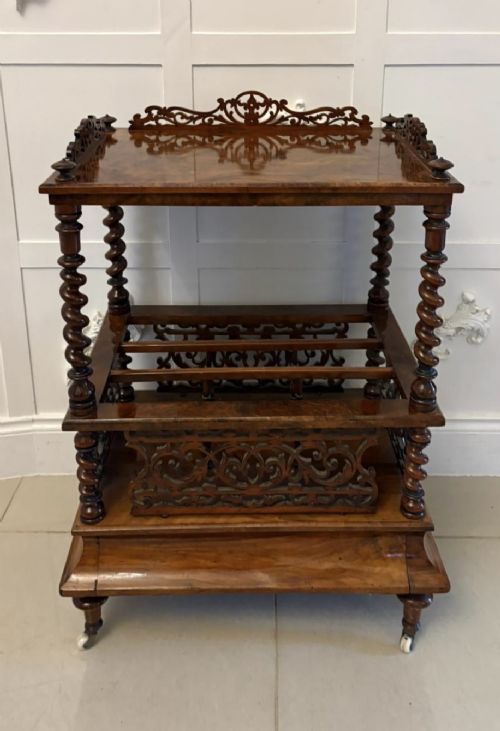
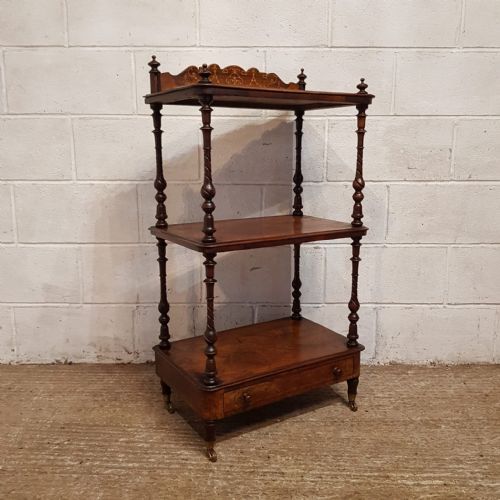
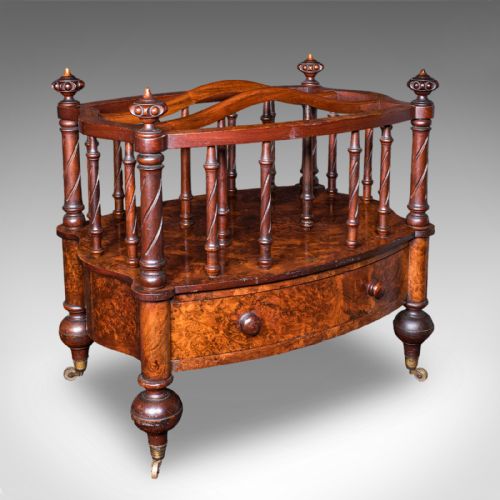
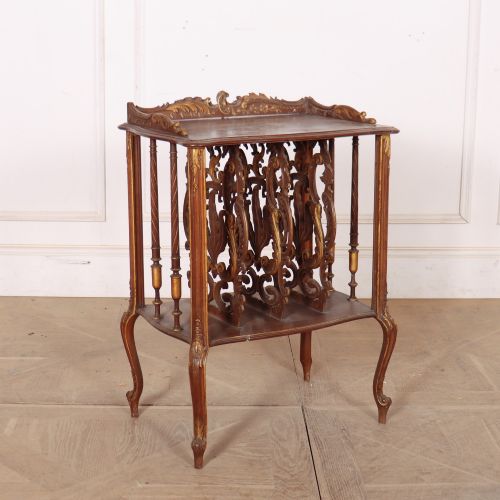
A vintage walnut music rack comprises traditional canterburys, music stands, and tiered whatnots designed to hold sheets, folios, and newspapers. The items on this page span the Victorian and Regency periods, alongside French rococo revival examples.
Most pieces encountered here are burr walnut canterburys, often combined with an occasional table, lamp table, or bottom drawer. These items range from simpler black walnut constructions to richly decorated nineteenth-century forms.
Originating primarily from English and French workshops, these furnishings combine compartmentalised storage with display surfaces. Buyers find them serving equally well beside pianos or as standalone lamp tables.
How they were made
Cabinet-makers built these stands using solid walnut and figured burr walnut veneers, which show deep, swirling grain patterns across the tops and divisions. Boxwood inlay and marquetry enrich many of the Victorian panels.
Makers incorporated turned brass castors, ceramic wheels, and gilt details to support the heavy timber frames and allow movement across carpets. Leather elements and carved ornamentation appear on select French and English iterations.
Many pieces roll quietly on tiny ceramic wheels, ready to follow the pianist from the drawing room to the parlour.
What varies in quality
The distinction between standard and superior pieces rests on the choice of timber figure, such as highly figured burr walnut against plain dark walnut. Finer examples display meticulous boxwood inlay and intricate marquetry work rather than simple turned bars.
Structural complexity marks the upper tier of these items, seen in combinations featuring drawers, multi-tiered whatnot shelving, or oval lamp table tops. The finesse of the turned spindles and the integration of brass castors reveal the maker's hand.
The Vintage Walnut Music Rack Glossary
- Canterbury
- A low stand with vertical partitions designed for holding sheet music, folios, and periodicals. It frequently includes a drawer at the base.
- Burr Walnut
- A distinctive timber veneer taken from the warted growths on walnut trees, prized for its swirling, highly decorative grain patterns.
- Marquetry
- The art of applying pieces of veneer to a structure to form decorative patterns and pictures. It appears on several Victorian surfaces here.
- Whatnot
- An open set of tiered shelves used for displaying ornaments or holding books and papers. Examples often combine this shelving with a canterbury base.
- Regency
- A stylistic period spanning the early nineteenth century, characterised by classical restraint and elegant proportions.
Vintage Walnut Music Rack: Frequently Asked Questions
What is a canterbury music rack?
A canterbury is a compartmentalised stand created specifically to keep sheet music and folios organised and upright.
Over time, these pieces evolved to hold newspapers and magazines while doubling as occasional tables.
How do I date a walnut music rack?
Dating relies on observing the structural style, timber choices, and decorative details like boxwood inlay or marquetry.
Victorian and Regency examples each display distinct turning styles and proportions typical of their decade of manufacture.
Where should I place a music rack at home?
These racks sit comfortably beside pianos, armchairs, or sofas to hold current reading materials close at hand.
Pieces with oval tops also function effectively as lamp tables in a corner or beside a fireplace.
Are these racks sturdy enough for heavy books?
Solid walnut and burr walnut construction provides robust support for standard sheet music, folios, and magazines.
Their sturdy timber partitions and substantial bases are built to bear the weight of stacked periodicals without bending.