


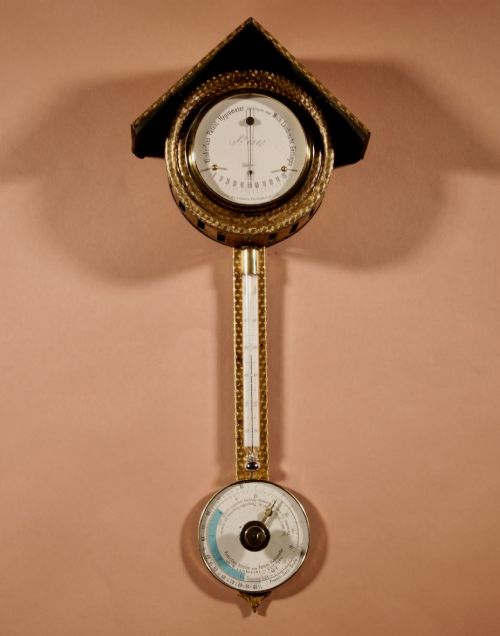


Vintage Wall Gauge
A vintage wall gauge offers precise atmospheric measurement housed in timber or metal cabinetry designed to hang directly in a domestic room.
Vintage Wall Gauge
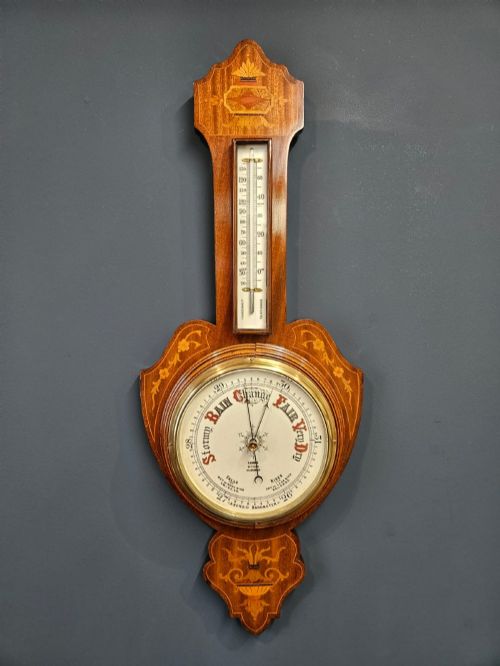
A vintage wall gauge encompasses functional scientific instruments used to measure atmospheric pressure, temperature, humidity, and altitude within domestic and industrial spaces. The pieces appearing most frequently across this selection are barometers and wall thermometers originating from the Victorian and Edwardian periods.
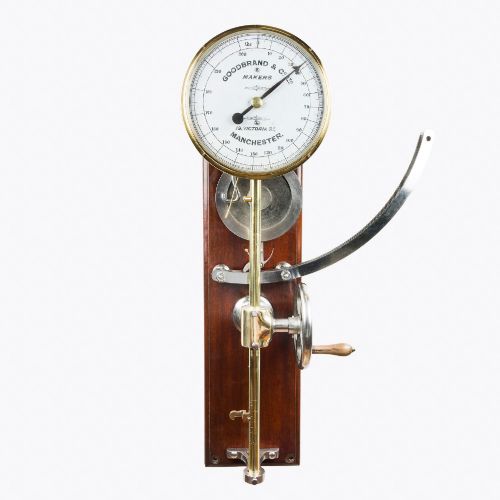
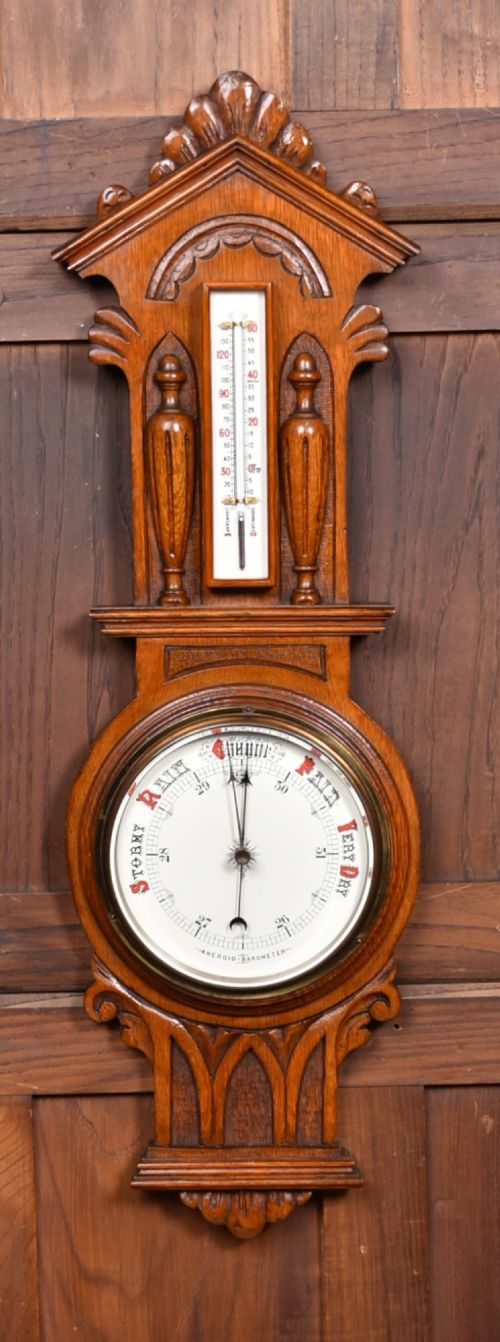
These instruments take various structural forms, ranging from traditional mahogany banjo barometers to circular oak aneroid dials and specialised hygrometers. The selection draws together domestic weather-recording devices alongside heavy industrial pressure gauges mounted for wall display.
Materials and construction
Cabinetmakers constructed the wooden housings using dense timbers such as mahogany, oak, walnut, rosewood, and beech, frequently employing marquetry inlay or ebonised finishes for decorative effect. Brass and steel provide the structural mountings and bezels, whilst fragile glass protects the delicate circular paper or ceramic dials.
Internal mechanisms rely upon sensitive aneroid capsules, mercury columns, or hair hygrometer strands to register environmental shifts. Master instrument makers fitted these brass and steel components with precision gears linked directly to visible pointer needles.
Vintage Wall Gauge Retail Price Guide 2026
Typical asking prices for vintage wall gauge among the pieces listed under this phrase on Sellingantiques today, from the lower quarter to the upper quarter. They describe what is for sale here now, not the wider market.
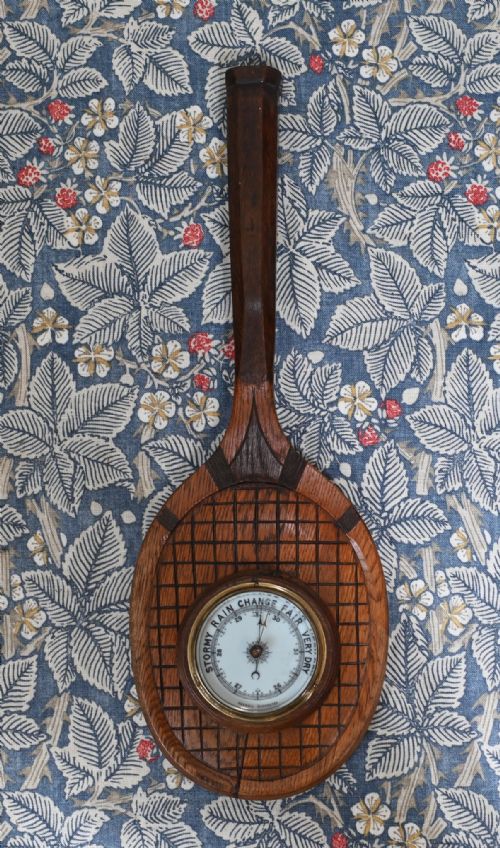
A tennis racquet club commissioned at least one aneroid barometer to hang proudly beside the court.
What separates the finest examples
Quality rests upon the precision of the internal mechanical movement and the caliber of the workshop that signed the dial. Instruments produced by established scientific makers command greater attention due to their superior calibration accuracy and complex mechanisms.
The choice of cabinet wood and the crispness of any applied carving or inlay dictate visual merit. Intricately carved Black Forest frames or finely figured mahogany cases indicate a higher grade of production than plain utilitarian housings.
Goodbrands and Co·Wilh Lambrecht Gottingen·Poulenc Freres of Paris·Short and Mason London·George Adams of Fleet Street·Dewrance of London·Alexander Wright·Cox of Plymouth Dock·James H Kelly of Glasgow·Blake and Son·Dollond of London
The Vintage Wall Gauge Glossary
- Aneroid barometer
- An instrument that measures atmospheric pressure without liquids by utilising a flexible metal capsule. Changes in pressure cause the capsule to expand or contract, moving a pointer across a graduated dial.
- Hygrometer
- A device designed to measure relative humidity in the air. Examples in the inventory utilise human hair to register moisture fluctuations.
- Banjo barometer
- A domestic weather instrument housed within a distinctive elongated wooden case shaped roughly like a banjo. This form typically combines a dampening thermometer with a large circular dial.
- Skeletonised
- A design exposing the internal brass plates, wheels, and gears of the movement behind a glass face. This layout allows the observer to view the mechanical operation directly.
Vintage Wall Gauge: Frequently Asked Questions
How do aneroid barometers work?
An aneroid barometer uses a sealed corrugated metal box called an aneroid capsule that expands or contracts as atmospheric pressure changes. Mechanical linkages connect this capsule to the pointer needle on the visible dial.
Because the movement contains no liquid, these instruments can hang securely upon a wall in any orientation without leaking. The mechanism requires occasional calibration against a known local pressure standard to maintain accuracy.
Where should a wall barometer hang?
These instruments function best when mounted on interior partition walls away from direct sunlight, heating radiators, and damp exterior stone. Stable ambient temperatures ensure the internal metal components record true barometric shifts rather than localized thermal expansion.
Selecting a stable location also protects delicate wooden cabinet veneers and glass dial covers from accidental knocks in busy household corridors.
What is a hair hygrometer?
A hair hygrometer measures humidity by tracking the natural physical expansion and contraction of human hair strands as moisture levels rise and fall in the room. The treated hair connects directly to a pivoted pointer indicator.
Developed during the nineteenth century, these delicate instruments provide a direct visual reading of atmospheric humidity without requiring electrical power.
How do I date a Victorian barometer?
Dating relies upon examining the maker's signature, the typography of the dial paper, and the prevailing furniture style of the wooden case. Victorian examples frequently feature robust mahogany or walnut frames with distinct nineteenth-century dial layouts.
Maker signatures referencing specific London or provincial addresses often allow for precise chronological placement within the broader Victorian era.