





Vintage Travel Alarm Clock
These vintage travel alarm clocks are practical timepieces of brass, chrome, and leather designed to keep time on the move.
Vintage Travel Alarm Clock
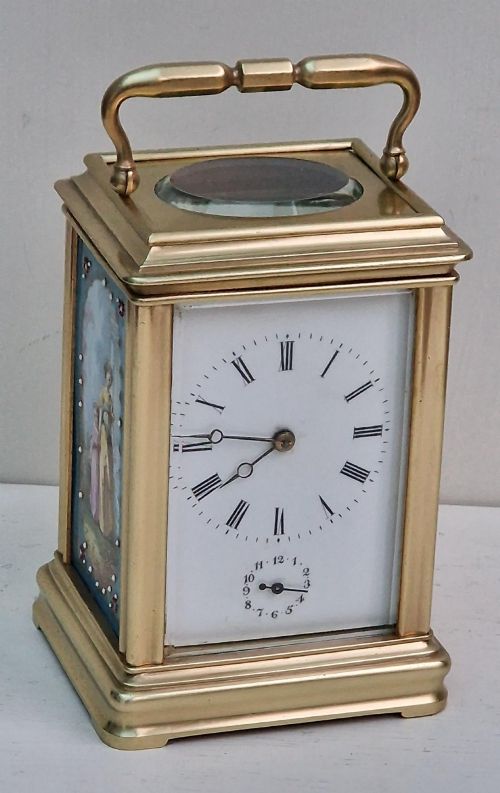
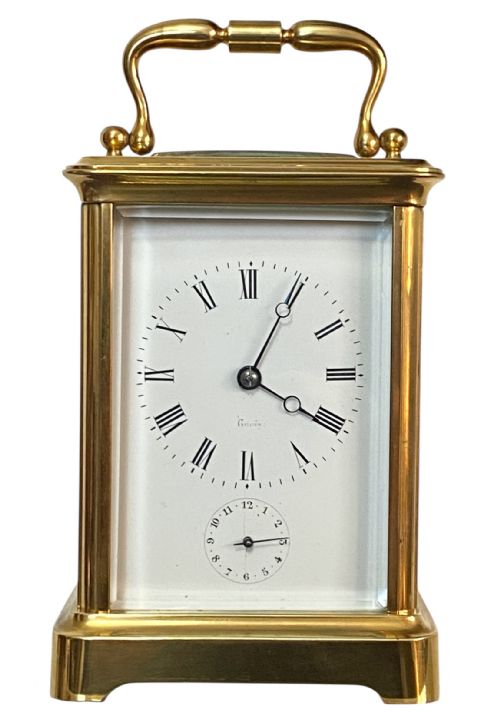
A vintage travel alarm clock is typically encountered as a compact carriage clock or a folding Art Deco timepiece housed in a protective case. These instruments span periods from the Victorian era to the 1930s, featuring heavy metal frameworks designed for portability.
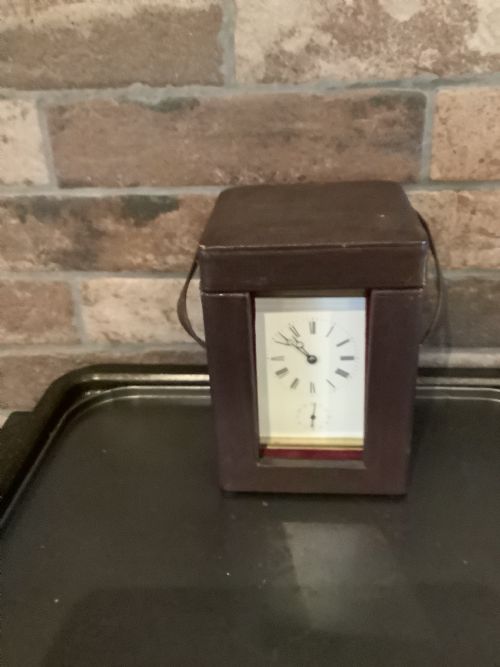
The selections range from French brass carriage models with alarm complications to polished chrome pieces by notable makers. Many retain their original leather or fitted cases, reflecting their intended use on nineteenth-century railways and twentieth-century journeys.
Materials and construction methods
Cases utilise brass, gilt bronze, and chrome-plated steel to protect the delicate mechanical movements inside. Glass panels or porcelain inserts are fitted into the frames to allow visibility of the dial and escapement.
Makers employed fine engraving and polishing techniques on the metal components, alongside leather tooling for the protective outer cases. The movements incorporate intricate gear trains for the striking and alarm functions.
Early travellers trusted their punctuality to brass boxes that weighed as much as a small dog.
Distinctions in craftsmanship and execution
Quality separates standard production timepieces from examples featuring complications such as grand sonnerie striking or petite sonnerie quarter-chiming. The depth and precision of hand-engraving across the brass sides indicate the level of workshop skill involved.
The presence of an original signed movement, matching case, and retained leather outer housing elevate a piece significantly. Heavier gilt bronze castings and complex repeater mechanisms demonstrate superior manufacturing standards.
Antoine Redier of Paris·Harrods of London·Drocourt·Van Cleef and Arpels·J. F. Bautte Et Cie·Bourdin, Paris·Hunt and Roskell·E. White·Jaz·Bayard
The Vintage Travel Alarm Clock Glossary
- Carriage clock
- A portable spring-driven timepiece developed for travel in the nineteenth century, usually featuring a rectangular brass case with glazed sides.
- Gorge case
- A distinctively shaped carriage clock case style characterised by stepped mouldings to the top and base.
- Repeater
- A mechanism that chimes the hours and quarters on demand when a button or pendant on the case is depressed.
- Grande sonnerie
- A complex striking train that automatically chimes the hours and quarters on every quarter-hour, often combined with an alarm.
- Corniche
- A traditional rectangular carriage clock case design with simple rounded pillars at each corner.
Vintage Travel Alarm Clock: Frequently Asked Questions
How do I wind a mechanical travel clock?
Most models use a dedicated key inserted into square arbours on the backplate to tension the mainsprings for timekeeping, striking, and alarm functions.
Care should be taken not to overwind the springs, stopping as soon as resistance is felt.
What is the difference between a carriage clock and a desk clock?
Carriage clocks were originally built with sturdy folding handles for transport and robust metal cases designed to withstand movement.
Desk clocks are generally stationary pieces intended for fixed placement on a surface rather than packing into luggage.
Did travel clocks always have leather cases?
Many Victorian and Edwardian examples were supplied with custom-fitted leather outer cases to protect the gilt brass and glass during transit.
Later Art Deco models often integrated the folding case directly into the metal housing of the clock itself.
How do I set the alarm on an antique clock?
The alarm mechanism is typically wound separately and set by turning a small subsidiary dial or hand on the face.
When the hour hand reaches the set point, a small internal hammer strikes a bell or gongs inside the case.