




Vintage Terrier Oil Painting
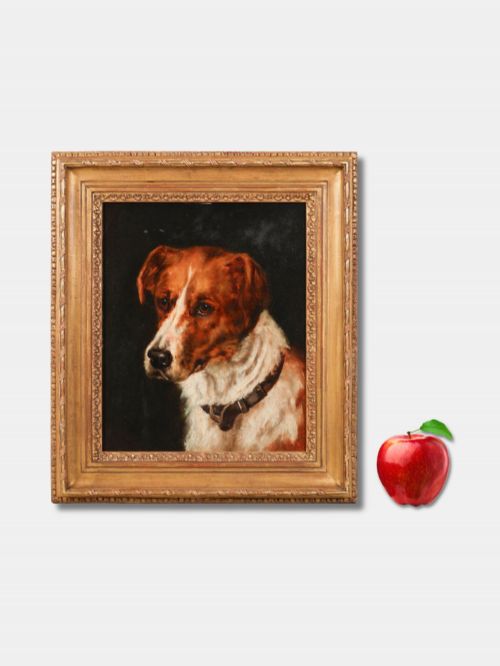
A vintage terrier oil painting captures the tenacity and character of the breed in brushwork that spans the nineteenth and twentieth centuries.
Vintage Terrier Oil Painting
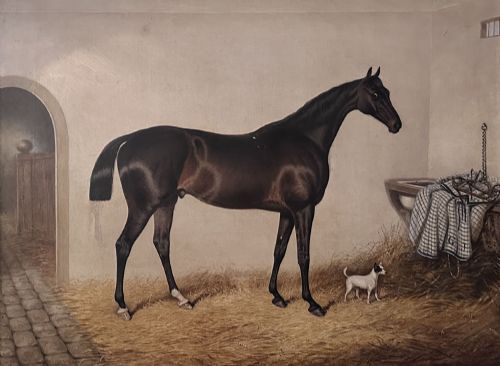
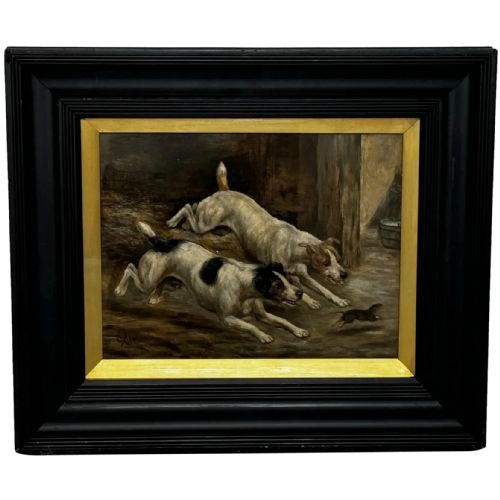
When you search for a vintage terrier oil painting, you find works depicting breeds such as Jack Russells, Cairns, and Scottish terriers in various settings. These pieces range from simple head studies to lively scenes of dogs guarding rat traps or standing in walled gardens.
The versions you are most likely to meet on this page belong to the nineteenth and twentieth centuries, encompassing Victorian realism and mid-century styles. Artists render these animals on canvas or board, often within giltwood frames.
Subjects include individual portraits and pairs of dogs, capturing the distinct personality of each terrier. The works reflect both formal canine portraiture and sporting art traditions.
Materials and techniques
These works are painted using oil pigments applied to supports of canvas or board. The application of oil paint allows for subtle blending of tones to render the texture of dog coats and the play of light.
Many paintings are housed in wooden or giltwood frames that complement the period of the artwork. The combination of oil on canvas or board with traditional framing defines the physical construction of these pieces.
Several terriers are caught mid-action, paying close attention to caged rats rather than posing politely for the artist.
What separates the top of the range
The distinction between standard and superior works lies in the precision of brushwork and the anatomical accuracy of the terrier. A stronger piece captures the alertness and texture of the animal with vitality.
Composition and the handling of background detail also set works apart. Paintings that place the terrier within a detailed narrative scene, such as a barn or garden, demonstrate a higher level of artistic ambition.
Sir Edwin Landseer·Percival Glenfern·M.E.Hankinson·Dixon Clark·John Emms·A. Betts·Samuel Fulton
The Vintage Terrier Oil Painting Glossary
- Oil on canvas
- Pigment suspended in drying oil applied to a stretched woven fabric support. This combination provides a flexible and durable surface favored by artists.
- Oil on board
- Pigment applied to a rigid wooden or composite panel rather than fabric. It offers a firm support often used for smaller studies.
- Giltwood
- Wood carved and covered with a thin layer of gold leaf or gilt. This finish is commonly found on the decorative frames enclosing these paintings.
- Victorian realism
- An artistic approach from the nineteenth century focusing on accurate depiction of everyday subjects without idealisation. In this context, it describes truthful portrayals of dogs and rural scenes.
- Sporting art
- Artwork depicting fieldsports, hunting, and animals associated with them. Canine portraits frequently align with this tradition.
Vintage Terrier Oil Painting: Frequently Asked Questions
How do I date a terrier oil painting?
Dating relies on the style of the brushwork, the stretcher construction, and framing materials. Nineteenth-century works often exhibit heavier realism, whereas twentieth-century pieces show broader mid-century execution.
Examining the canvas preparation and any inscriptions on the reverse provides further chronological clues.
Where should I hang an oil painting?
Choose a wall away from direct sunlight and strong heat sources to protect the oil paint and canvas. Stable indoor humidity prevents warping of the wooden stretcher and board supports.
Position the work at eye level where adequate ambient lighting reveals the texture of the brushstrokes.
What is the difference between canvas and board?
Canvas is a flexible woven fabric stretched over a wooden frame, offering a traditional textured surface. Board is a rigid flat panel that provides a firm, unyielding base for the paint.
Both materials appear frequently across different periods of terrier paintings.