





Vintage Sycamore Furniture
Vintage sycamore furniture brings pale timber and clean lines into a room, offering both quiet Georgian mirrors and bold Art Deco cabinets.
Vintage Sycamore Furniture
Vintage sycamore furniture encompasses items shaped from pale hardwood across several centuries, ranging from humble 19th century pub stools to refined Art Deco bedroom suites. When searching for vintage sycamore furniture, buyers encounter pieces that highlight the pale, fine-grained character of the wood rather than dark, heavy stains.
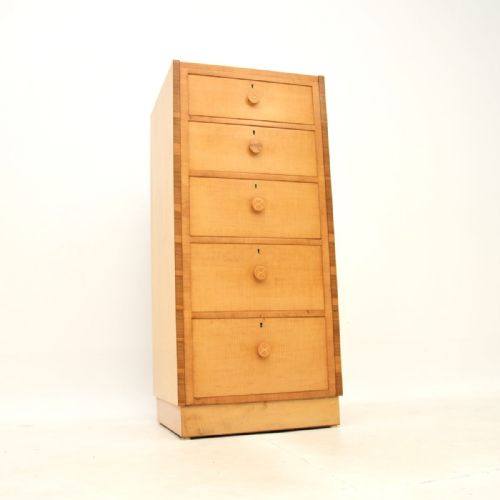
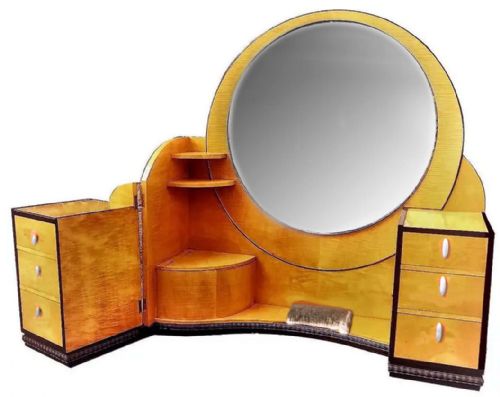
The selection on this page leans heavily toward the 1930s, featuring notable Art Deco items alongside older examples from the 18th, 19th, and late Victorian periods. Forms span practical household items including chests of drawers, bookcases, bedside tables, and wall mirrors.
Makers working in the 20th century utilised the light tone of sycamore to create sharp contrasts with darker woods like burr walnut, while earlier makers relied on the timber for utility or carved detail. Each piece demonstrates how different eras adapted this pale wood to changing domestic tastes.
What varies in quality
Quality in these pieces rests on the selection of the timber and the precision of the cabinetwork. Grain matching on veneered Art Deco surfaces dictates whether a piece looks cohesive or disjointed.
Proportion and execution separate standard utility items from works by prominent designers. The crispness of carved fretwork on earlier mirrors or the balance of a multi-drawer chest determines the standing of the piece within its period.
Vintage Sycamore Furniture Retail Price Guide 2026
Typical asking prices for vintage sycamore furniture among the pieces listed under this phrase on Sellingantiques today, from the lower quarter to the upper quarter. They describe what is for sale here now, not the wider market.
Pub stools made of sycamore survived decades of spilled ale because the pale wood is surprisingly tough against daily wear.
Hille·Betty Joel·Epstein
The Vintage Sycamore Furniture Glossary
- Sycamore
- A dense, light-coloured hardwood used for furniture making, known for its fine and uniform texture. It takes a clean finish and often forms the contrasting light sections in Art Deco marquetry.
- Giltwood
- Timber that has been coated with gold leaf or a gold-coloured finish. It frequently appears on the inner slips of 18th century mirrors to reflect light.
- Fretwork
- Ornamental pattern work cut through thin wood using a saw. Georgian mirror frames often feature this delicate technique along their outer edges.
Vintage Sycamore Furniture: Frequently Asked Questions
What is vintage sycamore furniture?
Vintage sycamore furniture consists of items made from pale hardwood, spanning utilitarian 19th century stools, Georgian mirrors, and stylish 1930s Art Deco cabinets.
The wood provides a naturally light surface that accepts clear finishes well, making it a favourite for designers seeking a clean aesthetic.
How do I identify Art Deco sycamore pieces?
Art Deco pieces from the 1930s often feature streamlined forms, contrasting veneers such as burr walnut, and work associated with makers like Betty Joel or Epstein.
These items generally display minimal ornamentation, relying instead on geometric lines and the natural grain of the pale timber.
How should I care for sycamore furniture?
Keep pale timber out of direct sunlight to prevent the light wood from darkening or yellowing unevenly over time. Dust gently with a soft dry cloth and avoid harsh chemical polishes.
Maintain steady room humidity to protect veneered surfaces from lifting or cracking.
How do 18th century pieces differ from 1930s items?
Eighteenth-century examples tend to be traditional in form, such as fretwork wall mirrors with gilt slips produced during the Georgian period. In contrast, 1930s pieces embrace modernism through streamlined bookcases, beds, and dressing tables.
The older items show hand-carved details, while the later pieces focus on flat veneered surfaces and contrasting wood pairings.