





Vintage Surveyor Instrument
A vintage surveyor instrument brings heavy brass optics and mahogany fitted cases straight from the field to the desk.
Vintage Surveyor Instrument
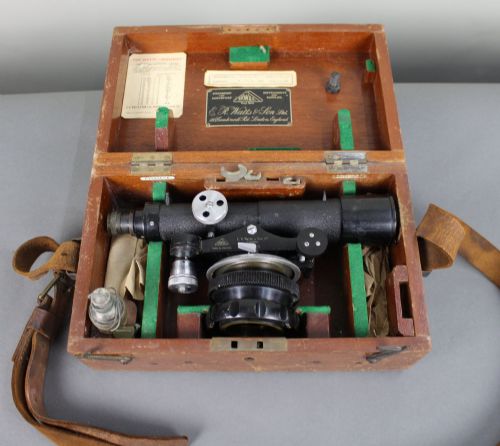
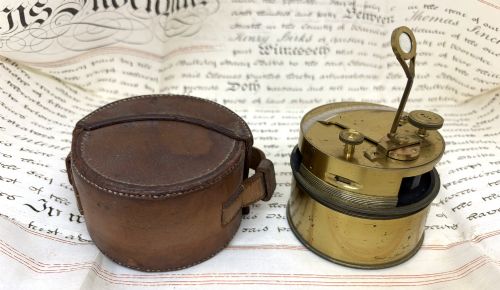
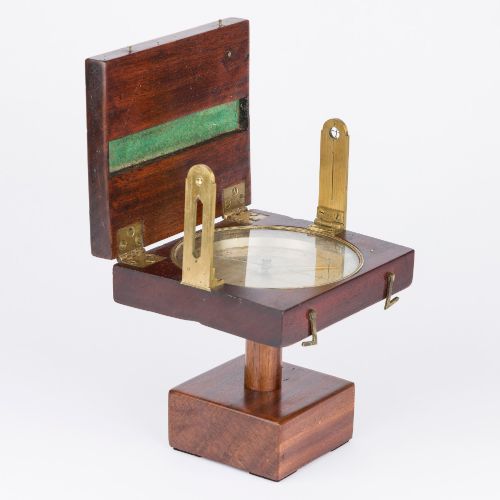
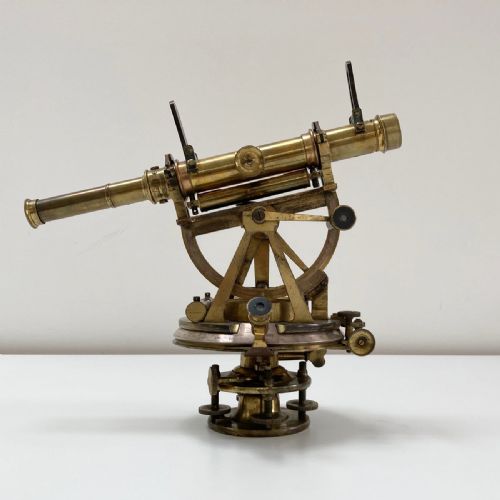
A vintage surveyor instrument comprises brass levels, theodolites, compasses, and pantographs built for measurement and mapping. These pieces emerge from the nineteenth century into the mid-twentieth century, spanning Georgian, William IV, and Victorian periods.
The most common forms on this page include brass theodolites and compasses housed in fitted wooden boxes. Makers from London, Edinburgh, Leeds, and Birmingham produced these scientific tools for land surveying and engineering.
Buyers find both field equipment and desk instruments, ranging from large vernier theodolites to miniature altazimuth instruments and mine compasses. Each object retains its original mechanical purpose, often complete with silvered dials and glass optics.
Materials and construction
Makers constructed these pieces primarily from heavy brass and polished mahogany, combining metal framing with protective wooden transport cases. Glass protects delicate compass dials and silvered metal scales, while leather occasionally appears on fitted straps or cases.
Precision engineering defined the production, utilising cast and turned bronze, brass, and steel components assembled by specialist scientific instrument makers. Signed plates, engraved dials, and signed silvered metal circles indicate the workshop origin.
Vintage Surveyor Instrument Retail Price Guide 2026
Typical asking prices for vintage surveyor instrument among the pieces listed under this phrase on Sellingantiques today, from the lower quarter to the upper quarter. They describe what is for sale here now, not the wider market.
Some nineteenth century miners carried compasses down dark tunnels while engineers in London peered through polished brass optics.
Assessing quality
Quality rests in the precision of the signed maker, the complexity of the mechanism, and the survival of the original fitted wooden case. Instruments bearing signatures from recognised London or regional makers command greater attention than unsigned workshop output.
The degree of original finish on the brass, the legibility of the silvered metal graduations, and the presence of auxiliary lenses or verniers distinguish standard field gear from masterwork commission pieces.
E.R. Watts & Son Ltd·G. Davis of Leeds·Baker, London·W&S Jones·L Casella & Co·Negretti & Zambra·Elliott Bros·Alexander Adie·Cox of Devonport·John Newman·R. Field & Son·WF Stanley
The Vintage Surveyor Instrument Glossary
- Altazimuth
- An instrument designed to measure both altitude and azimuth coordinates. These specialised theodolites appear in portable cased formats from the early nineteenth century.
- Pantograph
- A mechanical linkage connected in a parallelogram shape based on parallel geometric lines. Draughtsmen utilised it for copying maps and plans at different scales.
- Clinometer
- A tool used for measuring angles of slope, elevation, or depression of an object with respect to gravity. Surveyors and engineers relied on them in the field.
- Vernier
- A auxiliary scale device that permits accurate reading of a fractional part of a graduated scale. It appears on the silvered metal circles of quality theodolites.
Vintage Surveyor Instrument: Frequently Asked Questions
How were these instruments used in the field?
Surveyors mounted theodolites and levels onto wooden tripods to calculate angles and elevations across open terrain. Compasses and clinometers guided navigation and geological mapping.
Operators read measurements through brass telescopes and adjusted silvered metal vernier scales by hand. Every instrument was built to withstand outdoor work while maintaining precise calibration.
How do I display a vintage surveyor instrument?
These pieces suit desktop or cabinet placement, often displayed alongside their open mahogany cases. The polished brass and dark wood tones complement traditional and industrial interiors.
Ensure the surface is stable and dry, as the heavy brass components require secure support. Many collectors prefer to keep the instrument mounted on its original base or resting inside the fitted box.
How do I tell nineteenth century pieces apart from later ones?
Nineteenth century examples often feature hand-engraved maker signatures on silvered metal plates and heavy mahogany storage boxes. Georgian and Victorian instruments display distinctive cast brass components and older font styles on the vernier scales.
Twentieth century pieces, such as those from the nineteen-forties, tend to incorporate more streamlined industrial finishes and modified utility designs. Examining the retailer signature and the style of the wooden case helps confirm the era.
Do these instruments still function?
Most pieces retain their moving parts, including rotating circles, levelling screws, and focusing mechanisms. The optics and compass needles generally remain intact within their brass housings.
While they serve primarily as decorative and historic objects, skilled handlers can still operate the mechanical adjustments. Calibration for modern surveying work is rarely guaranteed.