



Vintage Stitch Sampler
These vintage stitch samplers are hand-worked textile pieces recording alphabets, names, and motifs across Victorian and Georgian eras.
Vintage Stitch Sampler
When you search for a vintage stitch sampler, you are looking at textile art and needlework pictures created to demonstrate stitching proficiency, record family names, or preserve alphabets. The pieces on this page span the Georgian and Victorian periods, extending into the early twentieth century through items dated nineteen hundred and nineteen thirty.
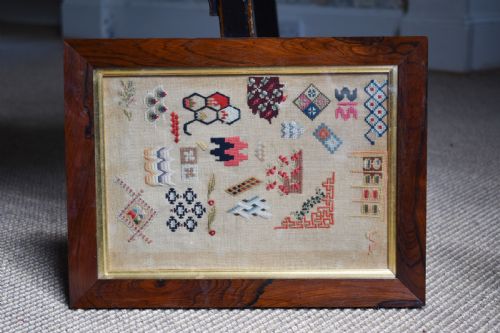
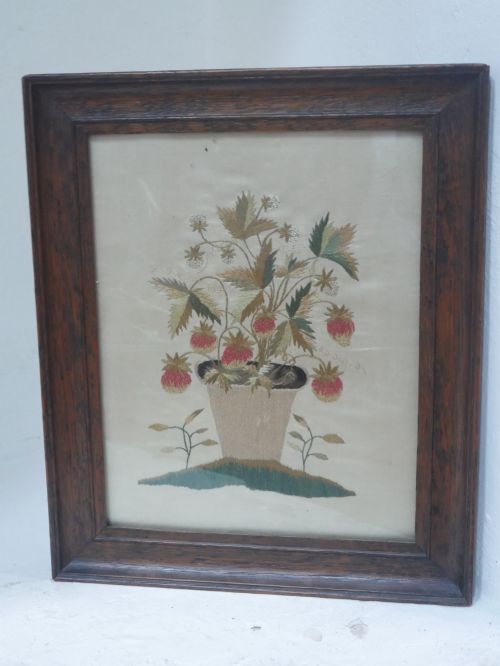
You will encounter works framed as wall art and textile panels, frequently signed and dated by young makers such as Ann Hodson, Margaret Ann Blackow, and Mary Mason. Subjects range from traditional alphabets and genealogical registers to pictorial scenes including pots of strawberries, horses, and folky compositions.
Most examples utilise linen or wool grounds stitched with silk thread and wool, often preserved in period wood and glass frames. These works originate from school rooms and domestic settings, capturing the needlework techniques taught to children and young women across the nineteenth century.
How they were made
Makers formed these pieces by working counted-thread embroidery, needlepoint, and tapestry stitches across fine linen fabric grounds. Threads of silk and wool provided the colour and texture for lettering, borders, and pictorial motifs.
Young makers relied on standard alphabets, numerals, and conventional symbols, executing each line by hand before mounting the finished linen within wood frames behind glass for display.
Vintage Stitch Sampler Retail Price Guide 2026
Typical asking prices for vintage stitch sampler among the pieces listed under this phrase on Sellingantiques today, from the lower quarter to the upper quarter. They describe what is for sale here now, not the wider market.
Listings feature linen grounds, silk thread, and wood frames spanning the Georgian and Victorian periods into nineteen thirty.
What varies in quality
The distinction between standard and superior pieces rests on the precision of the stitching, the complexity of the design, and the completeness of the maker's documentation. Works detailing the maker's age, exact date, and location carry greater historical depth.
Condition of the linen and silk thread, alongside the originality of the wood and glass framing, influences the integrity of the piece. Pictorial variety, such as specific motifs like horses or botanical studies, sets individual examples apart from standard alphabet exercises.
Ann Hodson·Margaret Ann Blackow·Mary Mason·Mary Street·Rachel·Emma and Hannah Barnes
The Vintage Stitch Sampler Glossary
- Sampler
- A piece of needlework produced as a demonstration or test of skill in various stitches. These typically include alphabets, numerals, and decorative motifs.
- Needlepoint
- A type of canvas work where yarn or thread is stitched through a stiff open-weave canvas ground, covering the foundation entirely. This technique creates durable panels with rich surface texture.
- Linen
- A textile made from the fibres of the flax plant, serving as the traditional woven foundation for most antique samplers. Its even weave allowed makers to count threads precisely.
- Tapestry
- A form of textile art traditionally woven on a loom or executed as needlepoint on canvas, depicting pictorial scenes or patterns. In these listings, tapestry describes heavier stitched display pieces.
- Alphabet sampler
- A specific form of needlework focused primarily on rows of capital and lowercase letters and numerals. These served as both literacy exercises and stitch practice.
Vintage Stitch Sampler: Frequently Asked Questions
What is a vintage stitch sampler?
A vintage stitch sampler is a hand-worked textile piece created to practise needlework techniques, record alphabets, or commemorate family events.
These works were typically made by young girls in domestic or school settings, often including names, dates, and ages alongside decorative borders.
How were these samplers used?
Makers used them to demonstrate proficiency in various embroidery stitches and to preserve patterns for future needlework projects.
Once completed, many were mounted behind glass in wood frames to decorate domestic interiors as wall art.
How do I date a sampler?
Many pieces include stitched inscriptions recording the exact year, the maker's name, and their age at the time of creation.
Stylistic indicators, such as Victorian or Georgian framing materials and specific alphabet layouts, help place undated examples within the nineteenth century.
How should I care for a framed sampler?
Keep textile pieces away from direct sunlight to prevent the silk threads and linen grounds from fading over time.
Ensure the frame and glass remain sealed to protect the historic fabric from dust, moisture, and atmospheric pollutants.