

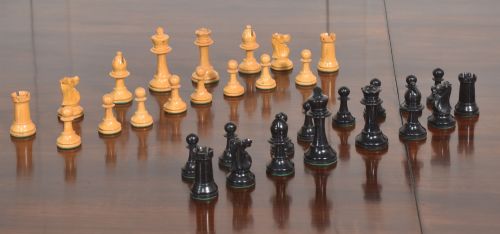


Vintage Staunton Set
A vintage staunton set is the definitive chess equipment for serious play, combining historic British craftsmanship with the traditional forms you need for the board.
Vintage Staunton Set
A vintage staunton set represents the standard pattern of chess pieces established in the mid-nineteenth century, designed for clarity and ease of play during matches. The pieces you encounter on this page date from the Victorian and Edwardian eras, spanning the late nineteenth century up to nineteen ten.
Most examples take the form of a complete chess set, frequently housed alongside a folding chess board or within a dedicated library box. These sets originate from English workshops and makers, capturing a period when chess equipment was produced with distinct attention to functional design.
The configurations on offer range from standard club sizes to larger weighted sets intended for serious play. Buyers searching for a vintage staunton set will find pieces that reflect the standard proportions codified by Nathaniel Cook and popularised by Jaques of London.
How they were made
Makers fashioned these pieces primarily from boxwood paired with contrasting ebony or ebonised wood to distinguish the opposing sides. Selected sets incorporate rosewood or incorporate brass and bone elements for specific components.
Craftsmen turned the wood on lathes to achieve the characteristic profiles of rooks, knights, and kings, often adding lead weighting to the base for stability during movement. Bases were commonly lined with felt to protect the board surface during play.
Vintage Staunton Set Retail Price Guide 2026
Typical asking prices for vintage staunton set among the pieces listed under this phrase on Sellingantiques today, from the lower quarter to the upper quarter. They describe what is for sale here now, not the wider market.
Some sets quietly retired from smoky Victorian parlours only to spend a century waiting in a dark mahogany box for a rematch.
What varies in quality
Quality in these sets depends heavily on the precision of the carving, particularly in the intricate details of the knight heads and the proportions of the coronets on the kings and queens. Superior examples display crisp, uniform turning and careful hand-carving that separates workshop output from mass production.
The presence of lead weighting and original felt bases distinguishes higher-grade club sets from lighter, unweighted alternatives intended for travel. Furthermore, the selection of dense boxwood and genuine ebony rather than cheaper stained alternatives marks the upper tier of the range.
British Chess Company·F. H. Ayres·Calvert Pattern
The Vintage Staunton Set Glossary
- Staunton
- The standard design of chess pieces created in the mid-nineteenth century featuring architectural motifs and clear, recognisable symbols for each piece type.
- Boxwood
- A dense, pale wood traditionally used for the lighter pieces in a chess set due to its fine grain and durability.
- Ebonised
- Wood, typically boxwood, that has been stained or treated to resemble true ebony for the dark pieces.
- Weighted
- Chess pieces fitted with internal lead weights in the base to improve balance and tactile feel during play.
Vintage Staunton Set: Frequently Asked Questions
How do I date a staunton set?
Dating relies on the style of the knight heads, the presence of specific maker stamps, and the materials used in construction. Earlier nineteenth-century sets often feature more compact knights and distinct crown markings.
Examining the turning techniques and the type of wood finish also helps narrow down the decade of production between the Victorian era and nineteen ten.
Are these sets suitable for regular play?
Many vintage staunton sets are robust enough for daily use, particularly weighted examples designed for club play. The sturdy boxwood and ebony construction withstands standard handling.
Collectors often pair older pieces with a vintage folding board of a matching period to preserve the authentic playing experience.
What is the Calvert pattern?
The Calvert pattern refers to a specific nineteenth-century style of chess piece design pre-dating the universal adoption of the Staunton standard. These sets feature distinct, often more stylised forms for the king and queen.
They represent an important transitional phase in English chess set manufacturing before standardised proportions took over.
Why are some pieces weighted?
Weighting was introduced to prevent chess pieces from tipping over easily during fast or competitive matches. Makers inserted lead into the hollowed base of each piece.
This addition provides a reassuring heft that improves stability on the board and enhances the tactile quality of the set.