



Vintage Spelter Pair
These vintage spelter pair selections bring matched decorative balance and mid-section weight to a mantelpiece or side table.
Vintage Spelter Pair
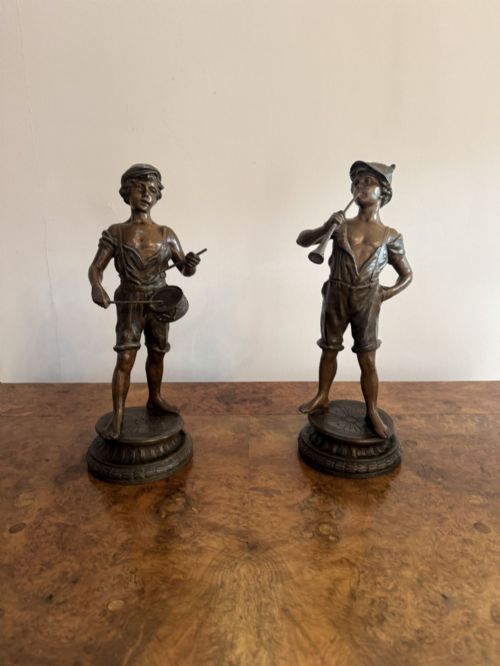
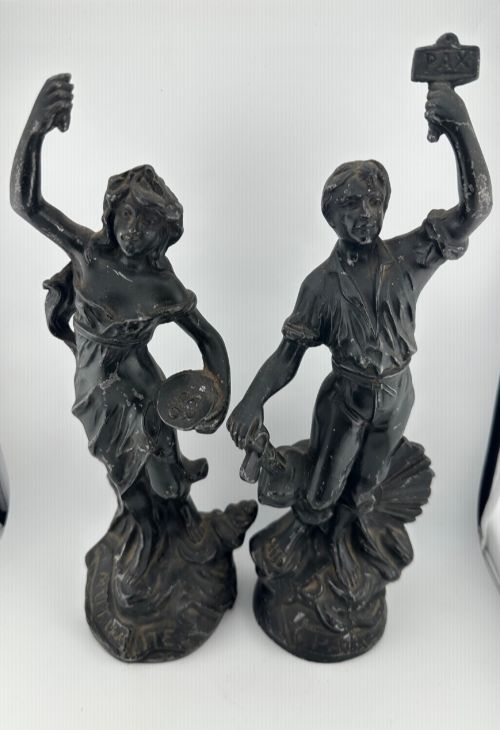
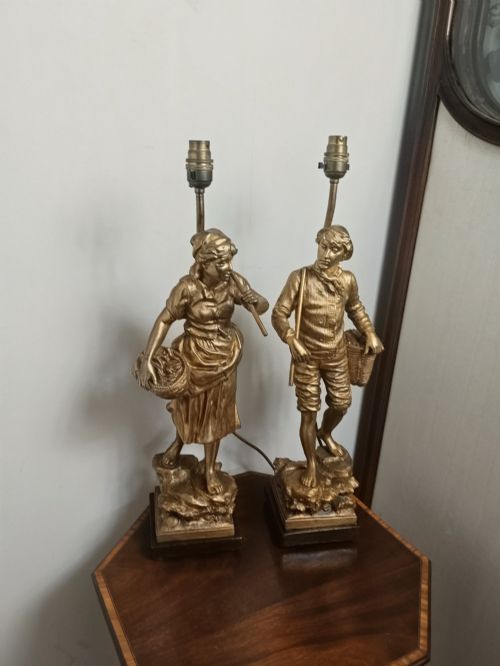
When you search for a vintage spelter pair, you are looking at matched dual items cast in a zinc-based alloy, most often taking the form of figures, bookends, lamps, and clock garnitures. These coordinated sets originate predominantly from French workshops spanning the Victorian era through the Art Deco period, alongside occasional American and British interpretations.
The versions you are most likely to meet on this page include French allegorical figures, soldiers, and harvesters dating from around nineteen hundred, as well as twin-light candelabra and figural table lamps. Such pieces were designed to sit symmetrically on either side of a central clock or focal point, reflecting the tastes of nineteenth and early twentieth-century domestic interiors.
How they were made
These items are produced by pouring molten zinc alloy into moulds, a process known as spelter casting, which allows for intricate detailing at a lower production cost than bronze. Makers frequently applied surface finishes such as bronzing, gilding, or polychrome paint to mimic more expensive metals.
Many of these objects incorporate secondary materials to provide stability and visual contrast, pairing the metal castings with heavy marble bases, wooden mounts, or fabric lamp shades. Enamel and brass details are also utilised on functional items like candelabra and clocks to enrich the finished appearance.
Vintage Spelter Pair Retail Price Guide 2026
Typical asking prices for vintage spelter pair among the pieces listed under this phrase on Sellingantiques today, from the lower quarter to the upper quarter. They describe what is for sale here now, not the wider market.
Listings feature items spanning the Victorian era through the Art Deco period, incorporating materials like marble, brass, and gilt metal.
What varies in quality
The standard of a casting determines its sharpness and depth, with superior examples retaining crisp facial expressions and fine drapery folds that weaker moulds tend to soften. Finer pieces demonstrate careful hand-chiselling after casting to clear away surface imperfections.
Applied patination and gilding show clear distinctions between tiers of production, as higher-grade finishes mimic aged bronze or rich gold leaf with layered nuance rather than flat paint. The integration of supporting elements like marble plinths and brass mounts also elevates the substance of the composition.
E Rousseau
The Vintage Spelter Pair Glossary
- Spelter
- A zinc-based alloy used as an economical alternative to bronze for decorative sculptures and household objects. It accepts patination and surface finishes readily.
- Garniture
- A set of matched decorative objects, typically a clock flanked by a pair of vases, candelabra, or figures, designed for a mantelpiece.
- Patination
- The surface appearance achieved through age, wear, or chemical treatment applied to mimic authentic oxidation on metal.
- Allegorical
- Representing an abstract idea or virtue through a human figure, common in French nineteenth-century sculpture.
Vintage Spelter Pair: Frequently Asked Questions
What is spelter metal?
Spelter is a zinc alloy that serves as a common base metal for nineteenth and twentieth century decorative sculptures. It provides a workable medium for intricate casting while remaining lighter and softer than bronze.
Because of its softer composition, makers applied various metallic finishes to protect the surface and achieve the look of traditional bronze or gold.
How do I clean vintage spelter?
Cleaning requires a soft, dry cloth to remove dust without disturbing the delicate surface patination or applied finishes. Moisture and harsh cleaning agents should be avoided entirely to prevent damage to the metal.
Preserving the original finish maintains the character and historical integrity of the piece over time.
Were these always sold together?
Matched pairs were typically produced and sold as a set to achieve symmetrical balance when placed on either side of a mantelpiece or central ornament. Clock garnitures specifically included matching side pieces designed in the same stylistic idiom.
Individual figures occasionally became separated over the decades, making matched survivals notable examples of their original format.
How do I date these items?
Dating relies on stylistic clues such as the classical drapery of Victorian pieces, the military uniforms of the late nineteenth century, or the geometric lines of Art Deco design. Materials like marble bases and mounting techniques also offer helpful chronological markers.
Comparing the casting sharpness and surface finishes with documented periods helps narrow down the decade of production.