




Vintage Rosewood Settee
A vintage rosewood settee brings rich grain and strong architectural form to a room, offering both seating and historic character.
Vintage Rosewood Settee
A vintage rosewood settee is a substantial seating piece defined by dense, figured timber and robust frames spanning multiple centuries and design movements. When you explore this selection, you encounter forms that range from restrained Regency lines to elaborate Victorian Rococo Revival curves.
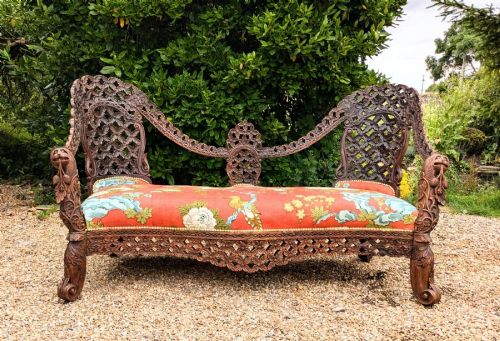
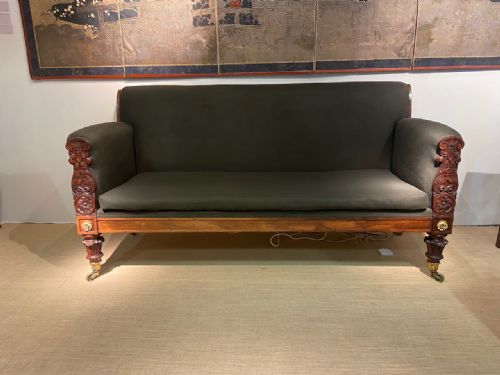
The pieces listed on this page include distinct regional interpretations such as Anglo-Indian Colonial sofas alongside classic European styles like French Rococo Revival and William IV designs. These items frequently appear as standalone sofas or as part of larger suites paired with armchairs.
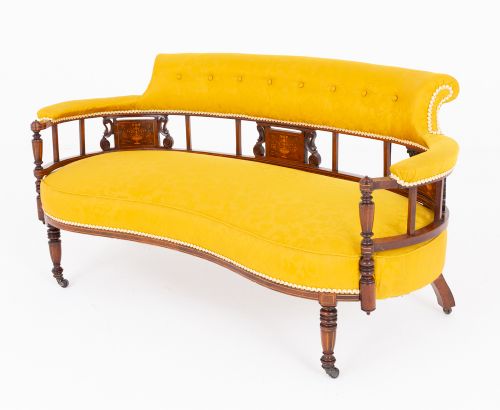
Makers utilised both solid timbers and simulated rosewood finishes to achieve deep colouration and dramatic grain patterns across different periods. Buyers most often meet variations that incorporate scroll shapes, inlaid details, and traditional upholstery fabric.
Materials and construction
Makers built these frames using heavy tropical hardwoods, notably rosewood and padauk, selected for their structural strength and rich natural oils. Craftsmen also employed simulated rosewood techniques on alternative woods to achieve similar dark, figured aesthetics during periods when solid timber was scarce.
Metal elements such as brass frequently reinforced structural joints or appeared as decorative mounts on classical and colonial forms. Upholstery fabrics were secured over traditional padding systems to complete the seating surface on both modest country house sofas and grand parlour suites.
Some nineteenth-century artisans clearly enjoyed tricking the eye with simulated rosewood when the real timber was simply too heavy to lift.
Judging quality and execution
Quality rests upon the crispness of carved details in the timber frame and the natural depth of the rosewood grain. Superior examples display seamless joinery and balanced proportions, particularly where scroll arms or complex crest rails meet the main structure.
The integrity of the underlying woodwork and the fidelity of regional styles, such as Anglo-Indian or French Rococo execution, dictate the standing of an individual piece. Lesser examples may show heavy secondary finishes or simpler secondary woods beneath simulated surfaces.
The Vintage Rosewood Settee Glossary
- Rosewood
- A dense, heavy timber prized for its dark purple-brown hue and dramatic black grain patterning. It takes a high polish and forms the primary material for many formal nineteenth-century frames.
- Simulated rosewood
- A painted or stained finish applied to a lighter secondary wood to imitate the appearance of genuine rosewood. This technique appears on country house furniture from the Regency period.
- Scroll shape
- A curved, volute-like architectural form commonly utilised for the arms and backrests of sofas from the Art Deco era and earlier classical revivals.
- Anglo-Indian
- A descriptive term for furniture made in India by local craftsmen using indigenous timbers for the British colonial market. These pieces often feature intricate carving and exotic hardwood construction.
Vintage Rosewood Settee: Frequently Asked Questions
What periods do these settees come from?
The pieces span several centuries, with examples originating from the eighteenth century, the Regency era, and through the Victorian and Edwardian periods up to the nineteen-twenties.
Each era contributes distinct stylistic markers, ranging from formal classical revivals to colonial craftsmanship and early twentieth-century modernism.
How do I identify simulated rosewood?
Simulated rosewood is created by applying grain-painting or staining techniques to a lighter, less expensive base wood to mimic the dark contrast of true tropical timber.
Close inspection of the surface grain and unpolished interior areas usually reveals the underlying wood species beneath the decorative finish.
Are these settees sold as part of suites?
Some listings combine the settee with matching armchairs to form a complete three-piece suite or larger furniture grouping.
These coordinated sets typically share identical carved details, timber selections, and upholstery fabrics intended for principal reception rooms.