
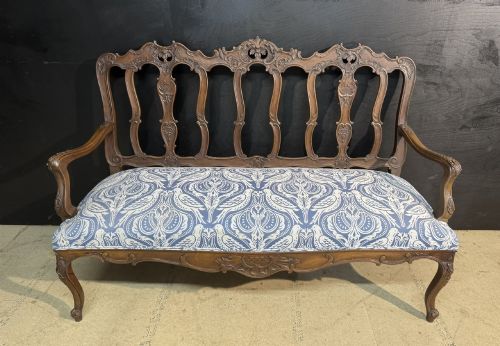
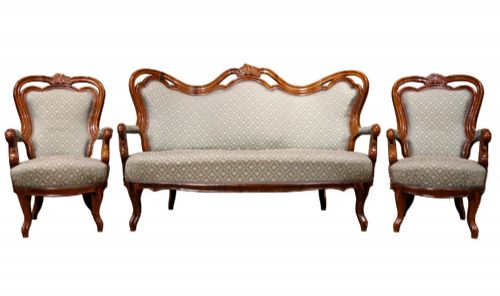


Louis XV Revival Settee
A louis xv revival settee brings French court elegance to a nineteenth-century drawing room through fluid, asymmetrical curves and carved wood frames.
Louis XV Revival Settee
A louis xv revival settee embodies the ornate forms of the Rococo Revival style, appearing in nineteenth-century incarnations from walnut, rosewood, and giltwood frames. These seats range from two-seater couches to expansive salon suites, reflecting the nineteenth-century passion for French eighteenth-century design.
The pieces listed on this page span the Victorian period through to nineteen-ten, taking the form of open arm sofas, gilt-painted canapes, and carved walnut settees. Walnut frames predominate among the current selection, often paired with contemporary or period upholstery fabric, velvet, and damask.
Makers and craftsmen of the nineteenth century interpreted the Louis XV style with varying degrees of French influence, producing both grand salon suites and smaller end-of-bed two-seater sofas. The structural forms remain consistent, relying on cabriole legs and serpentine rails derived from Rococo models.
How they were made
Cabinetmakers shaped solid walnut, rosewood, and beech to form the undulating frames characteristic of the louis xv revival settee. These timbers were carved by hand with floral motifs and scrollwork before being polished or finished with gold paint and giltwood.
Upholstery involved traditional stuffing techniques applied to sprung seats, covered in textiles such as silk damask, velvet, and patterned upholstery fabric. Brass tacks or gimp braid often secured the fabric to the wooden rails of the sofa or salon suite.
What varies in quality
The crispness and depth of the carved woodwork distinguish finer examples of a louis xv revival settee from simpler production. Superior pieces exhibit deeply undercut foliage and flowing asymmetrical lines that follow the grain of the walnut or rosewood without stiffness.
The integrity of the frame construction and the quality of the gilding or timber finish dictate the standing of each piece. Salon suites and couches retain greater distinction when their original giltwood or polished wood surfaces survive alongside harmonious period upholstery.
The Louis XV Revival Settee Glossary
- Canape
- An antique French settee or sofa featuring an exposed wooden frame, upholstered seat, and padded back. This form serves as a principal seating option in formal nineteenth-century salons.
- Giltwood
- Timber treated with a thin layer of gold leaf or gold paint applied to the carved surface. It provides the brilliant finish seen on many French revival salon pieces.
- Cabriole leg
- A furniture leg that curves out and then narrows inward, terminating in a small foot. This shape is a defining feature of Rococo Revival and Louis XV style seating.
- Damask
- A reversible figured fabric woven on a loom, frequently utilised for upholstering nineteenth-century couches and salon suites. Silk damask appears on several revival pieces in the archive.
- Salon suite
- A matched set of seating furniture, typically comprising a settee and matching armchairs designed for a drawing room. These suites unify the decor of nineteenth-century reception rooms.
Louis XV Revival Settee: Frequently Asked Questions
Where did these settees fit in a nineteenth-century home?
A louis xv revival settee belonged in the formal drawing room or salon, where hosts received guests and displayed their taste in French-inspired interior decoration. These seats often formed part of a larger salon suite alongside matching armchairs.
In smaller variations, such as end-of-bed seating, they served private chambers and dressing rooms. Their decorative carved walnut and gilt frames ensured they functioned as centrepieces wherever placed.
How do I distinguish walnut from rosewood on these frames?
Walnut displays a warm brown tone with varied grain patterns and takes a fine polish that suits the flowing carved lines of a louis xv revival settee. It remains the most common timber found across these nineteenth-century pieces.
Rosewood offers a darker, denser appearance with distinct reddish-brown streaks and a heavier weight. Both timbers were favoured by makers crafting French revival furniture for Victorian homes.
Can I use an antique settee for daily seating?
A nineteenth-century louis xv revival settee can serve as everyday seating provided the internal webbing, springs, and upholstery have been properly maintained or restored. Many surviving pieces retain sturdy walnut frames built to withstand regular use.
Buyers should consider the height and depth of the seat when planning daily use in a modern living space. Lighter two-seater couches and open arm sofas adapt well to contemporary drawing rooms.
What defines the French Rococo Revival style?
The style mimics the eighteenth-century reign of Louis XV through asymmetrical curves, naturalistic floral carvings, and scrollwork free of straight architectural lines. Makers in the nineteenth century revived these motifs to create ornate settees and salon furniture.
Characteristics include cabriole legs, serpentine aprons, and cartouche-shaped backs framed in carved walnut or giltwood. This aesthetic prioritised comfort and flowing grace over strict symmetry.
How do I tell an eighteen-eighties piece from an eighteen-forties one?
Dating a louis xv revival settee involves examining the carving style, timber selection, and assembly methods used within the nineteenth century. Pieces from the eighteen-forties often display heavier proportions and dense walnut framing.
By the eighteen-eighties, Victorian makers frequently incorporated brighter gilt finishes and lighter structural interpretations. Surviving upholstery or historical records can also help narrow the production decade.