

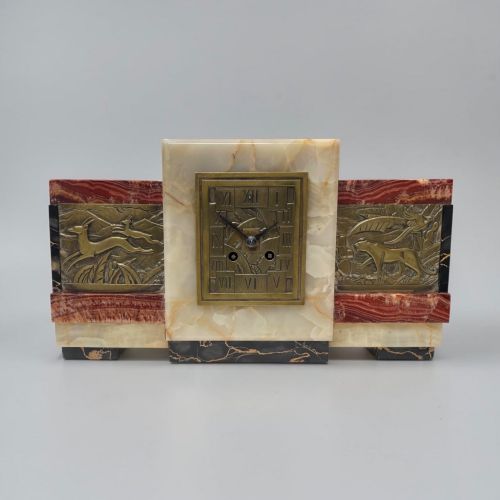


Vintage Onyx Clock
A vintage onyx clock brings heavy mineral colour and geometric weight to a mantelpiece, offering a solid anchor for a period interior.
Vintage Onyx Clock
When you search for a vintage onyx clock, you are looking at substantial timepieces formed from banded silicate stones, frequently paired with metal fittings and glass dials. These objects range from severe geometric designs of the twentieth century to highly ornate pieces from the nineteenth century.
The version you are most likely to meet on this page is the Art Deco mantel clock, often accompanied by matching garnitures or sculptural figures in spelter and bronze. These twentieth-century examples sit alongside earlier Victorian and Belle Epoque pieces originating mainly from French and English workshops.
Beyond standard mantel clocks, the selections include desk clocks, barometer combinations, and multi-piece garniture sets featuring dogs or human figures. Materials shift between plain dark stone, vivid green varieties, and contrasting panels of marble.
Materials and construction
Makers shaped solid blocks of onyx and marble into architectural cases, cutting the stone to expose natural mineral banding and polished planes. This stone work required steady sawing and extensive hand-polishing to achieve a smooth, glossy exterior.
Metal components such as brass, ormolu, and chrome were cast and applied to the stone cases as bezels, feet, and decorative mounts. Spelter was frequently cast into sculptural figures of animals or human forms to top the clock or flank it in a garniture set.
Clock movements and glass face covers were fitted into precisely bored cavities within the heavy mineral bodies. Enamel or metal dials with Arabic or Roman numerals were then secured behind glazed bezels to protect the hands.
Vintage Onyx Clock Retail Price Guide 2026
Typical asking prices for vintage onyx clock among the pieces listed under this phrase on Sellingantiques today, from the lower quarter to the upper quarter. They describe what is for sale here now, not the wider market.
Listings feature green onyx alongside standard banded stone, paired with materials like brass, chrome, and spelter across the Art Deco and Victorian eras.
Assessing quality and execution
The distinction between ordinary and superior pieces lies in the crispness of the stone cutting and the depth of the mineral polish. Finer examples display seamless joins between stone slabs and feature substantial, well-cast metal mounts rather than thin pressed sheet.
The inclusion of signed movements or named retail marks elevates a piece, as does the survival of an entire matching garniture set with original sculptures. Sculptural elements cast by named artists show sharper anatomical detail and better surface patination than generic factory castings.
Elliott·Michel Decoux·Ferdinand Priess·Garrards
The Vintage Onyx Clock Glossary
- Onyx
- A cryptocrystalline variety of quartz with parallel bands, utilised for its decorative hardness and varied natural banding.
- Garniture
- A set of matching decorative objects, typically comprising a central clock flanked by two side vases, urns, or sculptural figures.
- Spelter
- A zinc alloy used extensively as a substitute for bronze in decorative figures and clock mounts, usually painted or electroplated to resemble more expensive metals.
- Crystal regulator
- A mantel clock housed in a glass-panelled metal and stone case that reveals the swinging pendulum from multiple angles.
- Ormolu
- Gilded bronze produced by applying a mercury-gold amalgam to cast bronze, giving a rich golden surface finish to metal mounts.
Vintage Onyx Clock: Frequently Asked Questions
How do I wind a vintage onyx clock?
Most of these mechanical timepieces utilise a key inserted into specific dial holes to tension the spring-driven movement. Turn the key gently until you feel firm resistance, avoiding overwinding to protect the internal mechanism.
Regulate the beat using the small adjustment arbor if the clock gains or loses time over a twenty-four-hour period.
Where should I place a heavy stone clock?
Position the piece on a structurally sound, level surface such as a sturdy mantelpiece or a heavy sideboard. The considerable weight of the stone requires strong support to prevent tipping or sagging over time.
Keep the clock away from direct sunlight and damp walls to preserve the polished mineral surface and the integrity of the internal metal springs.
Are garniture sets meant to stay together?
Garniture sets were designed as unified decorative schemes for central placement on a mantelpiece or fireplace surround. Keeping the clock and its flanking sidepieces together preserves their historical context and visual balance.
Separating the objects diminishes the decorative impact intended by the maker or retailer.
How do I clean a vintage stone clock case?
Dust the stone and glass surfaces regularly with a soft, dry microfibre cloth to prevent particulate buildup. Avoid using commercial liquid cleaners or harsh detergents, as moisture can seep into stone fissures or damage aged metal mounts.
Apply a tiny amount of neutral wax to the stone only if the surface appears dry, buffing it gently with a clean cloth.