




Vintage Mountain Fine Art
These vintage mountain fine art works capture rugged peaks and sweeping valleys across oils and watercolours spanning the nineteenth and twentieth centuries.
Vintage Mountain Fine Art
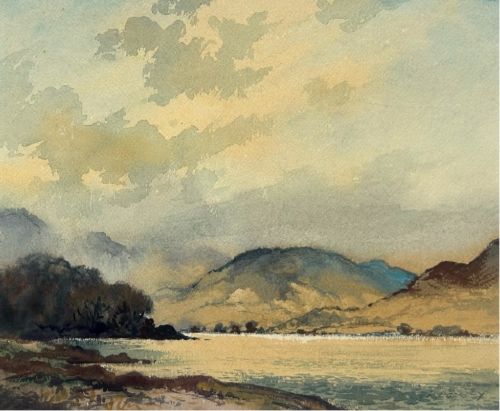
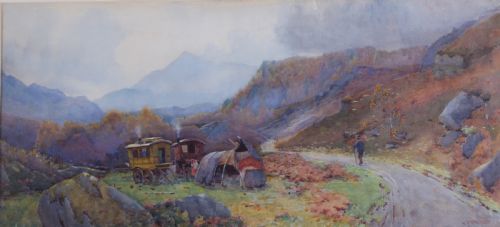
Vintage mountain fine art spans original watercolours, oil paintings on canvas or panel, and pen-and-ink drawings depicting dramatic upland scenery. These works record landscapes from the English Lake District, Scottish islands, and European ranges created by regional schools and notable painters.
Buyers encountering this group will find pieces ranging from Victorian studies to mid-century modernist interpretations. The selection covers diverse schools including Scottish Impressionism and 19th Century European painting, capturing peaks and lakes through distinct regional lenses.
Materials and construction
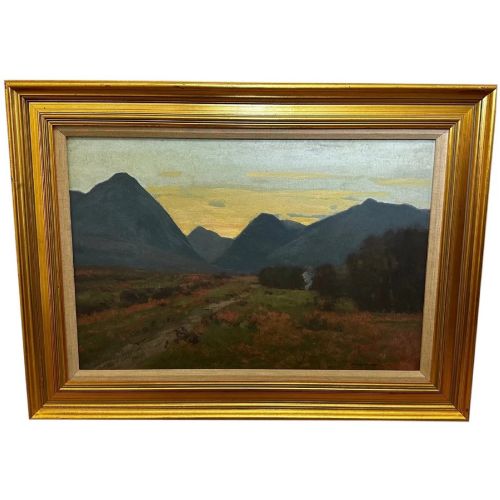
Painters utilised oil paint and watercolour applied to paper, wood panels, or stretched canvas to render mountainous terrain. Many canvases sit within period giltwood frames finished with gesso details.
Draftsmanship appears through precise pen-and-ink landscape drawings alongside expressive brushwork in oils. Support structures range from traditional wooden stretcher frames to heavy paper sheets preserved beneath glass.
Several artists clearly braved damp British weather to capture precise mountain views without ruining their watercolours.
Judging quality in mountain paintings
The strength of a composition rests on how effectively the artist handles light and shadow across jagged peaks and water bodies. Masterful works convey the atmospheric depth of weather rolling over upland slopes rather than relying on flat representation.
Condition varies in the preservation of the pigment and the integrity of the original support, whether canvas or panel. Superior examples retain the original framing, such as giltwood moulding, which complements the period of the painting.
George Houston RSA RSW·John Douglas Perrett·George Melvin Rennie·Alfred de Breanski Sr·Henry Bright
The Vintage Mountain Fine Art Glossary
- Oil on Canvas
- Pigment suspended in drying oil applied to a woven fabric stretched across a wooden frame. This medium allowed artists to build rich textures for rugged mountain surfaces.
- Watercolour
- A paint consisting of colour pigment suspended in a water-soluble vehicle, typically applied to paper. It offers translucent washes ideal for misty atmospheric mountain effects.
- Giltwood
- Wood carved and coated with gold leaf or a gold-coloured metallic finish. It frequently frames nineteenth-century landscape paintings.
- Gesso
- A paint mixture consisting of a binder mixed with chalk, pigment, or plaster. It provides a smooth base for gilding on antique frames.
- Scottish Impressionism
- A painting style influenced by continental movements, characterised by visible brushstrokes and natural light. It appears frequently in regional mountain landscapes.
Vintage Mountain Fine Art: Frequently Asked Questions
What periods do these mountain paintings cover?
The works span from the Victorian era through the early twentieth century up to mid-century modern interpretations. Artists recorded dramatic topography using techniques characteristic of their specific decades.
Earlier pieces often reflect nineteenth-century European landscape traditions, while later items embrace looser modernist brushwork.
How should I hang an oil painting?
Secure the artwork away from direct sunlight and steady temperature fluctuations to protect both the canvas and any original giltwood frame. Use sturdy wall fixings appropriate for the weight of the wooden stretcher.
Ensure the piece hangs at eye level to properly engage with the composition and perspective of the mountain scenery.
What is the difference between oil and watercolour?
Oil paint utilises a slow-drying oil medium that allows for thick impasto texture and rich colour blending. Watercolour relies on water-soluble pigments on paper, creating luminous, transparent washes.
Oils generally require protective framing with canvas supports, whereas watercolours need glazing to prevent moisture damage.
How do I identify regional painting schools?
Regional schools often display distinct geographic focuses, such as Scottish artists depicting highland landscapes or English painters recording the Lake District. Signatures, exhibition stamps, and stylistic brushwork provide further clues to provenance.
Cross-referencing the artist's active period helps anchor the work within its historical artistic movement.