
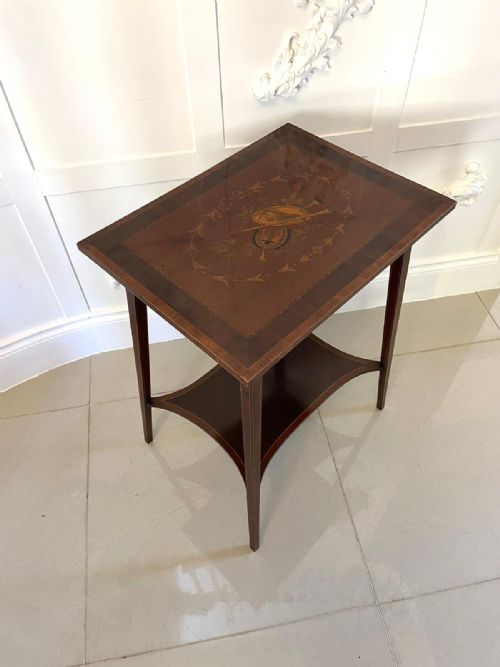


Vintage Marquetry End Tables
These vintage marquetry end tables bring decorative floral patterns and rich timber surfaces right beside a chair or sofa.
Vintage Marquetry End Tables
Vintage marquetry end tables appear across several periods including the Victorian, Edwardian, and Art Deco eras, with Edwardian and early twentieth century examples turning up frequently. These items function as side tables, lamp tables, occasional tables, nests, and bedside tables. Makers utilised various forms such as oval, rectangular, octagonal, and kidney shapes to fit compact spaces.
The selection ranges from Sheraton Revival and Georgian styles to French Napoleon III and Louis XV style pieces. Buyers encounter timber structures decorated with detailed wood inlay and floral marquetry, often finished with brass galleries or painted elements. These smaller occasional pieces provide functional surface space while showcasing intricate craftsmanship.
Materials and construction
Craftsmen built these tables using primary timbers like mahogany, walnut, rosewood, satinwood, and alder root. They applied contrasting veneers and wood inlay, incorporating boxwood and diverse timber species to create elaborate floral and geometric patterns.
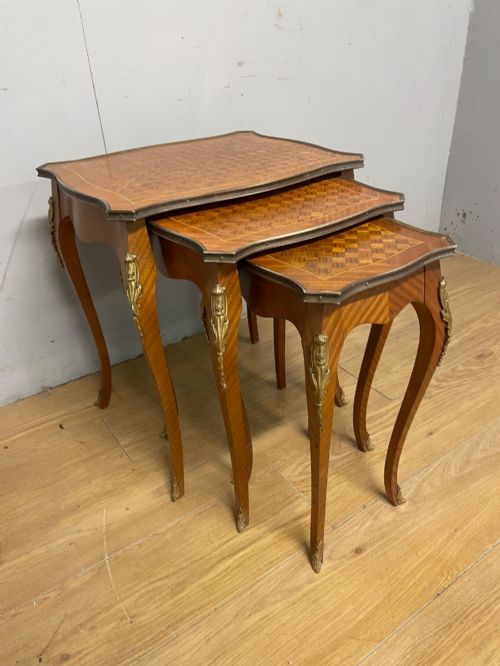
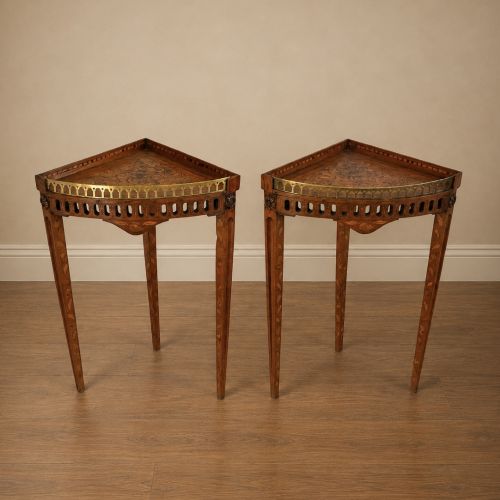
Structural enhancements include brass galleries fitted around table tops and mother-of-pearl accents embedded in the woodwork. Joinery methods varied from single occasional tables to nesting sets of three or four pieces designed to stack together.
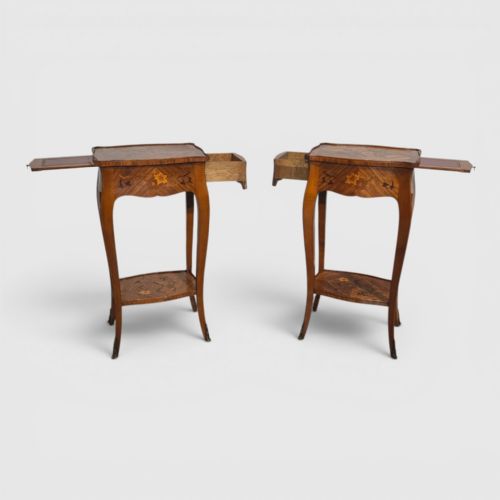
Some tables hide lift-up tops or tuck into neat nests of four.
Assessing quality and execution
Quality rests in the precision of the wood inlay and the crispness of the floral marquetry across the surface. Finer examples display tight joins in the parquetry and careful selection of figured timbers like satinwood and rosewood.
The choice of structural hardware and secondary materials distinguishes the standard of manufacture. Well-made pieces integrate solid brass galleries and stable leg constructions that support daily use without compromising the decorative top.
The Vintage Marquetry End Tables Glossary
- Marquetry
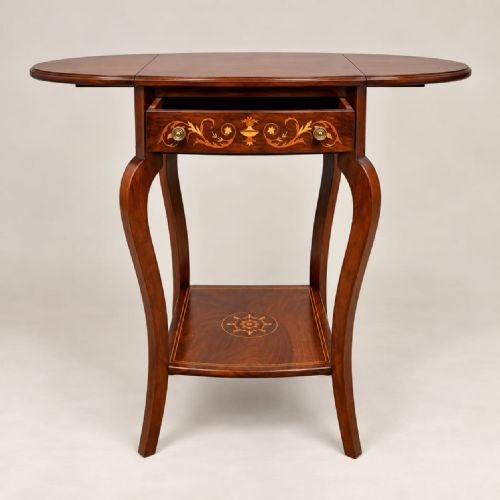
- Decorative veneer applied to a wood structure in patterns and pictures. Craftsmen cut contrasting woods to form floral or geometric designs.
- Parquetry
- Geometric mosaic woodwork used for floors and tabletops. It relies on regular shapes like squares or triangles.
- Satinwood
- A durable hardwood with a lustrous yellowish grain. Makers used it extensively during the Sheraton Revival period.
- Drop leaf
- A table with hinged flaps on the sides that fold down to save space. These flaps lift up when extra surface area is required.
- Gallery
- A raised ornamental border surrounding the edge of a tabletop. They are typically cast in brass.
Vintage Marquetry End Tables: Frequently Asked Questions
What is a marquetry end table?
A marquetry end table is a small occasional piece decorated with inlaid wood veneers. These tables were designed to sit beside seating for lamps or drinks.
They appear in forms such as lamp tables, side tables, and nests of tables.
How do I use an occasional table?
Occasional tables fit easily beside armchairs, sofas, or beds to hold small items. Nests of tables provide extra surface space when entertaining and tuck away when not needed.
Their compact sizes suit corners and bedside positions.
How do I date an Edwardian table?
Edwardian tables often feature satinwood or mahogany with delicate inlaid decoration. They reflect earlier Sheraton Revival tastes popular around the start of the twentieth century.
Construction details and timber choices help confirm the period.
What is the difference between marquetry and parquetry?
Marquetry uses fitted wood veneers to create pictorial or floral designs on furniture surfaces. Parquetry forms repeating geometric patterns using regular shapes.
Both techniques ornamented the tops of antique occasional tables.