



Vintage Majolica Urn
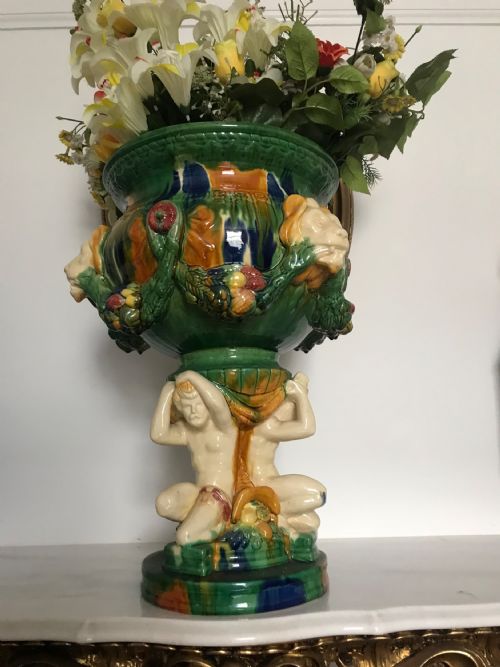
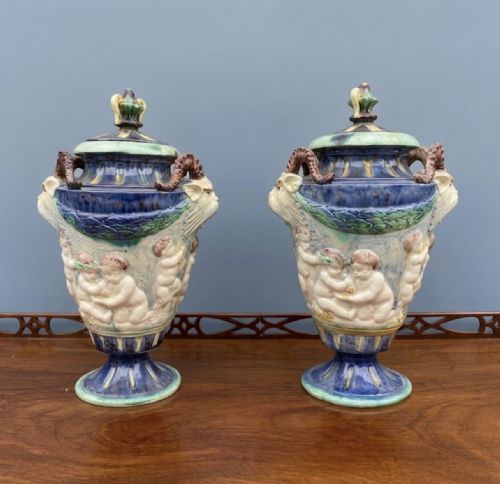
These vintage majolica urn pieces bring colourful tin-glazed earthenware and faience form into a room.
Vintage Majolica Urn
When someone searches for a vintage majolica urn, they encounter decorative vessels and planters shaped from earthenware and ceramic. These pieces draw on Italian Renaissance Revival, Victorian, and Art Nouveau styles.
The versions most commonly met on this page span the eighteenth, nineteenth, and early twentieth centuries. Makers created them as jardinieres, lidded urns, and vases intended for display.
Origins stretch across Italy, France, and wider European workshops during periods such as the Grand Tour era and the nineteenth century. Forms range from naturalistic planters to tall lidded vessels with figural or animal decoration.
How they were made
Potters shaped these objects from terracotta and earthenware bodies before applying tin glaze or lead glaze finishes. This technique allowed makers to achieve smooth, bright surfaces suitable for detailed painting.
Decoration often involved hand-painted tin-glaze designs, floral motifs such as the Garofano pattern, and moulded figural elements like lions' heads. Artisans fired the pieces to set the rich surface colours characteristic of maiolica and faience.
Vintage Majolica Urn Retail Price Guide 2026
Typical asking prices for vintage majolica urn among the pieces listed under this phrase on Sellingantiques today, from the lower quarter to the upper quarter. They describe what is for sale here now, not the wider market.
The object types recorded here include jardinieres, lidded urns, and vases reflecting Art Nouveau and Italian Renaissance Revival aesthetics.
What varies in quality
Quality rests on the crispness of the moulded detail, such as figural bases and animal heads, and the precision of the hand-painted glaze work. Stronger examples display balanced proportions and deep, vibrant surface colours.
The sophistication of the historical revival style also separates standard wares from superior studio pieces. Greater artistic ambition in forms like naturalistic planters or lidded urn pairs elevates the piece.
Julius Dressler·Cantagalli
The Vintage Majolica Urn Glossary
- Majolica
- A type of earthenware decorated with opaque tin glaze and painted in colours. It encompasses traditional Italian maiolica and later Victorian and continental revival wares.
- Faience
- European tin-glazed pottery, particularly associated with French and continental workshops. It shares technical roots with majolica production.
- Jardiniere
- A large ornamental pot or stand designed to hold plants or floral arrangements. These often feature naturalistic or classical moulded decoration.
- Garofano
- A traditional carnation motif frequently hand-painted on Italian ceramic wares. It appears on historical pieces originating from Italian kilns.
- Grand Tour
- A cultural journey of Europe undertaken by wealthy young men in the eighteenth and nineteenth centuries, inspiring the collection of classical souvenirs and urns.
- Lead glaze
- A glossy coating applied to earthenware and pottery before firing. It creates a transparent finish that shows the clay or slip beneath.
Vintage Majolica Urn: Frequently Asked Questions
What is a vintage majolica urn?
A vintage majolica urn is a glazed ceramic or earthenware vessel produced in historical revival styles. These objects function primarily as decorative ornaments or planters.
They reflect aesthetic movements from the nineteenth and early twentieth centuries, drawing on Renaissance and Art Nouveau design traditions.
How were these urns used historically?
Historically, makers designed these vessels for display in domestic interiors, formal gardens, and garden rooms. Large examples served as planters for trailing greenery or floral arrangements.
Covered urns and vases acted as mantelpiece ornaments or decorative centrepieces during the Victorian and Grand Tour periods.
How do I live with a majolica urn?
Living with these pieces involves placing them where their bright tin-glazed colours can catch the light. They suit placement on sturdy side tables, pedestals, or mantels.
When using them as planters, placing a protective liner inside prevents moisture from contacting the porous earthenware body.
How can I tell the periods apart?
Distinguishing periods relies on observing stylistic details such as the flowing organic lines of Art Nouveau or the classical symmetry of Renaissance Revival pieces. Material indicators like terracotta bases versus refined tin glaze also help narrow the era.
Marked pieces from specific makers provide clear dates, while unsigned items require stylistic comparison with documented examples from the nineteenth and early twentieth centuries.