

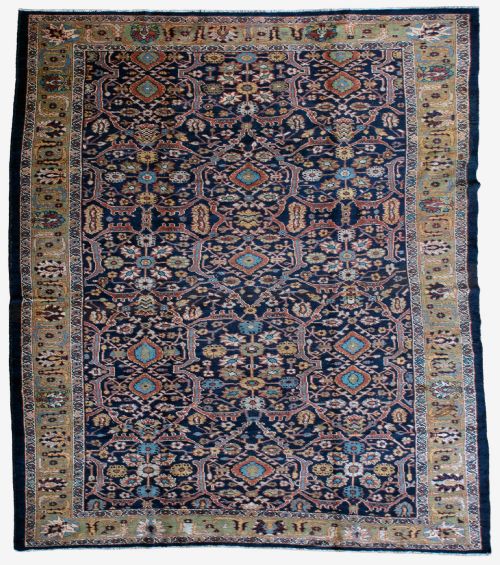
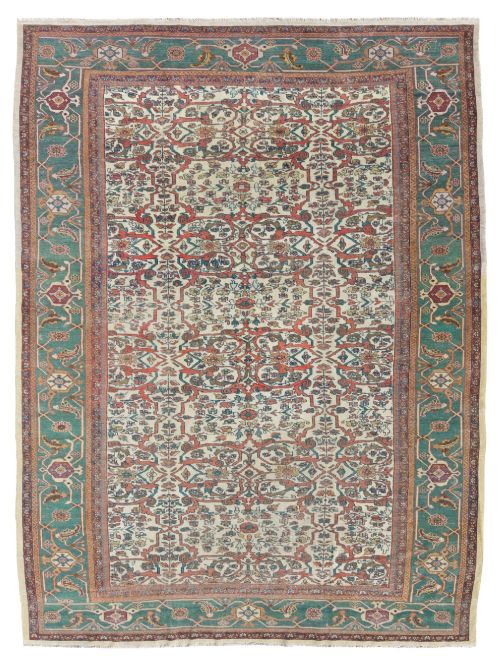
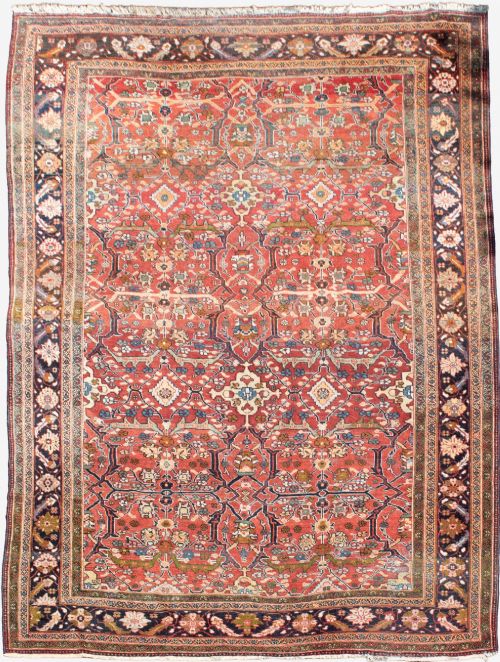


Vintage Mahal Floor Rug
A vintage mahal floor rug brings generous scale and rich pattern to a room, drawing on Persian weaving traditions from the nineteenth and early twentieth centuries.
Vintage Mahal Floor Rug
A vintage mahal floor rug is a substantial woven furnishing originating from western Persia, often spanning large room sizes down to narrower runners. Buyers searching for a vintage mahal floor rug encounter historic room-size carpets, corridor carpets, and village rugs dating from the late nineteenth century through the early decades of the twentieth century.
These floor coverings emerge from regional workshops and tribal traditions associated with the Chahar Mahal valley. The selection includes specific stylistic variations such as Ziegler and Sultanabad carpets alongside traditional Persian and Bakhtiari tribal pieces.
How They Were Made
The construction of these floor coverings relies primarily on wool piles knotted onto sturdy cotton foundations. This pairing provides the structural resilience needed for heavy domestic use while maintaining a dense, tactile surface.
Weavers employed natural dye traditions to achieve terracotta grounds, scarce blue and green fields, and intricate all-over shrub designs. The manual knotting process allowed for bold, scaled-up patterns tailored to large room dimensions.
What Varies in Quality
Quality rests upon the fineness of the knotting and the clarity of the design across the field. Superior examples display precise drawing in motifs like the Mustafi pattern and balanced proportions in large room-size formats.
The integrity of the wool pile and the survival of secondary colours in the ground determine the overall visual strength of a piece. Original dimensions and untouched edges further distinguish superior rugs from heavily restored or reduced examples.
The Vintage Mahal Floor Rug Glossary
- Mahal
- A type of Persian carpet woven in the district of the same name in western Persia, known for large-scale floral and geometric designs.
- Ziegler
- A nineteenth-century commercial carpet type produced in Persia to European taste, often featuring softer palettes and open designs.
- Sultanabad
- A nineteenth-century Persian carpet classification closely related to Mahal production, recognised by bold, sweeping floral patterns.
- Bakhtiari
- A style originating from the tribal region of western Persia, characterised by compartment designs and village motifs.
- Jajim
- A flat-weave textile produced by tribal groups in western Persia, utilised as a floor spread or wall hanging rather than a piled carpet.
Vintage Mahal Floor Rug: Frequently Asked Questions
Where were these rugs made?
These rugs were woven in western Persia, specifically within the region and valleys of the Chahar Mahal district.
Production spanned local workshops and tribal communities, incorporating designs tied closely to towns like Sultanabad.
How do I choose the right size?
Room-size carpets suit principal living spaces and dining areas, providing ample coverage beneath furniture.
Runners and smaller formats fit hallways, corridors, and narrower rooms where linear placement works best.
How should I care for wool rugs?
Vacuum regularly with a suction-only attachment to prevent dust accumulation within the wool pile.
Professional cleaning tailored to antique textiles helps preserve the natural dyes and cotton foundation.
What defines a Ziegler carpet?
Ziegler carpets represent a nineteenth-century collaboration between European firms and Persian weavers to suit Western interiors.
They typically feature muted palettes and scaled-down traditional motifs compared to standard village weaves.