

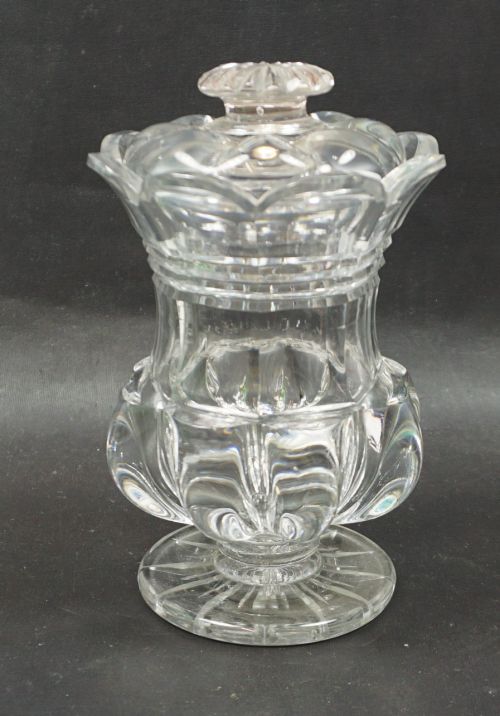


Vintage Lead Crystal Dish
These vintage lead crystal dish examples offer brilliant refraction and heavy substance, catching the light across dining tables and sideboards.
Vintage Lead Crystal Dish
When you search for a vintage lead crystal dish, you encounter decorative bowls, butter dishes, serving dishes, fruit bowls, and plates designed for display and service. The selections on this page span from Georgian jelly glasses up to Art Deco pieces, covering Victorian and Edwardian periods.
The most common forms you meet are heavy Edwardian and Victorian cut glass dishes and fruit bowls. These versatile vessels range from lidded butter dishes to large open bowls suited for fruit or table service.
Origins stretch across English, Irish, and continental workshops, including traditional Irish crystal and Belgian manufacture. These items reflect changing decorative tastes across the nineteenth and early twentieth centuries.
How they were made
Maker techniques rely heavily on lead crystal glass and cut glass, shaped through free blowing or press moulding before wheel cutting. Artisans cut deep facets into the heavy glass blank to maximise sparkle and light refraction.
Colour is introduced through overlay techniques, seen in blue over crystal glass bowls where a coloured layer is cut away to reveal the clear crystal beneath. Production methods combine molten glass manipulation with meticulous cold working by hand.
Vintage Lead Crystal Dish Retail Price Guide 2026
Typical asking prices for vintage lead crystal dish among the pieces listed under this phrase on Sellingantiques today, from the lower quarter to the upper quarter. They describe what is for sale here now, not the wider market.
Materials range from simple lead glass to complex coloured overlay and heavy free blown crystal.
What varies in quality
Quality rests upon the crispness of the cut glass facets and the weight of the lead crystal glass itself. Superior examples show deep, sharp cutting that remains smooth to the touch, whereas lesser pieces feel shallow and lack substantial heft.
Design complexity and named authorship elevate certain items, particularly when combined with free blown forming or coloured overlay. The clarity of the metal and the precision of the geometric or floral patterns distinguish standard utility ware from finer cabinet pieces.
Joseph Simon for Val St Lambert·Waterford
The Vintage Lead Crystal Dish Glossary
- Lead crystal
- Glass containing a significant proportion of lead oxide, which increases the weight, refractive index, and clarity of the material. This composition allows for deeper and sharper cutting.
- Cut glass
- Glassware decorated by holding it against rotating abrasive wheels to grind away material and form geometric or floral patterns. The process leaves distinct, sharp-edged incisions.
- Free blown
- Glass shaped by blowing air through a pipe into molten glass without the use of a mould. This traditional method produces unique pieces with subtle variations in thickness and form.
- Overlay
- A technique where a layer of coloured glass is fused over a clear glass base before being partially cut away. This exposes the clear crystal beneath in contrasting bands or patterns.
- Jelly glass
- A small glass vessel historically used for serving jellies or sweetmeats at formal dinners. Georgian examples often feature thick bases and simple, sturdy proportions.
Vintage Lead Crystal Dish: Frequently Asked Questions
Can I use these dishes for food service?
Most vintage lead crystal dishes remain entirely suitable for serving dry foods, fruit, butter, and confectionery at the table. Acidic foods should not be stored in lead glass for extended periods, but normal daily or occasional serving is safe.
Inspect the interior surfaces for heavy wear or roughness before serving moist items. Gentle hand washing keeps the pieces hygienic and ready for regular dining use.
How do I tell Georgian from Edwardian pieces?
Georgian crystal often displays simpler, heavier proportions with hand-polished pontil marks on the base and softer, broader cutting styles. Edwardian and Victorian examples tend to feature sharper, deeper machine-aided cutting and more elaborate geometric or floral motifs.
Examining the weight, colour tint, and stylistic elements helps separate the earlier eighteenth and early nineteenth-century work from later mass-produced Victorian and Edwardian output. Comparing pieces side by side reveals the evolution of cutting depth and pattern density.
What makes a piece traditional Irish crystal?
Traditional Irish crystal is characterised by exceptionally clear metal, heavy lead content, and deep, intricate diamond or fan cutting. Workshops in Ireland built a reputation for substantial tableware that commands attention through sheer brilliance and weight.
Checking the heft and the resonance when flicked gently helps identify the high lead content typical of these regional pieces. The density of the cutting often fills the entire surface of the bowl or dish.