
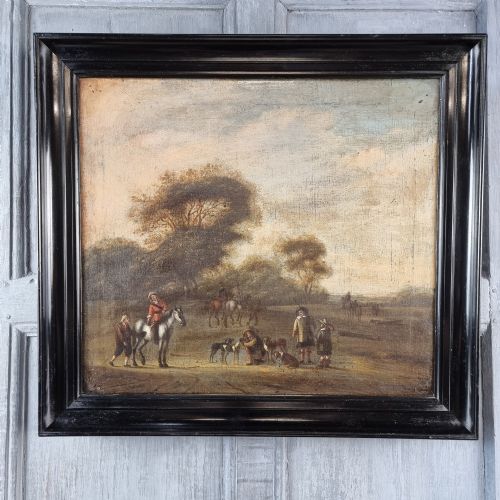


Vintage Hound Oil Painting
A vintage hound oil painting captures the enduring energy of the chase through traditional brushwork and rich canvas textures.
Vintage Hound Oil Painting
A vintage hound oil painting brings traditional sporting art directly into domestic interiors, depicting dogs in landscapes, hunts, and quiet portraits. These works span centuries of artistic output, capturing both solitary subjects and dynamic packs in pursuit.
The versions most commonly met on this page date from the nineteenth century and carry the distinct stylistic weight of Victorian sporting art. They range from intimate portraits of individual retrievers and spaniels to wide hunting scenes set across pastoral British countryside.
Beyond the nineteenth-century core, selections stretch from late seventeenth-century landscapes up to mid-century modern interpretations. Whether rendered on canvas or wood panels, each piece reflects the prevailing aesthetic of its specific decade.
Materials and technique
Artists relied primarily on oil paint applied to canvas or wood boards, utilising the rich medium to build depth in animal coats and shadowed backgrounds. Many of these historical works are finished within period frames constructed from giltwood and adorned with gold leaf.
Techniques varied from tight academic realism, as seen in Victorian copies and detailed portraiture, to looser gestural applications in mid-century interpretations. The interaction between pigment and support allows these paintings to retain their tonal richness over centuries.
Materials documented across the inventory include oil paint, canvas, wood panels, and giltwood frames with gold leaf.
Evaluating quality and execution
Quality rests heavily on the anatomical accuracy of the dogs and the handling of light across the landscape. Superior examples demonstrate a confident command of movement and texture, particularly in rendering the dense coats and alert expressions of the hounds.
The integration of the figures into their environment distinguishes finer works from more formulaic studio copies. A strong composition balances the dynamic energy of the animals with the atmospheric depth of the surrounding countryside.
George Wright·Sir Edwin Landseer·Jules Chardigny·John Sanderson-Wells·Henri Schouten·Ludolf de Jongh·Guillaume Urban Régamey·Richard Waitt·Henry Frederick Lucas-Lucas·Wilfred Bailey
The Vintage Hound Oil Painting Glossary
- Sporting art
- Genre of painting dedicated to depicting rural sports, including hunting, shooting, and equine or canine subjects. This tradition forms the foundation for most hound imagery.
- Oil on canvas
- Pigment suspended in a drying oil applied to a stretched woven fabric support. This combination provides flexibility and enduring luminosity.
- Giltwood
- Wood carved and finished with a thin layer of gold leaf or metallic powder. It frequently frames traditional paintings from the eighteenth and nineteenth centuries.
- Dutch Golden Age
- Period in Dutch history spanning the seventeenth century noted for exceptional achievements in painting. Works from this tradition influence later European landscape and animal portraiture.
Vintage Hound Oil Painting: Frequently Asked Questions
How do I identify a 19th-century hound painting?
Nineteenth-century works typically display the characteristic darker varnishes, canvas textures, and specific framing styles associated with Victorian sporting art. The depiction of the hounds often aligns with the traditional breeding standards and costume of the period.
Examining the stretcher bars, canvas weave, and any inscriptions on the reverse can offer further clues to the exact decade of creation.
Were these paintings created as fine art or decoration?
Many pieces originated as serious commissions for country houses, celebrating prized hunting dogs, successful packs, or specific estates. Over time, their role shifted towards general interior decoration while retaining their historical artistic merit.
Master artists and regional painters alike contributed to this tradition, producing works that served both as sporting records and aesthetic focal points.
How should I care for an oil painting on wood or canvas?
Keep the artwork away from direct sunlight, extreme temperature fluctuations, and high humidity to prevent the paint and support from warping or cracking. Dust the surface gently with a soft, dry brush without applying pressure to the pigment.
Avoid using water, chemical cleaners, or damp cloths on the painted surface or the gilt frame.
What subjects appear alongside hounds in these paintings?
Hounds frequently appear with huntsmen, horses, and handlers within expansive rural landscapes, farmyards, or tavern interiors. Other compositions focus purely on individual portraits of retrievers or spaniels set against simplified background foliage.
These varied settings reflect the shifting demands of patrons across the seventeenth, eighteenth, and nineteenth centuries.