
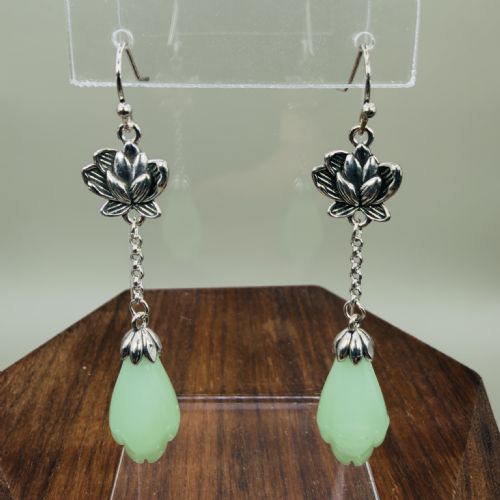

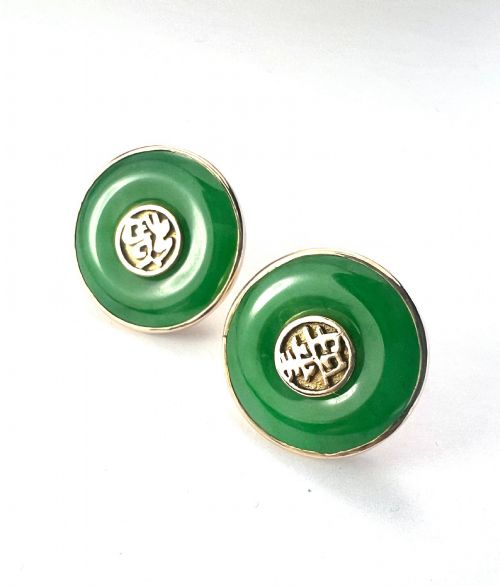


Vintage Green Stone Earrings
These vintage green stone earrings offer the distinct character of mid-century and art deco design, bringing vibrant colour and mineral texture to daily wear.
Vintage Green Stone Earrings
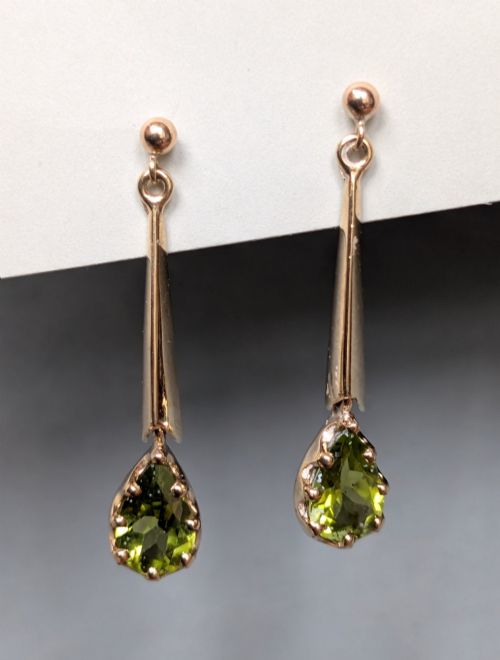
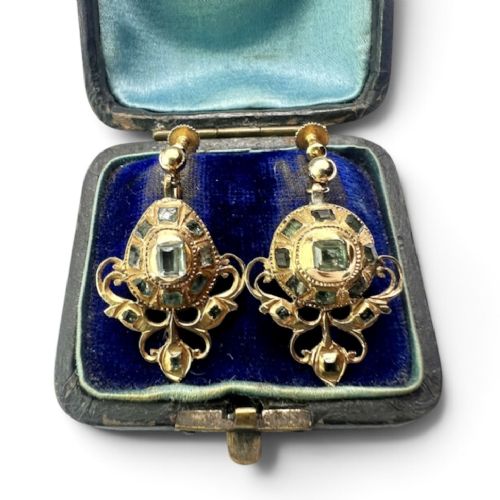
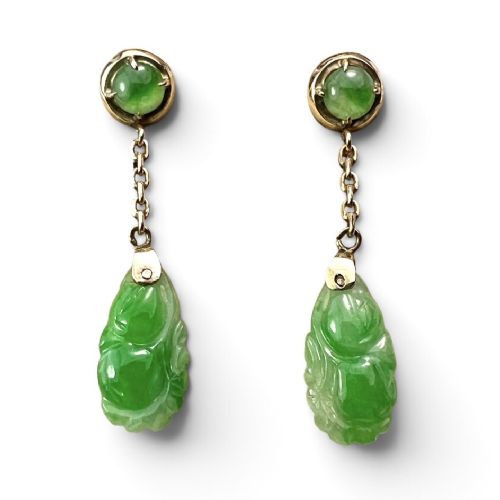
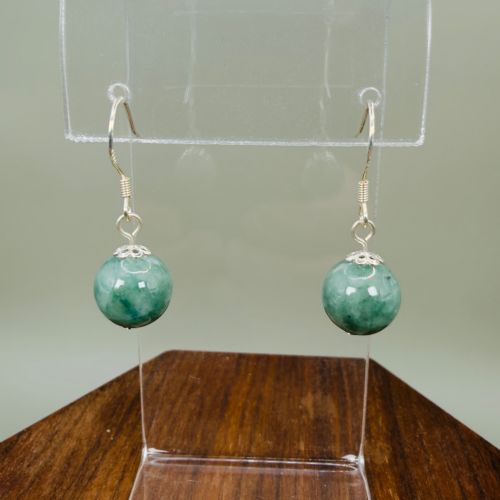
When you search for vintage green stone earrings, you encounter drop pendants, hook danglies, and screw-back studs originating across several decades. The selections combine carved or bead-cut minerals with precious metals, reflecting the shifting tastes of mid-century and art deco aesthetics. You are most likely to meet silver and gold pieces set with jade, jadeite, or green chalcedony from the 1930s, 1940s, and 1950s.
The forms range from botanical floral drops to geometric torus studs and simple bead hooks. Many examples incorporate supporting gems like diamonds or marcasite to frame the central green stone. This variety provides distinct silhouettes suited to both understated day wear and elaborate evening styling.
How they were made
Artisans built these pieces using traditional bench techniques, setting carved jade, green chalcedony, and chrysoprase into sterling silver, 9ct yellow gold, 14ct gold, and 18ct gold. The metalwork often involved meticulous claw settings, bezel mounts, and delicate hook mechanisms to secure the stones.
Lapidary work played a central role, shaping raw minerals into smooth beads, flat faceted drops, and intricate floral carvings. Some designs paired the primary green stones with platinum accents and small pavé-set diamonds to enhance the brilliance of the metal.
Some mid-century wearers kept screw-back pads tightly adjusted all evening, proving that looking like a botanical goddess required genuine dedication.
What varies in quality
The distinction between tiers rests upon the choice of materials and the depth of lapidary skill. Pieces featuring solid 14ct or 18ct gold settings alongside high-grade jadeite or natural green chalcedony represent the upper range of craftsmanship. Lighter sterling silver or 9ct gold iterations with simpler bead forms occupy the broader everyday tier.
Proportion and stone matching also dictate the overall standard of a pair. Uniform colour distribution across both earrings and balanced symmetry in carved motifs signal superior workshop execution. Settings that securely integrate secondary stones like diamonds without overwhelming the main green element show refined design judgement.
The Vintage Green Stone Earrings Glossary
- Jadeite
- A dense pyroxene mineral prized for its vivid green colour and translucency. It forms the carved drop and stud components in many mid-century Asian revival pieces.
- Green Chalcedony
- A microcrystalline variety of quartz exhibiting a soft, even green tone. Lapidaries frequently shape it into smooth cabochons or carved floral motifs for drop earrings.
- Chrysoprase
- A gemstone variety of chalcedony coloured by nickel oxide, displaying a bright apple-green shade. It appears in early twentieth-century silver mounts alongside marcasite.
- Screw-back
- A mechanical closure system utilising a threaded post and a small rotating disk to secure the earring without requiring pierced lobes. This fastening is common on mid-century non-pierced designs.
- Toris
- A ring-shaped or doughnut-like form often used for carved jade studs. The symmetrical geometry highlights the natural grain of the mineral.
Vintage Green Stone Earrings: Frequently Asked Questions
How do I care for vintage jade earrings?
Clean these pieces gently using a soft, damp cloth without harsh chemical solvents or ultrasonic jewellery cleaners. Store them separately in lined boxes to prevent the metal settings from scratching the softer green stones.
Avoid exposing older gold and silver mountings to prolonged moisture or perfumes, which can tarnish the metal and weaken historic adhesives used in composite settings.
Are all green stones jade?
The inventory includes several distinct green minerals alongside jade and jadeite, such as green chalcedony, chrysoprase, and andalusite. Each material possesses different hardness levels, crystalline structures, and optical properties.
Examining the internal structure under magnification reveals whether a piece consists of carved mineral, dyed quartz, or glass imitations typical of specific decades.
How do I date a pair of earrings?
Dating relies on combining the stylistic hallmarks of the mounting with the choice of metal and fastening mechanism. Pieces from the 1920s and 1930s often feature platinum accents, geometric art deco lines, and marcasite detailing.
By contrast, 1950s examples frequently utilise simple hook danglies, botanical floral motifs, and standard 9ct or sterling silver constructions without earlier geometric flourishes.
Can screw-back earrings be converted?
Jewellers can modify screw-back mechanisms into posts or modern hook wires depending on the structural integrity of the original mounting. This adaptation allows non-pierced styles to be worn comfortably by individuals with pierced ears.
Any alteration should be weighed against preserving the historical fastener, particularly on signed or highly decorative mid-century pieces.