

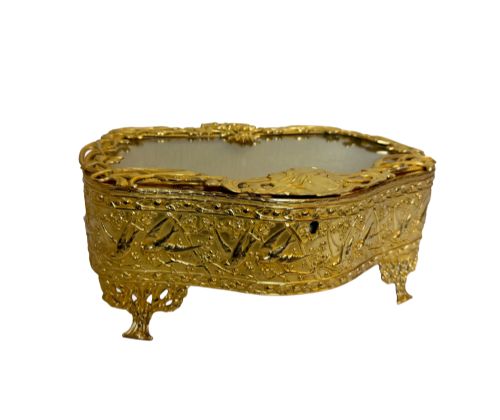


Vintage Glass Casket
A vintage glass casket is a small, hinged receptacle for jewellery or trinkets, prized for its decorative metal mounts and heavy glass walls.
Vintage Glass Casket
A vintage glass casket is a small container designed to hold jewellery, trinkets, or desk accessories upon a dressing table or writing surface. When you search for a vintage glass casket, you encounter hinged boxes constructed primarily of transparent or cut glass held together by metallic frames.
The versions most commonly met on this page date from the late nineteenth century through to the Edwardian period, often reflecting French or British manufacture. These pieces frequently take the form of jewellery boxes or decorative caskets mounted in ormolu, gilt bronze, or brass.
Makers and styles span Victorian, Edwardian, and Art Nouveau aesthetics, alongside French nineteenth-century revival designs. Alongside standard rectangular boxes, variants include heart-shaped containers and occasionally double inkstands incorporating cut glass inkwells.
How they were made
These caskets rely on heavy structural glass panels, often bevelled at the edges or deeply cut with geometric patterns, fitted precisely into cast metal frameworks. Materials like ormolu, gilt bronze, brass, and silver plate form the supporting hinges, feet, and decorative mounts that secure the glass sides.
Some examples incorporate enamelled glass or fine cast bronze relief work, occasionally bearing manufacturer attributions or marks upon the metal mounts. The assembly demands careful soldering and mechanical fitting so the hinged lids align correctly with the heavy glass bases.
Vintage Glass Casket Retail Price Guide 2026
Typical asking prices for vintage glass casket among the pieces listed under this phrase on Sellingantiques today, from the lower quarter to the upper quarter. They describe what is for sale here now, not the wider market.
Some nineteenth-century caskets were built with hidden compartments large enough to hide a particularly chunky pocket watch.
What varies in quality
Quality in these pieces rests upon the thickness and clarity of the glass, whether it is simply bevelled or deeply cut with complex facets. The weight and chasing of the metal mounts, from plain brass to heavy gilt bronze or ormolu, signal the level of craftsmanship invested in the object.
Proportion and structural integrity separate standard utility boxes from finer decorative caskets. Pieces featuring signed mounts, such as those by known makers, or complex elements like hand-enamelling demonstrate higher standards of nineteenth and early twentieth-century production.
Posen of Frankfurt and Berlin·S Theeman·Baccarat
The Vintage Glass Casket Glossary
- Ormolu
- A technique of applying finely ground, high-carat gold to a bronze object, creating a rich golden finish used on mounts.
- Bevelled glass
- Glass panes with edges ground and polished at an angle, creating a framed effect and catching the light.
- Gilt bronze
- Bronze that has been coated with a thin layer of gold, providing a durable and decorative metallic surface.
- Cut crystal
- High-quality glass containing lead oxide, cut with sharp facets to refract light brilliantly.
- Trinket box
- A small container designed for holding rings, brooches, or other small personal items.
Vintage Glass Casket: Frequently Asked Questions
What were glass caskets used for?
These caskets served primarily as decorative receptacles for jewellery, hairpins, and small precious trinkets upon dressing tables.
They also functioned as desk accessories, holding items like inkwells or stamps in domestic interiors.
How do I date a glass casket?
Dating relies on stylistic clues, such as the flowing organic lines typical of Art Nouveau or the heavier geometric forms of the Victorian era.
Material choices like ormolu, silver plate, and the specific style of the metal mounts help narrow the period of manufacture.
Are all these boxes French?
Many fine examples originate from France, particularly during the nineteenth century under Napoleon III and the Empire revival styles.
However, production also spans British Edwardian workshops and German makers such as Posen.
How should I clean a vintage glass casket?
Clean the glass panels gently with a soft cloth and mild glass cleaner, taking care not to let moisture seep into the metal joints.
Avoid harsh abrasives on ormolu or gilt bronze mounts to preserve the historic metallic finish.