


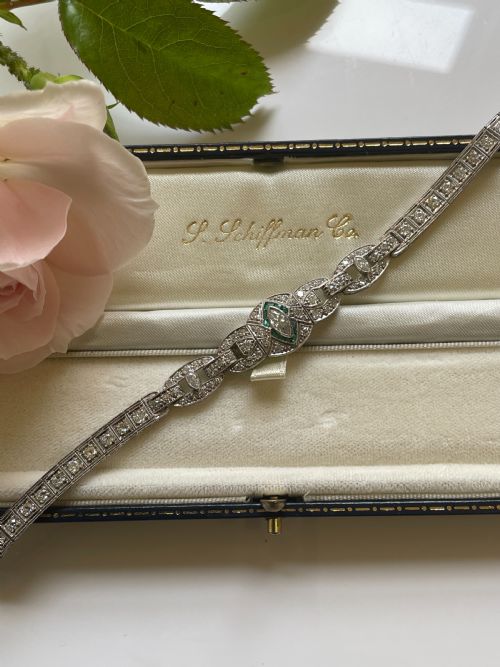


Vintage Geometric Line Bracelet
A vintage geometric line bracelet brings together sharp linear geometry and glittering stones, offering wrist-wear that remains endlessly wearable and striking.
Vintage Geometric Line Bracelet
A vintage geometric line bracelet is a continuous band of precious metal set with diamonds, emeralds or sapphires, arranged in repeating patterns. These pieces follow strict linear designs, relying on symmetry and sharp angles rather than flowing curves.
Buyers browsing this selection encounter pieces primarily from the Art Deco period alongside mid-century interpretations. Platinum and white gold dominate the metal choices, frequently paired with old cut diamonds and calibre-cut coloured gems.
French craftsmanship appears frequently among these offerings, showing exceptional attention to detail in the delicate pierced mounts and hinge work. The scale ranges from delicate everyday bands to substantial diamond-heavy statements.
How they were made
Master jewellers constructed these bracelets using platinum and white gold, often fabricating flexible articulated links by hand. Each section connects seamlessly to ensure the band drapes fluidly around the wrist without catching on clothing.
Diamonds and coloured gemstones are held securely within meticulous channel or millegrain settings. Old cut diamonds provide the signature sparkle, complemented by calibrated emeralds and sapphires cut precisely to fit geometric channels.
Even the tiniest emeralds in these geometric layouts were often cut by hand to fit bespoke channels.
What varies in quality
Quality rests in the architectural precision of the metalwork and the uniformity of the stones. Superior examples display crisp geometric edges and completely flush stone settings that show no irregularity under magnification.
The flexibility of the articulation dictates the standard of manufacture. Top-tier pieces maintain structural integrity and smooth movement across every single hinge, whereas lesser examples suffer from stiffness or worn pins.
The Vintage Geometric Line Bracelet Glossary
- Art Deco
- A design style from the nineteen-twenties and nineteen-thirties characterised by geometric shapes, streamlined forms and symmetrical patterns. It forms the stylistic backbone of most pieces in this category.
- Millegrain
- A decorative technique featuring a row of tiny raised metal beads along the edge of a setting. This softens the metal boundary and adds texture to the piece.
- Calibre-cut
- Gemstones cut specifically in small, uniform geometric shapes to fit tightly together within a channel setting. It allows makers to create unbroken lines of colour.
- Old cut
- Diamond cutting styles popular before the modern round brilliant, featuring smaller tables and high crowns. These cuts produce a softer, deeper candlelit sparkle.
- Line bracelet
- A symmetrical bracelet featuring a continuous line of gemstones set in precious metal. They are designed to sit flexibly and snugly against the wrist.
Vintage Geometric Line Bracelet: Frequently Asked Questions
How do I wear a line bracelet daily?
These bracelets integrate easily into modern wardrobes, pairing well with evening wear or sharp tailoring. Their low profile sits comfortably beneath cuffs without snagging.
Secure the safety clasp properly each time you wear the piece. Regular checks by a jeweller ensure the hinges and box catches remain robust.
How do I tell Art Deco from mid-century bracelets?
Art Deco pieces typically utilise platinum with intricate pierced work, millegrain edges, and old cut diamonds arranged in strict symmetrical motifs. French examples often show the most complex geometric patterns from this era.
Mid-century designs shift towards yellow or white gold with bolder, heavier metalwork and cleaner modernist lines. The stones in later pieces often use modern brilliant cuts rather than historic cuts.
Are these bracelets flexible?
True line bracelets use a series of small, articulated hinges connecting each gemstone section together. This engineering allows the entire band to curve smoothly around the wrist.
Stiffness usually indicates dirt accumulation or wear within the internal pins. Professional ultrasonic cleaning and inspection restore the intended fluid movement.
What metals were used historically?
Platinum was the preferred metal during the height of the Art Deco period due to its strength and bright white finish. It allowed jewellers to create ultra-fine settings that maximised stone visibility.
White gold and yellow gold appear more frequently in pieces dating from the mid-century era. Fourteen-carat and eighteen-carat gold standards provide durability for daily wear.