

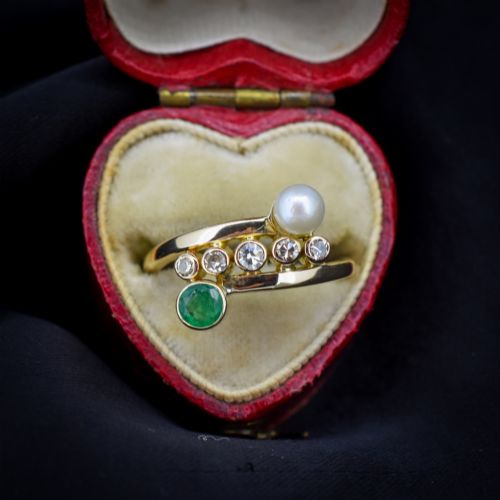
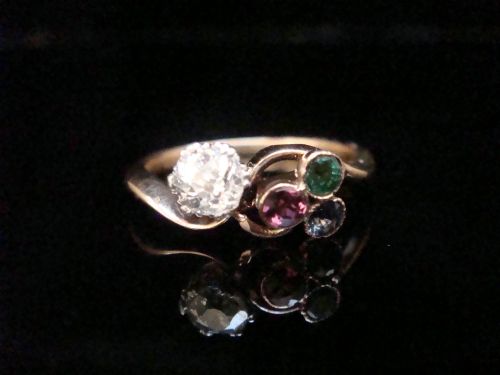


Vintage Gemstone Bypass Ring
A vintage gemstone bypass ring brings two opposing stones together in a fluid twist, offering a distinctive silhouette that collectors prize for its graceful movement.

Vintage Gemstone Bypass Ring
The materials record traditional pairings of diamonds with vibrant coloured stones like rubies, sapphires, emeralds, tourmalines, and pearls. Yellow gold and platinum serve as the principal precious metals shaping these fluid bands.
Materials and construction
Goldsmiths shaped these rings from eighteen-carat gold, nine-carat yellow gold, and durable platinum to support the curving shoulders. Old cut diamonds and natural gemstones are securely set alongside cultured pearls and turquoise within these twisting bands.
Techniques relied on precise metalwork to maintain the tension and balance of the cross-over design without losing structural integrity. Master jewellers balanced contrasting gems, such as blue and pink sapphires or rubies and diamonds, within the flowing framework.
Vintage Gemstone Bypass Ring Retail Price Guide 2026
Typical asking prices for vintage gemstone bypass ring among the pieces listed under this phrase on Sellingantiques today, from the lower quarter to the upper quarter. They describe what is for sale here now, not the wider market.
The inventory spans multiple periods, including the Edwardian era, Art Deco, and the nineteen-fifties and sixties.
Assessing quality and craftsmanship
Superior examples demonstrate harmonious stone pairing and careful proportion, where neither gem overwhelms the sweeping symmetry of the twist. The weight and gauge of the gold or platinum shank dictate the lasting durability of the cross-over design.
The distinction between finer pieces and simpler iterations lies in the cut and saturation of the selected gemstones, alongside the crispness of the surrounding metalwork. Original Edwardian or Art Deco settings show meticulous hand-finishing that elevates the entire profile.
The Vintage Gemstone Bypass Ring Glossary
- Bypass ring
- A ring style where the shank sweeps around the finger and the ends pass each other rather than meeting centrally. This design creates a dynamic sense of movement on the hand.
- Crossover
- An alternative term for a bypass or twist configuration, uniting two principal elements. These rings balance dual stones in a continuous flow.
- Old cut
- A diamond facet style typical of earlier periods, featuring a smaller table and higher crown than modern stones. This cut produces a softer candlelight sparkle.
- Platinum
- A dense, durable white metal utilised in fine jewellery making. It holds delicate settings securely while maintaining a bright finish.
Vintage Gemstone Bypass Ring: Frequently Asked Questions
What is a bypass ring?
A bypass ring is a design where the two ends of the band cross past each other rather than forming a complete circle.
This configuration creates a distinctive twist shape that often holds two main gemstones side by side.
How do I care for a vintage gemstone ring?
Vintage gemstone rings require gentle cleaning with warm soapy water and a soft brush, avoiding harsh chemical dips.
Store them separately in lined boxes to prevent softer stones like pearls or turquoise from scratching.
Are these rings suitable for daily wear?
Many of these rings use durable metals like platinum and eighteen-carat gold suitable for regular use.
However, softer organic gems like cultured pearls need extra care during everyday activities.
How can I tell an Edwardian ring from a later piece?
Edwardian pieces often feature intricate platinum work and old cut diamonds arranged in delicate floral or cluster motifs.
Mid-century and later vintage examples tend to show bolder lines and different gold purities like nine-carat yellow gold.