
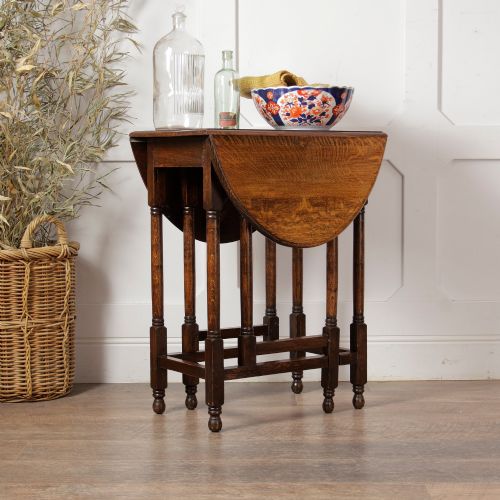


Vintage Gateleg Coffee Table
These vintage gateleg coffee table designs offer folding leaves and sturdy timber construction, giving you versatile surface space for any room.
Vintage Gateleg Coffee Table
A vintage gateleg coffee table combines the folding drop leaves of traditional dining furniture with the lower profile needed for modern seating. These pieces adapt easily to smaller rooms by folding down when floor space is tight.
The versions met most often on this page date from the Edwardian era through to the 1930s, constructed predominantly in solid oak or mahogany. Makers of these tables adapted historic styles like Jacobean Revival and Arts and Crafts for domestic use.
Forms range from simple oval oak surfaces to refined mahogany designs with intricate inlays and double spider legs. Buyers look to these tables for practical utility paired with early twentieth-century character.
Materials and construction
Makers relied heavily on solid oak and mahogany for the primary frames and drop leaves, ensuring the hinged flaps remained stable when extended. Burr walnut and satinwood appear alongside wood inlay and marquetry on more decorative surfaces.
Structural stability depends on pivoting gate legs that swing out to support the drop leaves, joined by traditional wood framing techniques. Brass fittings and ceramic castors occasionally appear on specific periods and styles.
Listings feature oak, mahogany, burr walnut, and satinwood across Edwardian, Victorian, and Arts & Crafts styles.
What separates the best from the rest
Quality rests in the precision of the timber selection, such as figured burr walnut or detailed marquetry inlay, compared to plain utility oak. Grain matching across the folding leaves distinguishes more considered workshop production.
The robustness of the pivoting gate mechanism and the tightness of the joinery determine how well a table survives daily use. Refined turning on the legs and slender proportions elevate certain Edwardian and Arts and Crafts examples above standard domestic pieces.
The Vintage Gateleg Coffee Table Glossary
- Gateleg
- A table with hinged leaves supported by one or more legs that swing out like a gate. This allows the surface area to expand or contract according to requirement.
- Drop leaf
- A hinged section of a table top that folds down when not in use. It provides flexibility in room layout and furniture placement.
- Marquetry
- Decorative patterns created by fitting small pieces of veneer into a backing material. It often displays floral or geometric motifs on tabletop surfaces.
- Sutherland table
- A narrow table with exceptionally slender drop leaves that fold down almost vertically. These originated in the nineteenth century for compact parlour use.
Vintage Gateleg Coffee Table: Frequently Asked Questions
How do gateleg coffee tables work?
These tables feature hinged leaves supported by swinging legs that pivot outward from the frame. When extended, the legs lock into position beneath the leaf to provide a stable surface.
Folding the leaves down reduces the footprint of the table for storage or tighter spaces. The wooden hinges and pivots require careful alignment to operate smoothly over time.
What woods were used for these tables?
Oak and mahogany form the foundation of the majority of listings on this page. These hardwoods provided the necessary strength for the folding leaf mechanism.
More decorative examples incorporate burr walnut, satinwood, and detailed marquetry inlay. These finer materials were typically reserved for formal drawing room or parlour pieces.
Are these tables suitable for everyday use?
Solid timber construction makes these tables durable enough for daily living spaces. The drop leaves provide adjustable surface area for drinks, books, or lamps.
Care should be taken not to place excessive weight on the outer edges of extended leaves. Regular maintenance involves simple dusting and occasional polishing to protect the wood finish.
How do I identify an Edwardian gateleg table?
Edwardian examples often feature lighter mahogany timbers, sometimes enhanced with decorative wood inlay or marquetry. Delicate leg turnings, such as double spider designs, frequently characterise this period.
Proportions tend to be more slender compared to heavier Victorian or Jacobean Revival furniture. These refined details suit sitting rooms that require lighter visual weight.
What is a Sutherland table?
A Sutherland table is a specific variation with exceptionally narrow drop leaves and a very slim central frame. When fully folded, the table occupies minimal floor space.
This form was originally designed for nineteenth-century parlours where versatility was essential. They function well as occasional coffee tables in contemporary interiors.