
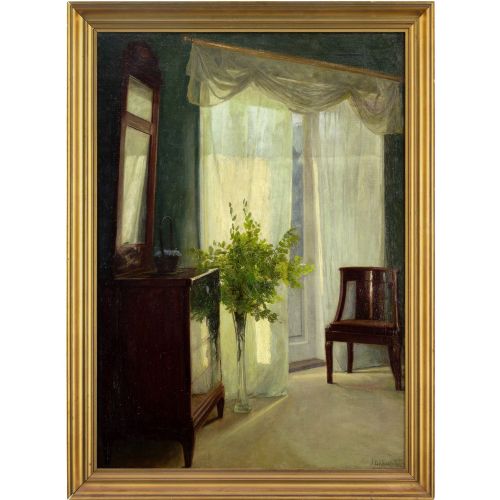


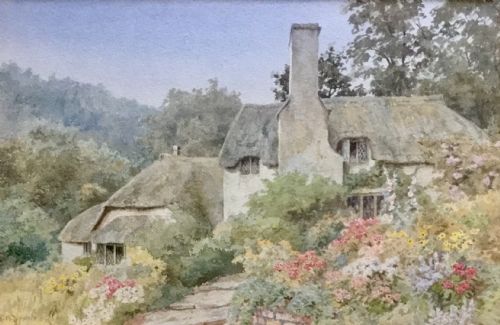


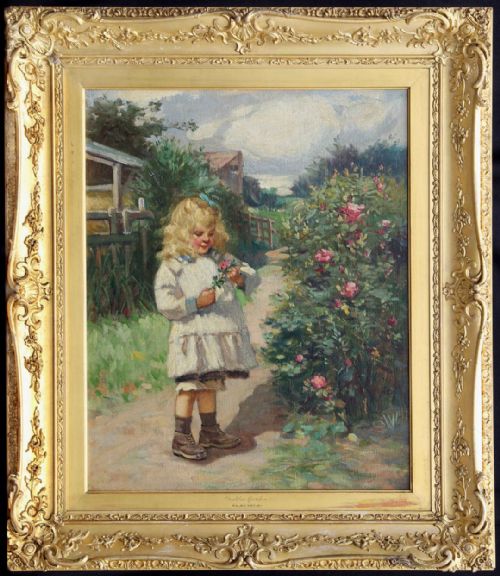

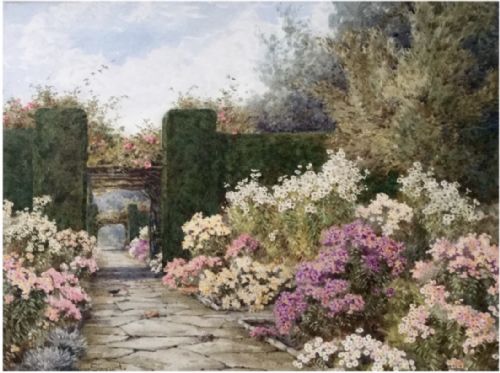

Vintage Garden Scene Painting
A vintage garden scene painting brings the quiet hush of cultivated lawns and herbaceous borders directly onto the interior wall.
Vintage Garden Scene Painting
A vintage garden scene painting captures the particular intimacy of domestic horticulture across the nineteenth and twentieth centuries. These works record walled sanctuaries, cottage doorways and sunlit pathways through loose brushwork and direct observation.
The selections encountered here span from Victorian rural genre watercolours to mid-century oil paintings on canvas and board. English and Scandinavian traditions dominate the assortment, reflecting a shared fascination with cultivated nature.
Works range from detailed depictions of herbaceous borders by known hands to atmospheric mixed media pieces of floral plots. Framed artwork forms the primary output, frequently preserved in period gilt wood frames that complement the painted foliage.
Materials and methods
Artists relied upon oil paint applied to canvas, board or wood panels to build rich textures and deep tones for garden foliage. Watercolours on paper offered a lighter touch for translucent floral studies and sunlit pathways.
Substrates varied according to the period, with heavy canvas and wooden boards supporting robust oil pigments while delicate watercolours required protective paper framing under glass. Gilt wood frames provided the standard finishing touch for the finest canvases.
Materials across the selection range from delicate watercolours on paper to robust oil paint on canvas, board and wood.
Evaluating quality and execution
Quality rests upon the artist's handling of natural light and shadow across unstructured floral arrangements and architectural elements. Superior works convey the palpable atmosphere of a specific afternoon through confident brushwork rather than rigid botanical illustration.
The relationship between the subject and its frame also dictates the overall merit of a piece. Original gilt wood framing that suits the scale and palette of the artwork elevates the entire object significantly.
John Lübschitz·Lilian Stannard·Owen Bowen·William Hatherell·Herbert Royle·Arthur Claude Strachan·Thomas Nicholson Tyndale·Jane Utley·Edgar Bundy·Hermoine Hammond·William Greaves·Ralph Hedley·John F. Pasmore
The Vintage Garden Scene Painting Glossary
- Chrystoleum
- A historic method of applying a hand-coloured paper print to convex glass and clarifying it with oil or varnish before backing.
- Gilt wood
- Carved timber finished with a thin layer of gold leaf or metallic gilt, commonly utilised for traditional picture frames.
- Mixed media
- An artwork combining two or more distinct artistic materials, such as watercolour, gouache and ink upon a single paper or board support.
- Provenance
- The documented history and ownership trail of an artwork that establishes its authenticity and timeline.
- Watercolour
- A paint consisting of water-soluble pigments applied to paper to achieve translucent layers and luminous washes.
Vintage Garden Scene Painting: Frequently Asked Questions
What periods do these paintings cover?
The available works stretch from nineteenth-century Victorian pieces up through Edwardian compositions and into the mid-twentieth century of the 1950s.
Most items concentrate around the early decades of the nineteen hundreds, capturing late Victorian and Impressionist sensibilities.
How should I hang a canvas?
Hang these framed artworks away from direct sunlight to protect delicate watercolours on paper and rich oil pigments from fading over time.
Ensure the wall fixings are strong enough to support the weight of heavy gilt wood frames and wooden boards.
Are these works signed by the artist?
Many of the listed paintings bear the signatures of known practitioners like Lilian Stannard or Owen Bowen, while others represent the output of regional English schools.
Attributions are drawn directly from the inscribed signatures and historical records associated with each individual piece.
What surfaces were used?
Painters utilised traditional supports including stretched canvas, sturdy wooden boards, and heavy paper sheets for watercolours.
Each material dictates the specific framing requirements needed to preserve the artwork safely.