


Vintage French Religious Charm
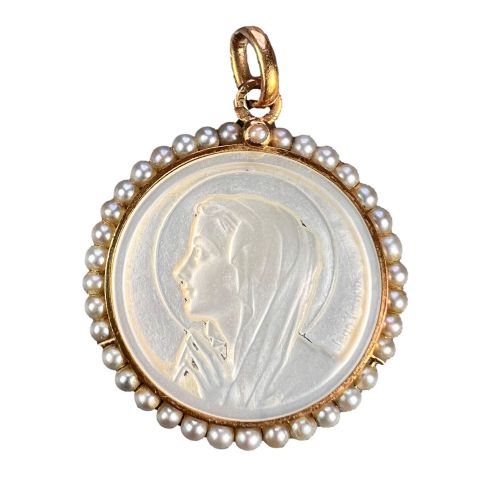
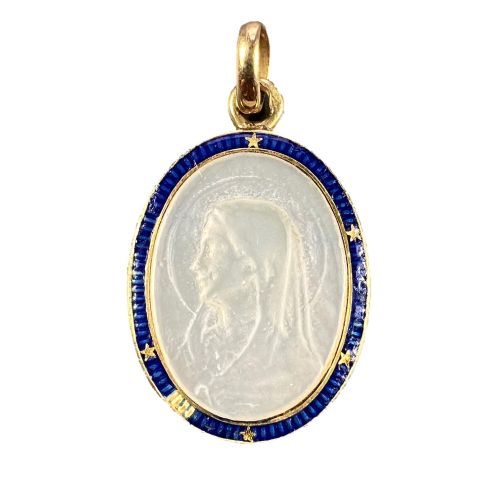
These vintage french religious charm selections bring together gold, enamel and mother-of-pearl miniature works of devotional art.
Vintage French Religious Charm
A vintage french religious charm encompasses small devotional pendants and medals issued in France across the late nineteenth and mid twentieth centuries. These pieces typically take the form of circular or cross-shaped medallions designed to be worn on a chain or bracelet.
The versions most frequently encountered on this page feature depictions of the Virgin Mary, the Madonna and Child, or figures such as Saint Christopher and Saint John the Baptist. Makers utilised gold alongside decorative inlays to create miniature devotional objects intended for personal protection or remembrance.
The forms span several decades, moving from ornate nineteenth-century engraving toward cleaner Art Nouveau and Art Deco profiles. Collectors find that each piece records a distinct moment in French devotional jewellery production.
Materials and technique
Goldsmiths relied principally on eighteen-carat yellow, rose and white gold to form the bezels, frames and suspension loops of these charms. This metal provided a durable foundation capable of withstanding daily wear while retaining a warm lustre.
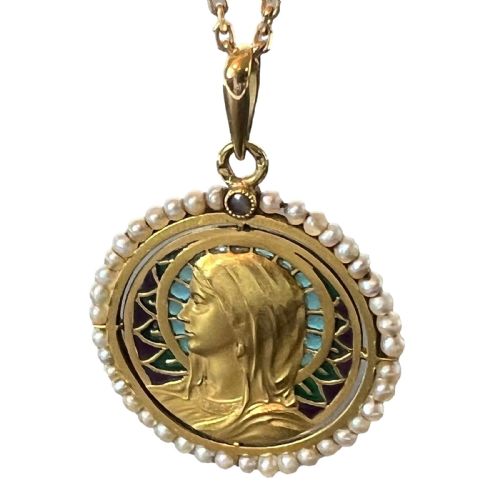
Surface decoration frequently incorporated translucent enamel, plique-a-jour enamel and mother-of-pearl backings to catch the light behind stamped figures. Artisans also set seed pearls or diamonds into specific designs to accent halos, stars and floral motifs.
Among the sacred figures, a stray hunting horn slips in to remind collectors that French medallists occasionally pursued earthly leisure.
Craftsmanship and distinction
The standard of a piece depends heavily on the precision of the engraving and the clarity of the metalwork relief. Master medallists achieved remarkable depth in miniature, rendering facial expressions and drapery folds with sharp definition.
Enamelling quality separates standard production from superior examples, particularly where glass colours are blended smoothly without bubbling or discoloration. Pierced openwork frames and delicate plique-a-jour cells require advanced technical skill that elevates the finished object.
Emile Monier·Paul Brandt·Mazzoni·Guilbert·Vernon·Emile Dropsy·Sellier·Rasumny·Tairac·Pageri Perroud
The Vintage French Religious Charm Glossary
- Plique-a-jour
- An enamelling technique where translucent enamel is fired without a backing, creating a stained-glass effect that allows light to pass directly through the design.
- Miraculous Medal
- A specific devotional medal associated with an apparition of the Virgin Mary, featuring standard devotional symbols and text on an oval form.
- Medallion
- A large flat coin-shaped pendant, often struck in relief with sacred figures or scenes on one or both sides for personal devotion.
- Seed Pearl
- A tiny natural pearl, frequently utilised in Victorian and Edwardian jewellery to edge bezels or accent floral and celestial patterns.
Vintage French Religious Charm: Frequently Asked Questions
How do I wear a religious charm?
These pieces function well suspended from a delicate gold chain as a pendant or attached securely to a sturdy charm bracelet. Their compact scale makes them suitable for daily wear either singly or layered with other small gold items.
Ensure any jump ring is properly soldered or closed to prevent loss during movement. Pairing them with similar gold weights maintains visual balance.
What periods do these charms cover?
The selection spans from the late nineteenth century through to the middle of the twentieth century, encompassing periods such as Art Nouveau and Art Deco. Dating relies on stylistic markers, hallmarks stamped on the gold, and the distinct artistic signatures of individual medallists.
Earlier examples often display detailed hand-engraving, while mid-century pieces lean towards cleaner geometric frames or sunburst motifs.
Are these charms made of solid gold?
The pieces recorded here are constructed from eighteen-carat yellow, rose or white gold. French hallmarking standards of the era strictly regulated gold purity, ensuring reliable metal content across the range.
This high gold content provides the durability necessary for intricate pierced work and secure settings for enamel and pearls.
What subjects appear most frequently?
Depictions of the Virgin Mary dominate the offerings, appearing alone or alongside the infant Jesus as the Madonna and Child. Other common subjects include Saint Christopher, Saint Joseph, various crosses, and symbolic motifs such as the Sacred Heart or holy doves.
Each subject carried specific devotional meaning for the original owner, often commemorating sacraments like first communion or serving as a travel talisman.