



Vintage Field Gun
These vintage field gun models and desk ornaments bring tangible artillery history to any mantel or study through solid bronze and cast iron engineering.
Vintage Field Gun
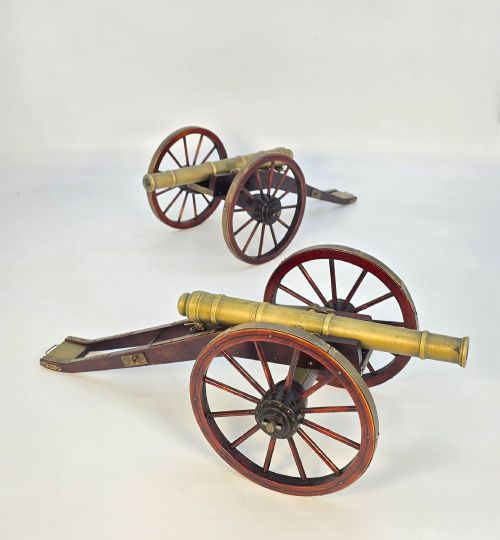
A vintage field gun selection comprises scale models, desk ornaments, and decorative artillery pieces spanning the seventeenth century up to the nineteen-thirties. You encounter Victorian brass ornamental pieces, heavy polished bronze desk cannons on mahogany undercarriages, and cast iron French Gribeauval field gun models.
The objects take the form of muzzle-loaded field guns, pairs of model French cannons, and related sporting antiques such as patent cartridge case removers. Origins stretch from English workshops to French foundries, capturing centuries of military design in miniature.
Most examples function purely as decorative models and desk ornaments rather than active ordnance. Collectors find both single display pieces and matched pairs resting on wooden carriages.
How they were made
Maker construction relies heavily on cast iron, bronze, and brass barrels mounted to carriages formed from hardwoods such as oak and mahogany. Artisans cast the metal components before finishing them with polished surfaces or nickel plating.
Hand built models incorporate detailed metal barrels secured to wooden undercarriages using iron and brass fittings. These combined media create robust desktop display items that replicate historical artillery proportions.
Vintage Field Gun Retail Price Guide 2026
Typical asking prices for vintage field gun among the pieces listed under this phrase on Sellingantiques today, from the lower quarter to the upper quarter. They describe what is for sale here now, not the wider market.
Materials across the listings include bronze, cast iron, brass, nickel plated steel, oak, mahogany, and general hardwood.
What varies in quality
Quality separates through the precision of the metal casting and the fidelity of the miniature carriage woodwork. Finer models display crisp barrel detailing and substantial polished bronze or brass weights.
Material combinations indicate superior manufacture, particularly where heavy cast iron carriages pair with polished bronze tubes or fine hardwoods are utilised for the mounting blocks. Simpler cast pieces lack the refined hand built joinery found on exhibition models.
The Vintage Field Gun Glossary
- Gribeauval
- A standardised artillery system developed in France during the eighteenth century that influenced field gun design. Models replicating this system feature distinctive barrel contours and carriage proportions.
- Muzzle-loaded
- An obsolete method of loading firearms and artillery where the projectile and propellant are inserted down the front of the barrel. Most decorative desk models replicate this historic loading configuration.
- Undercarriage
- The wooden or metal chassis that supports the cannon barrel and wheels. Fine examples utilise dense hardwoods like mahogany or oak.
- Sporting antiques
- Collectable items associated with historical field sports and shooting pursuits. This category includes specialised accessories like cartridge case removers.
Vintage Field Gun: Frequently Asked Questions
What materials make up these models?
Makers constructed these models using cast iron, bronze, brass, and nickel plated steel for the barrels and frames. Carriages frequently incorporate hardwoods including oak and mahogany.
Metal components appear either polished to a bright finish or left in their heavier cast state.
Were these cannons meant for firing?
The pieces listed function as scale models, desk ornaments, and decorative displays rather than working ordnance. They serve to illustrate historical artillery design.
Carriages and barrels are built for visual appreciation on desks and mantelpieces.
How do you date a model cannon?
Dating relies on stylistic clues, historical military designs being referenced, and the choice of manufacturing materials. Victorian and early twentieth-century examples often carry specific period characteristics in their metalwork.
Construction techniques, such as hand built wooden framing, also point to particular eras.
Where were these decorative models produced?
Origin points span English and French workshops producing military models for display. French military styles and English Victorian pieces represent the main regional designs.
Foundries and private makers both contributed to the variety of surviving items.